
9 Benefits of hiring independent contractors for global businesses

Key takeaways
- Independent contractors cut costs by removing payroll taxes, benefits, and training overhead.
- They give you fast access to specialized or hard-to-find skills, often across borders.
- You can scale a contractor team up or down without the legal weight of hiring or layoffs.
- Correct worker classification matters — misclassification carries real legal and financial risk.
In today’s global economy, companies increasingly rely on independent contractors to access specialized skills, reduce hiring costs, and scale operations quickly. More businesses are shifting toward blended workforce models — combining full-time employees with independent professionals — to stay agile as project needs change.
Understanding the benefits of hiring independent contractors can help organizations build flexible teams while staying competitive in a rapidly evolving market.
What is an independent contractor?
An independent contractor is a self-employed individual or business that provides services under a contract, without being under a client’s direct control or supervision. Unlike employees, contractors set their own methods and schedule, pay their own taxes, and aren’t entitled to employee benefits or legal protections.
1099 contractors are responsible for paying their own taxes and benefits. They are not entitled to the same legal protections as full-time employees.
Want to learn more about what a 1099 contractor is?
| Independent Contractor | Employee | |
|---|---|---|
| Taxes | Pays own self-employment taxes | Employer withholds and pays payroll taxes |
| Benefits | Not entitled to employer benefits | Eligible for health insurance, PTO, retirement |
| Control | Sets own methods, hours, tools | Works under employer direction and schedule |
| Cost to business | No payroll tax, no benefits overhead | Full payroll tax and benefits cost |
| Engagement length | Project- or contract-based | Ongoing, indefinite |
See our full breakdown: Independent Contractors vs. Employees
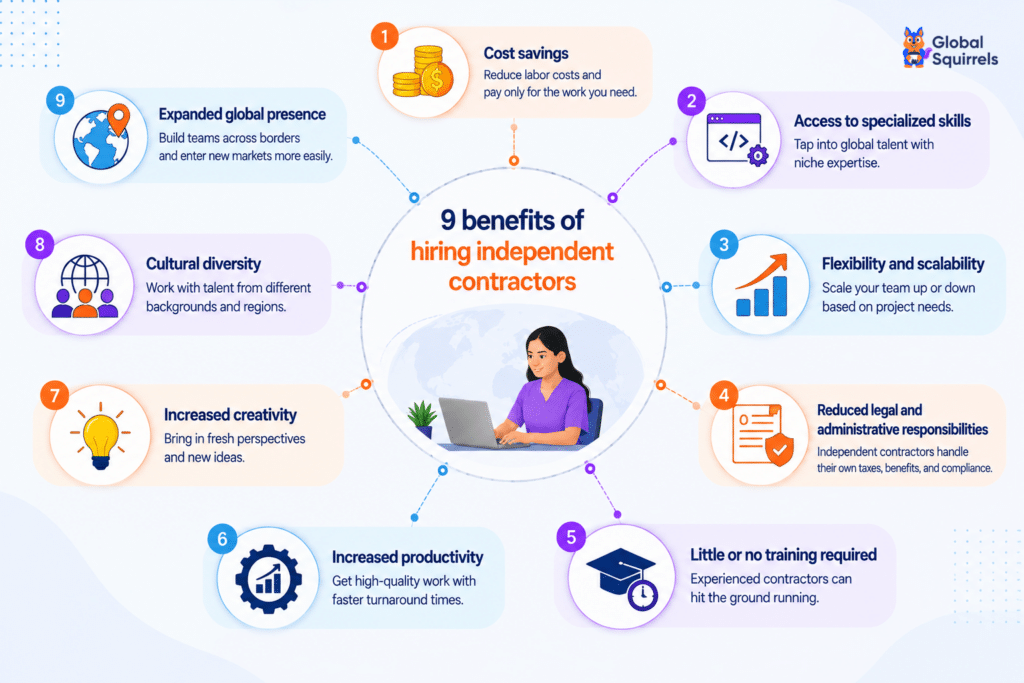
9 Benefits of hiring independent contractors
- Cost savings on hiring
- Access to specialized skills
- Flexibility and scalability
- Reduced legal and administrative responsibilities
- Less or no training required
- Increased productivity and efficiency
- Increased creativity at the workplace
- Cultural diversity in the workforce
- Expanded global presence
1. Cost savings on hiring
Hiring independent contractors cuts costs because businesses avoid payroll taxes, benefits, and overhead tied to full-time staff. Contractors also need little to no training, and companies can scale the team up or down based on project needs — making costs more predictable during fluctuating demand.
This flexibility can be particularly valuable in industries with fluctuating demand, such as tech or consulting. As contractors will be adept in the required project as per your expectations, the additional training expenses will also be considerably lower.
Want to know about how to hire & pay independent contractors abroad compliantly
2. Access to specialized skills
Hiring independent contractors lets businesses fill skill gaps — like a specific programming language or niche expertise — without a full-time hire. It’s especially useful when the right talent isn’t available locally; companies can look internationally, often gaining fresh perspectives along with the skill.
For example, a company in the US may need to hire a contractor with expertise in a specific programming language that is more prevalent in India or the Philippines. Hiring international contractors can also bring fresh perspectives and new ideas to the table, which can be invaluable in industries that require innovation and creativity.
Want to know more? Hiring International Remote Employees: Benefits & Challenges
3. Flexibility and scalability
Independent contractors let businesses scale their workforce up or down for specific projects or time periods, without the fixed overhead of full-time employees. Many also work flexible hours and remotely, making them easier to coordinate across time zones and fluctuating workloads.
This flexibility allows businesses to quickly adapt to changing project demands while maintaining operational efficiency. It is especially useful for companies with fluctuating workloads or seasonal demand.
Additionally, independent contractors often have more flexible schedules and can work remotely, which can be beneficial for businesses with employees in different locations or time zones.
4. Reduced legal and administrative responsibilities
Independent contractors handle their own taxes, licenses, and benefits, so businesses aren’t responsible for health insurance, paid time off, or retirement contributions. This lowers administrative and legal overhead — but correct worker classification is essential, since misclassification carries legal and financial penalties.
Overall, hiring an independent contractor can be a cost-effective and efficient way to access specialized skills and expertise without the added administrative and legal responsibilities of hiring a full-time employee.
However, it is important to note that there are specific guidelines for classifying workers as independent contractors, and misclassification can result in legal and financial consequences.
5. Little or no training required
Independent contractors are typically already experts in their field, so they need little or no onboarding compared to new employees. Because they work on a project basis, they’re also motivated to complete work quickly, which shortens turnaround time and reduces training-related costs.
Additionally, because cross-border contractors work on a project basis, they get motivated to complete the work quickly and efficiently. It leads to faster turnaround times and increased productivity. Overall, hiring an independent contractor can be a cost-effective solution for businesses seeking high-quality work without extensive training or supervision.
6. Increased productivity and efficiency
Independent contractors tend to be highly skilled, work flexible schedules, and face fewer workplace distractions than in-house staff. Because their reputation depends on the quality of delivered work, they’re motivated to perform efficiently — which helps businesses hit goals faster.
Additionally, because independent contractors are not employees, they are not subject to the same workplace distractions and interruptions that can impact productivity. Their value and professional reputation are based on the productivity and quality of the work they deliver to employers.
Therefore, they will strive to deliver the best for your business and will not compromise on quality. Overall, hiring an independent contractor can help your business achieve its goals more efficiently and effectively.
7. Increased creativity in the workplace
International contractors bring diverse perspectives that challenge conventional thinking and spark new solutions. Because they’re less entrenched in a company’s existing culture, they’re often more willing to question the status quo — which can inspire the rest of the team to think differently too.
Additionally, cross-border contractors may be more willing to challenge the status quo and bring fresh ideas to the table, as they may not be as entrenched in the company’s culture. By hiring international contractors, you can unlock a world of creative potential for your business.
8. Cultural diversity in the workforce
Hiring self-employed workers from different backgrounds brings cultural diversity into the workplace. A more diverse team introduces varied perspectives that strengthen problem-solving, creativity, and decision-making across the business.
9. Expanded global presence
Local independent contractors bring on-the-ground knowledge of a region’s market, consumer behavior, and business norms, helping companies enter new markets faster. Their insights let businesses adapt products or services to local preferences and build connections in unfamiliar business landscapes.
Independent contractors from various countries offer valuable insights into local markets and consumer behaviors. It helps businesses to understand the needs and preferences of customers in different regions. This helps businesses adapt their products or services to local market needs, and ultimately increases profitability.
Additionally, offshore independent professionals can help you establish a presence in new markets, providing valuable connections and expertise to navigate unfamiliar business landscapes.
Compliance considerations when hiring independent contractors
Businesses must classify workers correctly when hiring independent contractors — misclassifying an employee as a contractor can trigger legal and financial penalties in many countries. Review local labor laws and tax regulations before engaging contractors internationally to stay compliant.
Regulators generally weigh three things when deciding whether a worker is truly an independent contractor or a misclassified employee:
- Control — does the company dictate how, when, and where the work gets done, or only the end result?
- Integration — is the worker doing core, ongoing business functions, or a defined, separate project?
- Financial independence — does the worker use their own tools, set their own rates, and take on their own business risk?
Penalties for misclassification can include back taxes, fines, and legal liability — and rules vary significantly by country. Many businesses manage this risk by hiring contractors through a global employer of record or compliance platform rather than handling classification themselves. For a closer look at how contractors and employees are classified differently, see our guide on independent contractors vs employees.
Conclusion
Hiring remote contractors worldwide benefits businesses through cost savings, access to high-skilled talent, cultural diversity, and increased flexibility. However, successfully working with international contractors requires careful planning and management. It includes clear communication, well-defined expectations, and adherence to local laws and regulations.
Following these best practices helps businesses gain the benefits of international contracting while reducing risks. Ready to build a strong global contractor team?
Global Squirrels helps businesses find, hire, and pay independent contractors compliantly in over 150 countries — without setting up a local entity or navigating classification rules alone. Get started and build your global team in a few clicks.
