
How much does it cost to hire a paralegal?

When it comes to legal support, hiring a paralegal is generally more cost-effective than hiring a full-time attorney. Paralegals handle many important legal tasks, including drafting documents, conducting legal research, and managing case files at a lower cost. Businesses that want flexible legal support often hire remote paralegals to manage these tasks efficiently. However, the cost of hiring a paralegal depends on several factors, including location, experience, area of specialization, and whether they are hired on a freelance, full-time, or part-time basis.
In this blog, we outline the key factors influencing the cost of hiring a paralegal and provide an overview of common pricing models. From understanding hourly rates to evaluating how outsourcing legal support can reduce expenses, this guide will help businesses make informed decisions about budgeting for legal support. Regardless of the size of your organization, understanding the cost of hiring a paralegal is an important step in building an efficient and cost-effective legal team
What factors influence the cost of hiring a paralegal?
When hiring a paralegal, there is more to consider than just the hourly rate or salary. Several factors influence the cost of hiring a paralegal, and understanding them can help businesses make informed decisions aligned with their needs and budgets. Some of the key factors that affect paralegal costs include:
1. Location
The paralegal’s geographical location has a major impact on cost. Paralegals based in large metropolitan areas or regions with a high cost of living typically charge higher fees than those in rural areas or regions with a lower cost of living. When hiring remotely, businesses can take advantage of lower-cost locations, significantly reducing overall hiring expenses.
2. Expertise and experience
Like most professions, the more specialized skills and experience a paralegal has, the higher their rates tend to be. A paralegal with years of experience in a specific area of law, such as intellectual property or healthcare law, will typically command higher fees compared to a general paralegal. Additionally, paralegals with professional certifications often charge higher rates because of their specialized knowledge and ability to handle complex legal tasks..
3. The type of legal work
The complexity of the legal work required also plays a major role in determining costs. Routine tasks such as filing documents, managing case files, or preparing simple contracts generally cost less than more specialized work like conducting detailed legal research, drafting complex legal briefs, or providing litigation support. A paralegal handling high-stakes litigation or complex legal research will typically charge more due to the higher level of expertise required.
4. Type of employment
Full-time in-house paralegals are usually salaried employees, and businesses must also account for overhead costs such as office space, equipment, and employee benefits. In contrast, freelance or remote paralegals are often hired on a project or hourly basis, offering greater flexibility and cost savings for companies that do not require full-time legal support. However, if the business requires long-term legal assistance, hiring a full-time paralegal may become more cost-effective over time compared to continuously hiring freelancers.
5. Certifications and specialized skills
Some paralegals possess specialized certifications or niche expertise that increases their value. For example, paralegals with advanced certifications or experience in specific areas of law may charge higher fees because they can handle complex legal tasks more efficiently. Businesses that require highly specialized expertise should factor these additional costs into their hiring budget.
6. Amount of work
The volume of work required also affects overall cost. If a business needs occasional legal support, hiring a freelance paralegal for specific projects can be a cost-effective solution. However, if ongoing legal support is required, hiring a full-time paralegal may involve higher upfront costs but can provide better long-term value.
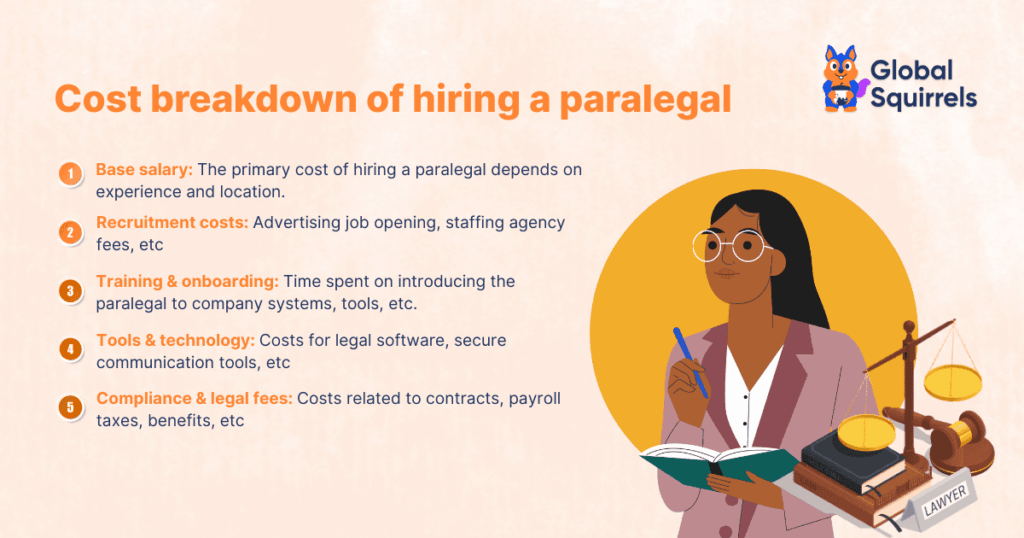
When budgeting for a paralegal, it is important to remember that payroll costs go beyond base salary. They often include indirect expenses such as health insurance, payroll taxes, workers’ compensation, retirement contributions, and training costs. Businesses can explore these additional considerations in Global Squirrels’ guide to employee payroll costs.
What are the additional costs to consider when hiring a paralegal?
When hiring a paralegal, the total cost goes beyond just hourly or salary rates. There are several additional expenses that businesses should consider to ensure the hiring process is properly budgeted. Below are some key additional costs to consider when hiring a paralegal.
1. Markup fees of the staffing agency
If you hire a paralegal through a staffing agency, one of the additional costs you may encounter is the agency markup fee. Staffing agencies usually add a percentage to the paralegal’s hourly or project rate to cover administrative costs and their service fees. This markup can range anywhere from 30% to 50% of the paralegal’s base rate, depending on the agency’s pricing structure and the complexity of the required tasks.
While staffing agencies provide the convenience of handling recruitment and placement, the added markup can make hiring through them more expensive than hiring a paralegal directly or through alternative hiring platforms.
Traditional staffing firms typically add 30–50% markups on a paralegal’s rate. However, Global Squirrels’ legal staffing platform offers a markup-free model in which businesses pay only payroll costs and a flat license fee, providing transparent, lower-cost hiring.
2. Wire transfer fees (if hiring globally)
When hiring a remote paralegal, businesses may also need to account for wire transfer fees or other international payment charges. These fees vary depending on the payment provider, the paralegal’s country, and the amount being transferred.
For international payments, wire transfer fees often range from $15 to $50 per transaction. If payments are made regularly, these costs can accumulate quickly. Businesses should factor these fees into the overall budget when hiring paralegals from other countries.
3. Onboarding and training costs
Before a new paralegal can start contributing effectively, they need to be onboarded and trained in line with the company’s processes, tools, and systems. Training costs may include expenses for training materials, software licenses, and internal training sessions.
Depending on the complexity of the role and the systems involved, onboarding costs can range from a few hundred to several thousand dollars.
4. Tools and technologies
Remote paralegals require access to various tools and software to perform their work efficiently. These tools may include document management systems, project management platforms, and legal research databases.
Businesses may also need to invest in secure file-sharing platforms, communication tools, and e-signature services to support smooth collaboration with remote legal professionals.
5. Administrative and legal costs
Hiring a paralegal may also involve administrative and legal expenses. Businesses often need to prepare agreements such as non-disclosure agreements (NDAs), employment contracts, and intellectual property agreements.
These documents may require legal review to ensure compliance and accuracy. Additionally, costs for background checks, reference verification, and other hiring-related paperwork can add to the overall expense.
6. Insurance and compliance
For businesses hiring remote paralegals – especially across different countries or regions – compliance with local labor laws and regulations is essential. Additional costs may arise from insurance coverage, compliance requirements, and benefits for full-time remote employees.
Businesses may also need legal consultation to ensure that contracts and employment agreements comply with the laws of the jurisdiction where the paralegal is located.
Why does cost transparency matter when hiring a paralegal?
Hiring a paralegal is an investment in your business, and understanding the full cost of that investment is essential. While hourly rates or salaries may appear to be the main cost factor, pricing transparency plays a critical role in ensuring businesses receive the best value for their investment.
Below are some reasons why cost transparency is important when hiring a paralegal through a staffing agency.
1. Helps you stay within budget
Transparent pricing helps businesses avoid hidden fees or unexpected expenses that could exceed their planned budget. Some agencies or platforms may add recruitment fees, administrative charges, or markups, increasing the overall cost.
With clear and transparent pricing, businesses can accurately estimate hiring expenses and avoid financial surprises.
2. Builds accountability and trust
Transparent pricing builds trust between businesses and staffing providers. When hiring a paralegal through an agency or staffing platform, it is important to understand the cost breakdown and which services are included.
This transparency also ensures that service providers remain accountable for delivering quality support.
3. Allows you to compare hiring options effectively
When businesses have full visibility into cost structures, they can compare different service providers or candidates more effectively.
For example, one provider may charge a higher hourly rate but include additional services such as specialized legal tools or guaranteed expertise. Transparent pricing enables businesses to determine whether the additional cost delivers sufficient value
How much does it typically cost to hire a paralegal?
The cost of hiring a paralegal can vary depending on several factors such as location, experience, and the type of legal work required. Understanding average paralegal salary ranges can help businesses plan their budgets effectively and ensure they pay a fair rate for the skills and services required.
Below is a general breakdown of average paralegal salary ranges across different regions:
- USA: $54T – $85T per yr
- Mexico: $9072 – $10,368 per yr
- Philippines: $7128 – $11880 per yr
- India: $6336 – $6864 per yr
Source: Glassdoor
These cost differences are one of the main reasons many businesses are now choosing to hire remote paralegals from global talent markets rather than relying solely on local hiring.
How will working with Global Squirrels reduce the costs of hiring a paralegal?
When it comes to hiring legal support, paralegals are already a cost-effective alternative to full-time attorneys. However, even hiring a paralegal can entail additional expenses, including recruitment, onboarding, and ongoing administrative overhead.
This is where Global Squirrels can help businesses reduce hiring costs. By leveraging a global talent pool, employer of record (EOR) services, and flexible staffing solutions, Global Squirrels helps organizations access skilled legal professionals while maintaining cost efficiency.
Below are some ways Global Squirrels helps businesses reduce hiring costs.
1. Access to a global talent pool
One of the most effective ways for businesses to reduce hiring costs is to access global talent markets. Instead of hiring locally and paying higher salaries in expensive regions, Global Squirrels connects companies with skilled paralegals from cost-efficient hiring destinations such as Mexico, India, and the Philippines.
By hiring remote legal professionals from these locations, businesses can access experienced talent at significantly lower costs compared to hiring locally in the United States. This approach also helps reduce overhead expenses such as office space, equipment, and employee benefits.
2. EOR services for administrative and compliance-related issues
When hiring remote employees across different countries, businesses must comply with local labor laws, tax regulations, and employment requirements. Managing these legal obligations internally can be complex and time-consuming.
Global Squirrels simplifies this process by offering Employer of Record (EOR) services, which handle compliance, payroll management, and employment administration on behalf of the business.
From drafting compliant employment contracts to managing payroll and ensuring tax compliance, the EOR model eliminates the need for businesses to establish foreign entities or navigate complex cross-border employment regulations.
3. Transparent pricing with no hidden fees
Many staffing agencies and freelance marketplaces add hidden fees or high markups to the cost of hiring talent. These additional charges can significantly increase the total hiring cost.
Global Squirrels offers a transparent pricing structure in which businesses pay only payroll costs and a flat platform fee. This clear and predictable pricing model helps companies plan budgets accurately while ensuring they receive high-quality legal support without unnecessary markups.
4. Streamlined recruitment process
Recruiting and onboarding legal professionals internally can require significant time and resources. Businesses must advertise the role, review resumes, conduct interviews, and verify candidate credentials.
Global Squirrels simplifies this process by providing pre-screened paralegal candidates. After submitting a hiring request, businesses receive curated candidate profiles that have already been evaluated for professional experience, qualifications, and legal expertise.
This streamlined process reduces recruitment time and allows businesses to focus on selecting the best candidate rather than managing the entire hiring process.
How to hire a paralegal through Global Squirrels?
If you are looking to hire a paralegal through Global Squirrels, the Employee/Contractor Plan would be a great fit since it will cover recruitment and EOR/payrolling. To onboard a self-sourced talent, the EOR/COR Plan will handle this and also take care of the payroll and benefits administration. The involved steps are:
- Log in or sign up and post the job requirements along with the hiring location, position, etc.
- In 2-5 business days, you should receive an email notification to review three curated profiles on the portal.
- Conduct an interview and shortlist the ideal candidate for the onboarding process.
- Review and approve the offer letter and pay the new hire’s onboarding deposit fee. Here, the one-month hiring cost is equivalent to the payroll cost and the flat license fee.
- Global Squirrels will onboard the paralegal and will handle the HR related duties like payroll, compliance, and benefits.
Hiring a top paralegal does not have to be complex or expensive if the right staffing partner is chosen.
Gain a detailed understanding of our staffing and payrolling platform’s functionality and discover how Global Squirrels can make a difference in remote talent hiring. Take a tour!
