
How to hire a remote paralegal: A complete guide for businesses

Hiring legal support is essential for many businesses, but it does not always require high costs or lengthy in-house recruitment. Remote paralegals help organizations manage legal research, compliance, and documentation tasks with greater flexibility and efficiency. From drafting contracts and conducting legal research to managing case files and ensuring regulatory accuracy, remote paralegals can provide the same level of expertise as traditional hires while offering added scalability and flexibility. Businesses that want to expand their legal support teams can also hire remote paralegals through Global Squirrels to access pre-screened professionals from a global talent pool.
However, hiring a remote paralegal requires more than simply posting a job online. Businesses need to understand where to find qualified talent, how to evaluate relevant skills, and what factors to consider when working with a remote legal professional.
In this article, we provide a detailed overview of how to hire a remote paralegal, including the benefits, best practices, potential challenges, and the key steps to help you find the right fit for your organization.
Why are Paralegals important for Businesses and Law Firms?
Paralegals play an important role in the legal ecosystem by providing efficient and cost-effective support to organizations that rely on legal services. Whether it is a small business managing contracts, a law firm handling multiple clients, or a corporate legal department ensuring compliance, paralegals help legal teams operate more efficiently. Many organizations today also hire remote paralegals to expand their legal support teams while maintaining flexibility and cost efficiency.
1. Affordable legal support
Hiring a full-time attorney for every task can be expensive. Paralegals handle important responsibilities such as preparing legal documents, conducting research, and drafting contracts at a fraction of the cost. Businesses often evaluate these costs before expanding legal teams, which is why understanding how much it costs to hire a paralegal can help in planning legal support budgets.
2. Improved productivity and efficiency
By managing routine legal tasks, paralegals allow lawyers and executives to focus on strategy, negotiations, and high-value decision-making. This division of responsibilities helps teams meet deadlines while maintaining quality. Many businesses today combine in-house legal teams with remote professionals to streamline operations and improve overall productivity.
3. Expertise in special areas
Many paralegals are trained in niche areas such as corporate law, real estate, healthcare, employment law, and intellectual property. Their specialized knowledge makes them valuable assets in industries with complex regulatory environments. This expertise allows businesses and law firms to manage specialized legal tasks without expanding their internal legal teams significantly.
4. Risk and compliance management
Businesses and corporate legal departments must stay compliant with labor laws, contracts, and industry regulations. Paralegals help monitor compliance, draft policies, and reduce legal risks before they escalate into costly issues. Having structured legal support ensures that organizations can maintain regulatory accuracy while focusing on business growth.
5. Document and case management
Law firms and corporate teams often handle large volumes of documents. Paralegals organize case files, maintain accurate records, and ensure quick access to important information, helping streamline legal workflows. Many organizations also support these processes with digital collaboration tools and remote legal professionals.
6. Scalability and flexibility
Organizations can scale legal support by hiring paralegals for specific projects or during periods of high workload. This flexibility allows businesses to remain agile without committing to additional full-time attorneys. Companies that want to expand their legal support teams globally often rely on global hiring platforms like Global Squirrels to access skilled legal professionals from different regions.
Why do businesses hire remote paralegals?
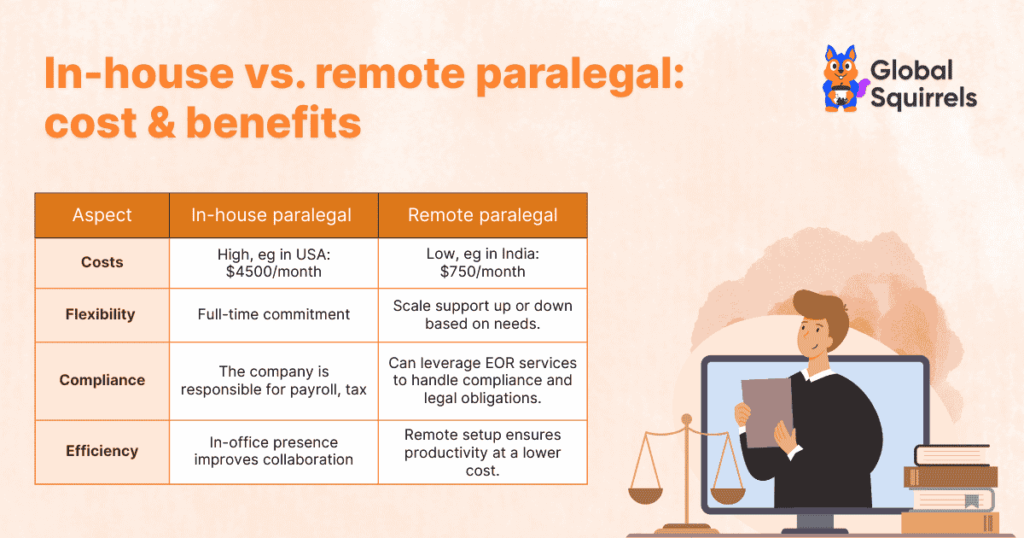
Hiring remote professionals is becoming a standard practice, and businesses are extending this flexibility to their legal support teams as well. Hiring a remote paralegal is gaining attention because it combines professional expertise with scalability and cost savings. Many organizations today hire remote paralegals to manage legal research, documentation, and compliance tasks without expanding their in-house teams.
Here are the key reasons businesses choose this model:
1. Major cost savings
Hiring remote paralegals is often more affordable than maintaining full-time in-house legal staff or relying entirely on external law firms. Companies can hire talent on an hourly, contract, or project basis, paying only for the services they actually need. Businesses evaluating their legal budgets often research how much it costs to hire a paralegal before expanding their legal support teams,
2. Access to a global pool of talent
Businesses are no longer limited by geography when hiring legal professionals. Remote hiring enables organizations to access skilled paralegals from around the world, including talent markets in the United States, Mexico, the Philippines, India, and Canada. This broader reach helps companies find professionals with the right legal expertise while enabling them to build flexible and cost-effective legal support teams.
3. Talent on demand
Many remote paralegals specialize in areas such as intellectual property, compliance, real estate, or corporate law. Businesses can bring in these professionals when needed without committing to long-term hires, allowing companies to scale their legal support based on project requirements.
4. Increased efficiency
With collaboration tools designed for remote teams, paralegals can conduct legal research, manage documentation, and assist with drafting contracts efficiently. This allows attorneys and executives to focus on strategic legal work while routine tasks are handled by skilled professionals.
5. Business continuity
In situations where in-office support may not be available, remote legal professionals help ensure that important processes such as compliance reviews, documentation, and case management continue without disruption. Many organizations rely on remote paralegal services to maintain continuity in their legal operations while supporting distributed teams.
What to consider before hiring a remote paralegal?
Hiring a remote paralegal can be a valuable solution for businesses seeking flexible legal support, but it requires careful evaluation. Beyond identifying the right skills, companies must also consider compliance, data security, and communication practices to ensure a successful remote collaboration. Below are some key factors businesses should review before hiring a remote paralegal.
1. Experience and credentials
Businesses should verify a candidate’s qualifications, certifications, and professional experience. Depending on the legal requirements – such as corporate law, intellectual property, litigation, or real estate – it is important to look for relevant specialization. A paralegal with proven experience in similar industries or cases can adapt quickly and deliver reliable results.
2. Confidentiality and data security
Legal work involves highly sensitive information. Businesses should ensure that remote paralegals are comfortable signing confidentiality agreements and working within secure systems for document sharing and communication. Using encrypted platforms and clearly defined data security policies can help prevent potential breaches.
3. Knowledge of jurisdiction
Legal regulations vary across states, countries, and industries. Even small compliance errors can create significant legal risks. Businesses should confirm that the paralegal understands the relevant legal framework and jurisdiction in which the organization operates.
4. Collaboration and communication
Successful remote work depends on clear and consistent communication. Businesses should establish expectations for availability, collaboration tools, reporting methods, and response times. Regular check-ins can help maintain alignment and ensure that tasks remain on schedule.
5. Pricing and cost model
Before hiring, businesses should decide whether the role will be hourly, project-based, or long-term contract support. Transparent pricing structures and clearly defined billing terms help avoid unexpected costs while maintaining accountability for deliverables.
6. Alignment of time zone
When hiring internationally, businesses should consider time zone differences to avoid workflow delays. Even a few hours of overlapping working time can significantly improve communication, collaboration, and overall productivity.
How to hire a remote paralegal: Step-by-step Guide
Hiring a remote paralegal can be one of the smartest ways for businesses to access professional legal talent while keeping costs under control. However, the process involves more than simply posting a job online. From defining legal requirements to ensuring compliance and onboarding efficiently, every step plays an important role in finding the right candidate.
1. Define your legal support needs
The hiring process will begin by defining the type of legal support that a business will require. Some companies will require ongoing assistance with compliance reviews, drafting contracts, or case management, while others might require short-term help with research or document preparation. Being clear about the scope of work, budget, and your expectations for outcomes will ensure that you target the correct type of candidate from the very beginning.
2. Choose the right hiring model
Once the requirements are clearly outlined, the next step is choosing the right hiring model. Freelancers are a viable option for one-time projects or seasonal spikes in workload. For companies that are seeking consistent support, part-time or full-time remote paralegals might be more suitable. Businesses that are planning to hire across borders should also consider compliance, which is where EOR services will provide a huge advantage.
3. Create a clear role description
After deciding on the model, work on a detailed role description. This will highlight the responsibilities, qualifications, and any specialized legal knowledge, like intellectual property, corporate law, or real estate. This will also include expectations around working hours, communication, and performance metrics for a smooth collaboration in a remote setting.
4. Screen and evaluate candidates
Screening goes way beyond just checking resumes. Reviewing samples, conducting small tests, and holding structured interviews will help in assessing both technical expertise and communication skills. Reference checks and verifying the credentials will ensure that the paralegal is qualified and reliable. This step will reduce risks and confirm that the candidate will handle the complexity of the legal requirements.
5. Ensure security and compliance
Before making a final decision, it is important to address confidentiality and compliance. Legal work will often involve sensitive data; therefore, NDAs and secure data-sharing processes should be put in place. This helps protect the business while also building trust with the paralegal from the very first day.
6. Onboard and manage the paralegal
Onboarding becomes important once a candidate is hired. Providing access to templates, tools, and case management will assist the paralegal in quickly integrating into the workflow. Establishing regular check-ins and setting measurable performance indicators will ensure consistent quality of work and accountability. Eventually, tracking metrics like accuracy, stakeholder satisfaction, and turnaround times will enable you to measure effectiveness and refine the working of a relationship.
Cost of hiring a remote paralegal from top countries
When businesses consider hiring a remote paralegal, one of the first questions that arises is cost. Salaries and rates for paralegals vary significantly depending on the country, market demand, and level of expertise. Hiring locally can get expensive; thus, tapping into global talent pools will allow companies to access highly skilled paralegals at more affordable rates without compromising on quality.
The cost of hiring remote paralegals varies by country, experience level, and market demand. Some common countries businesses hire remote paralegals from include:
- Philippines: $4536 – $7776 per year
- India: $6336 – $6864 per year
- Mexico: $9072 – $10,368 per year
Source: Glassdoor
What are the challenges of hiring a remote paralegal?
Although hiring a remote paralegal offers flexibility, cost savings, and access to a broader talent pool, it comes with certain challenges. Analyzing these potential hurdles in advance will assist you in planning better and building a successful working relationship.
1. Verify the experience and credentials
Since the hiring process will take place online, it could get difficult to confirm a candidate’s background, experience, and certifications. Businesses should exercise caution when conducting background checks, making reference calls, and requesting sample work to ensure they are hiring a qualified professional.
2. Issues related to compliance and jurisdiction
Laws tend to change as per state and country; however, not all paralegals who are trained in the jurisdiction will be relevant to the business. This could create severe compliance gaps or limit the paralegal’s ability to perform certain tasks. Verifying the jurisdictional expertise is important prior to hiring.
3. Gaps in collaboration and communication
Remote work can often lead to miscommunication, especially if expectations are not set clearly. Without a face-to-face interaction, tasks can be easily misunderstood, and deadlines can be missed. Regular check-ins and structured communication tools will help in overcoming this challenge.
How does Global Squirrels help you hire skilled paralegals?
Finding and hiring the right paralegal can get time-consuming, especially when balancing costs, compliance, and the need for specialized legal expertise. We help you source pre-vetted paralegals, manage the hiring across borders, and handle the payroll and compliance seamlessly. Whether you are a business, a law firm, or a corporate legal department, Global Squirrels will simplify the hiring process and ensure that you get skilled legal professionals without any hassle. Here’s how we help in simplifying the challenges:
1. Pre-screened candidates
One of the biggest challenges of hiring a remote paralegal is verifying the background, experience, and credentials. At Global Squirrels, we will ensure that this burden is taken off your shoulders by conducting a thorough pre-screening and vetting before candidates reach you. Our team will carefully validate the qualifications, certifications, and professional history of the candidate to ensure authenticity.
2. Handle the compliance issues
Our platform will make sure that the business will not have to undergo any legal risks. This is because Global Squirrels carefully manages compliance with local and international labor and tax laws.. Additionally, our platform will make sure that the freelancers you hire will fill out all the mandatory forms, which include the W-8BEN. The forms will have to be filled out and submitted to the IRS will be done by the platform.
3. Monitoring tasks and performance
One of the most common problems with managing remote talent is a lack of visibility into the performance and tasks. You can easily assign one-time or recurring tasks to your remote paralegal workers with a single click. Managers and employees can easily track task status at a glance which will ensure transparency and accountability.
How does it work?
Hiring the right paralegal is important for a business, but the process can get time-consuming and complex. Global Squirrels will simplify this by offering a streamlined and organized way to hire a remote paralegal. Whether you need short-term assistance or EOR services, Global Squirrels has a plan to fit your needs:
1. Employee/Contractor Plan
The Employee/Contractor Plan will help you find and hire a paralegal who meets all your business requirements. After enrolling and selecting the plan, you must enter information about your job title, job description, budget, anticipated start date, educational background, and necessary skills. Our platform will provide carefully selected profiles within 2 to 5 business days after you request a new resource. After reviewing these profiles, you may choose which prospects to onboard by interviewing your top picks and providing feedback. After onboarding starts, our software handles all HR tasks with ease.
Here are the steps to hire and manage paralegals using our Employee/Contractor Plan:
- Create an account and post your job requirement for free. Mention the desired hiring location, for instance, India, the Philippines, Mexico, etc.
- Within two to five business days, you will receive an email notification to review three curated profiles on the portal.
- Interview potential hires and shortlist for onboarding.
- Review and accept the offer letter, then pay the onboarding deposit for your new workers, which is a one-month hiring fee equal to the payroll cost and flat license fee.
- Global Squirrels will onboard the remote paralegal and handle all HR-related tasks, including compliance, payroll, and benefits.
2. Employer of Record (EOR)/Contractor of Record (COR) plan
Our EOR/COR Plan will enable you to smoothly onboard a paralegal whom you have previously found. Choose the plan after registering or logging in, then enter the candidate’s full name, email address, job position, responsibilities, anticipated start date, and any pertinent onboarding paperwork. Our software handles all HR tasks once onboarding begins, guaranteeing a seamless and effective procedure.
Are you ready to hire a remote paralegal? Request a demo!