Employer of Record (EOR) in Puerto Rico
An Employer of Record (EOR) in Puerto Rico is a third-party organization that allows companies to hire, manage, and pay employees legally without establishing a local entity. The EOR will act as the legal employer and handle employment responsibilities such as payroll processing, HR administration, tax compliance, employee benefits, and adherence to local labor regulations.
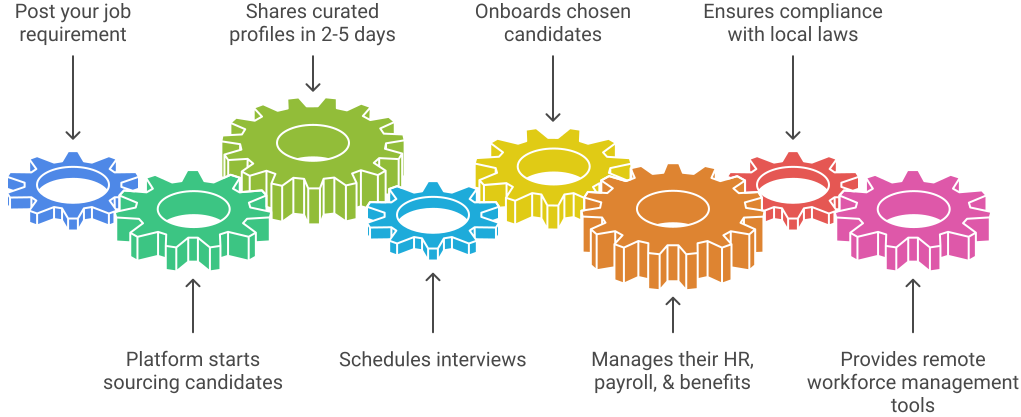
Global Squirrels is an Employer of Record platform that helps businesses hire employees in Puerto Rico quickly and efficiently. Our SaaS-based platform combines EOR/COR solutions with staffing. This allows companies to source qualified talent, review curated candidate profiles within just 2-5 business days, onboard selected candidates, schedule interviews, and manage their HR, payroll, and benefits seamlessly.
By assuming employers’ responsibilities and liabilities, Global Squirrels will ensure full compliance with Puerto Rico’s employment and labor laws. Your business stays protected from the risks of non-compliance with legal requirements, including hefty penalties, lawsuits, and more. Additionally, our platform offers tools to manage your remote workforce efficiently, including timesheet tracking, leave management, salary adjustments, termination support, and SquirrelTracker, which monitors employee productivity, work hours, and activities.
How it works?
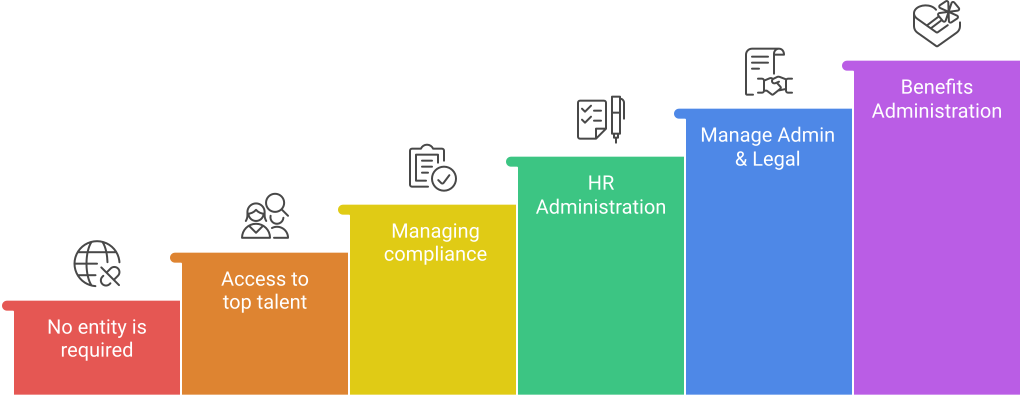
1. No entity is required
With Global Squirrels as your Employer of Record in Puerto Rico, you can hire employees without establishing any local legal entity. This will eliminate the time-consuming, expensive process of company registration and allow you to expand your workforce quickly.
2. Access to top talent
Once you share your job requirement on the platform, your team will start sourcing qualified professionals. You will receive curated profiles or skilled candidates within 2-5 business days. This allows you to review and interview the best fit for your business.
3. Managing compliance
Our EOR platform will ensure that employment contracts, payroll processing, and benefits administration will comply with Puerto Rico's labor laws and employment regulations. This will help your business to avoid compliance risks and legal complications.
4. HR administration
Global Squirrels will handle administrative tasks such as employee onboarding, payroll management, tax deductions, statutory contributions, and employee record management.
5. Handle the admin and legal aspects
While you will maintain full control over the employees' roles, performance, and tasks, Global Squirrels will handle the legal and administrative responsibilities related to the employment.
6. Benefits administration
Our Employer of Record in Puerto Rico will manage employee benefits, including health coverage, leave policies, statutory benefits, and other employment entitlements, in accordance with local labor regulations.
Expand your team in Puerto Rico without establishing a local entity. Access skilled professionals and onboard quickly!
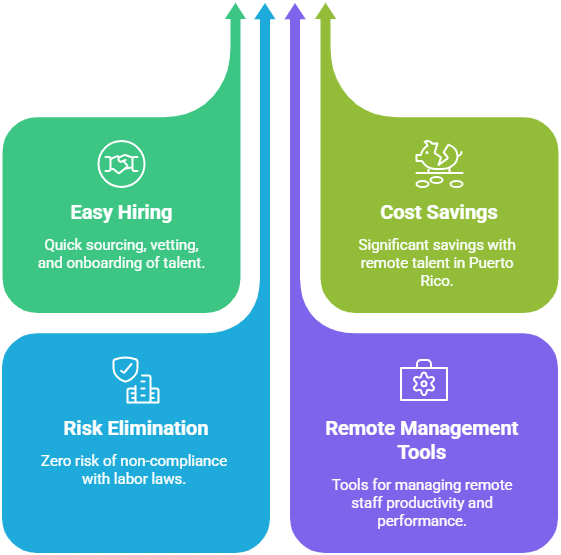
Benefits of using an EOR in the Puerto Rico
- Hire easily and quickly: Our portal will source top talent, vet them, schedule interviews, onboard the desired candidates, and manage HR operations, payroll, and benefits.
- Significant savings: Hire top-tier remote talent in Puerto Rico while saving significantly with our platform.
- Zero risk to your business: Eliminate the chances of non-compliance with the labor laws and regulations, thus keeping your business and employees protected from any risk.
- Tools to handle remote staff: Global Squirrels offers tools to help you handle the productivity and performance of the remote talent in Puerto Rico.
Interested in using our Employer of Record services in Puerto Rico?
Table of Contents
Worker classification in Puerto Rico
Global Squirrels is a staffing and payrolling platform that helps you to hire talent based on your job requirements. You can also onboard self-sourced candidates compliantly. Our EOR/COR will handle onboarding, payroll, and legal compliance, and generate offer letters for the staff you have already sourced. The Employee/Contractor Plan will source and recruit talent based on job requirements and manage their AOR/COR. We also offer our Managed Office Plan with similar features, which allows your hired staff to work from one of our dedicated offices in India, the Philippines, Mexico, the USA, and Canada. This plan is perfect for companies that would prefer increased security and management.
Hire employees or contractors with complete compliance while Global Squirrels handles payroll, HR, and legal requirements.
When hiring talent in Puerto Rico, you should accurately classify workers as either employees or independent contractors, as this will determine the tax obligations, employee benefits, and labor laws that apply to the relationship. Incorrect classification can result in legal penalties, compliance issues, and financial liabilities for employers.
The country’s labor regulations define worker classification based on factors such as the level of control over work, contract terms, independence, and the nature of the working relationship. For companies expanding here, understanding this is important to avoid misclassification risks. Using an EOR in Puerto Rico will simplify this process by assisting businesses in hiring and managing workers in compliance with local employment regulations and laws.
1. Permanent employees
Employees in this category work under the employer’s direct control and supervision. You will determine the work schedule, responsibilities, and the way tasks will be performed. You should comply with the labor laws of Puerto Rico when hiring employees. This includes processing payroll, withholding taxes, and providing statutory benefits. These employees will be entitled to protections like minimum wage, overtime pay, paid leave, and other employment benefits mandated by local regulations.
2. Independent contractors
Independent contractors are self-employed professionals who will provide services to businesses under contract-based agreements. Unlike employees, contractors typically have greater control over how they perform the work and often serve multiple clients. Companies hiring contractors are not usually responsible for providing employment benefits. However, you should ensure that the relationship reflects contractor status to avoid misclassification issues.
3. Temporary or project-based workers
Temporary or project-based workers are hired for a certain duration or to complete a project. These workers can be employed directly by a company or through staffing arrangements. Their employment terms are usually defined by the duration of the assignment, and they might receive compensation and benefits depending on the agreements and employment structure.
Employment agreements in Puerto Rico
Hire and onboard employees quickly while Global Squirrels manages contracts, payroll, and local compliance.
Employment agreements in Puerto Rico will define the terms of the working relationship between you and the employees. This includes responsibilities, compensation, benefits, and working conditions. Having a clear agreement will help establish expectations and ensure compliance with local labor laws. It will protect both parties by outlining important employment policies and obligations.
Types of employment contracts
Employers in Puerto Rico can use various types of employment contracts depending on the nature of the role, duration of employment, and business requirements. These contracts will define the terms of responsibilities, employment, and working conditions while also ensuring compliance with local labor laws.
1. Indefinite-term contracts
Indefinite-term contracts are the most common types of employment agreements in Puerto Rico. These contracts will not have a fixed end date and will continue until either the employer or the employee terminates the relationship in accordance with labor laws and company policies. Employees under indefinite contracts are usually entitled to statutory benefits and employment protections.
2. Fixed-term contracts
Fixed-term contracts are used when employment is needed for a certain period. These contracts will clearly define the start and end dates of employment and are usually used for temporary projects, seasonal work, or short-term business needs. Once the contract period ends, the employment relationship will conclude unless both parties agree to extend it.
3. Part-time contracts
Employees who work fewer hours than full-time employees are covered by part-time contracts, which specify working hours, pay, and responsibilities, and guarantee compliance with relevant labor laws and employment rights.
4. Temporary or project-based contracts
Temporary or project-based contracts are usually used when employees are hired to complete a certain assignment or project. These contracts usually last until the project is completed or the agreed-upon duration ends. They provide businesses with flexibility while also clearly defining the scope and terms of employment.
Important components of an employment contract in Puerto Rico
The employment laws in Puerto Rico establish several obligations and terms of employment that both employees and employers should follow. Some of them include:
Job title and responsibilities | The contract should clearly outline the employee’s job titles, responsibilities, and duties. This will help establish expectations regarding the role and ensure that both the employer and the employee understand the scope of work. |
Working hours | The contract should define the employee’s working hours, work schedule, and overtime policies. The standard workweek in Puerto Rico is 40 hours, typically divided into 8-hour days. |
Overtime | Employers must ensure that overtime pay and work-hour regulations align with local labor laws. Overtime applies after 8 hours per day or 40 hours per week, with 1.5x pay for hours over 10 per day. |
Probation period | Many employment contracts include a probationary period during which the employer evaluates the employee’s performance before confirming permanent employment. For executives, administrators, and professionals, the probation period is up to 12 months. For general employees, it is up to 9 months. |
Anti-discrimination laws | Puerto Rico’s primary anti-discrimination law is Act No. 100 of June 30, 1959, which prohibits workplace discrimination based on age, race, color, sex, social or national origin, social condition, political ideas, or sexual orientation. |
Health and Safety Act | The Puerto Rico Occupational Safety and Health Act (Act No. 16 of August 5, 1975, as amended) ensures safe working conditions for employees and largely mirrors federal OSHA standards. |
Notice period | There is no mandatory statutory notice period for either employers or employees to terminate an employment relationship. While not legally required, providing notice is considered professional courtesy. |
Intellectual Property (IP) | Intellectual property clauses in employment contracts will define ownership of inventions, software, designs, research, or other work created by employees during their employment. |
Dispute Resolution | Employment contracts often include provisions requiring disputes to be resolved through arbitration, mediation, or other alternative dispute resolution methods rather than traditional litigation. |
Post-Employment (Post-Termination) | The law allows certain restrictive covenants, such as non-compete agreements, but they must meet strict conditions to be enforceable. For example, non-compete clauses must be written, reasonable in scope, and generally cannot exceed 12 months after termination. |
Payroll in Puerto Rico
Let Global Squirrels handle payroll processing, tax compliance, and employee benefits while you focus on growing your business.
Payroll calculation in Puerto Rico usually involves estimating an employee’s total earnings and ensuring compliance with labor laws and tax regulations. This process will include calculating gross salaries, applying deductions, and determining net salaries. EOR services in Puerto Rico can simplify this process by handling payroll and ensuring regulatory compliance, helping businesses avoid legal risks and streamline operations.
Payroll contributions | Amount or % |
Social Security (FICA/OASDI) | 6.2% (up to $168,600) |
Medicare | 1.45% + 0.9% over $200k |
Federal Unemployment (FUTA) | 0.3% (up to $9,000) |
Puerto Rico Unemployment (PRUI) | 1–5.4% (up to $7,000) |
State Insurance Fund (Disability) | 0.3% (up to $9,000) |
Source: IRS
Puerto Rico is governed by various statutory and legal requirements. This will include:
- Internal Revenue Code of 2011 (as amended): Governs local income tax, sales and use tax (SUT), and inheritance taxes.
- Penal Code (Act No. 146-2012): Defines local crimes and punishments.
- Incentives Code of 2019 (Act 60): Provides tax incentives for export services, investors, and economic development.
- Political Code of 1902: Contains foundational administrative and public laws.
- The Puerto Rico Federal Relations Act of 1950: This statute governs the ongoing relationship between Puerto Rico and the United States and establishes the framework for adopting the local constitution.
Businesses should ensure that they adhere to local rules and regulations. By partnering with an EOR in Puerto Rico, you can simplify this process, ensure compliance, and eliminate related issues.
Social security benefits
Social Security is governed by the US Federal Insurance Contributions Act (FICA), which funds retirement, survivor, and disability benefits.
- Applicability: This applies to most employees and employers working in Puerto Rico, which is similar to the United States.
- Contribution rates: Employees will contribute 6.2% of wages towards Social Security, and employers should match this with an additional 6.2% contribution.
- Medicare contribution: Both employers and employees should contribute 1.45% of wages towards Medicare.
- Wage-based limit: Social security contributions apply only up to the annual wage base limit set by the U.S. government.
- Employer Responsibility: Employers must withhold employee contributions and remit both employer and employee portions to the federal authorities in compliance with payroll regulations.
Employee benefits in Puerto Rico
When you partner with Global Squirrels, your employees in Puerto Rico will receive all the statutory benefits required by law. This will include insurance, paid leave, social security contributions, gratuity, and other mandatory entitlements. Our platforms will assume the responsibilities of the legal employer, helping ensure full compliance with local labor regulations while also protecting your business from potential legal risks, disputes, or penalties.
As an Employer of Record in Puerto Rico, Global Squirrels will handle these mandatory benefits on behalf of your company, thus allowing you to focus on managing the team and operations.
Employee benefits are regulated via a combination of statutory labor laws and employer-provided benefits. These benefits are designed to support employee well-being, financial security, and work-life balance. Employer of Record services in Puerto Rico will handle employee benefits in compliance.
Some of the key employee benefits in Puerto Rico include:
1. Minimum wage
- All companies should pay salaries to all employees that are at least equal to the government-set minimum wage.
- Under the Fair Labor Standards Act, the minimum wage for all employees is $10.50 per hour.
- The Fair Labor Standards Act does not cover employees working in sectors such as agriculture, government, or the professions. Hence, the minimum wage is not applicable in most of these cases.
- Also, employees covered by a specific collective bargaining agreement usually have a predetermined minimum wage that may differ from the government-established minimum wage.
Source: Dol gov
2. Working hours and overtime
- The employees should work 8 hours per day and 40 hours per week.
- Employees who work more than the specified working hours are entitled to overtime pay as per the Fair Labor Standards Act.
- The overtime rate is about 1.5x the employee’s regular salary.
- Employees who work on holidays are also entitled to overtime pay.
Source: Lexology
3. Paid time off
- All employees will be entitled to an annual leave once they complete 115 hours every month.
- Every month, 1 ¼ days of annual leave will be added to employees’ total leave.
- The leave accrual system will only apply to companies with more than 15 employees. For companies with fewer than 12 employees, a ½-day leave is added each month.
- Employees who have worked for a year can take up to 6 days of paid leave. The number of leaves will increase to 9 days and 12 days for employees working for one to five years, and 5 to 15 years, respectively.
- For employees who have been with the company for more than 15 years, the annual leave entitlement is 15 days.
4. Maternity leave
- Female employees can take up to 8 weeks of maternity leave.
- These leaves are divided into two parts: four weeks prior to and four weeks after the due date.
- Employees may take these leaves up to a week before the due date and resume work within the next two weeks after birth, provided a certificate of medical fitness is submitted.
- Pregnant employees who are at risk of complications can extend their leave to 20 weeks. However, the company does not pay for the additional 12 weeks.
5. Parental leave
- Companies with more than 50 employees also provide parental leave.
- The employees will be entitled to 12 weeks of unpaid leave under the US Federal Family and Medical Leave Act.
Leave policy in Puerto Rico
Global Squirrels is an EOR platform with built-in tools to help you manage and track employee leave. Everything from timesheets to leave balance can be easily tracked on the platform.
Leave policies in Puerto Rico are monitored by multiple laws and regulations. This can vary depending on the type of employment and industry. The goal of these policies is to ensure that employees have adequate time off for personal, health, and emergency needs while also maintaining business continuity. An Employer of Record service in Puerto Rico will handle leave-related compliance. The types of paid leave are given below:
Annual leaves
Puerto Rican workers are entitled to paid annual leave; the number of days increases with the length of their employment. This leave policy aims to honor employees’ commitment and years of service.
The annual leave accrual in Puerto Rico is given below:
- First year of employment: Employees will be eligible for six days of paid annual leave.
- Between one and five years of service: Employees will receive nine days of annual leave.
- Between 5 and 15 years of service: Annual leave will increase to 12 days per year.
- More than 15 years of service: These employees are entitled to 15 days of paid leave.
Source: Gobierno de Puerto Rico
Sick leave
Puerto Rico has mandated that employers provide paid sick leave to employees who cannot work due to illness. Full-time employees can earn 1 day of sick leave per month if they work for a certain number of hours. Sick leaves can be used for personal illness, medical appointments, or caring for a family member, and unused days can be carried over to the next year.
Source: Gobierno de Puerto Rico
Maternity leave
Maternity leave in Puerto Rico will provide eight weeks of paid leave, usually four weeks prior to childbirth and four weeks after the birth. Employees can adjust their start and return dates with a medical certificate. In cases of pregnancy-related complications, leaves can get extended to around 20 weeks, though the additional 12 weeks are usually unpaid.
Source: Gobierno de Puerto Rico
Paternity leave
Paternity leave is not mandatory in private companies in Puerto Rico. Fathers can take up to five days of unpaid or job-protected leave to care for the newborn, typically using personal leave or employer-provided benefits.
Source: Justia US Law
Parental leave
Parental leave in Puerto Rico is handled by the US Family and Medical Leave Act (FMLA). Eligible employees working for companies with 50 or more employees can take up to 12 weeks of unpaid and job-protected leave for childbirth, adoption, caring for a family member with a serious health condition, or their own medical needs.
Employment Laws in Puerto Rico
Global Squirrels handles compliance with local labor laws and regulations, allowing businesses to hire and manage employees in Puerto Rico without navigating complex legal and administrative requirements.
The US Department of Labor and the Puerto Rico Department of Labor work together to provide employment standards and protections for all employees in Puerto Rico. Given below are some of the employment and labor laws that will take care of the workers’ rights in Puerto Rico:
- Puerto Rico Minimum Wage Act: Establishes the minimum wage requirements for employees working in Puerto Rico.
- Puerto Rico Working Hours and Overtime Law (Act No. 379 of 1948): Regulates working hours, overtime pay, and rest periods for employees.
- Puerto Rico Unjust Dismissal Act (Act No. 80 of 1976): Protects employees from wrongful termination and establishes severance requirements for unjust dismissal.
- Puerto Rico Employment Discrimination Law (Act No. 100 of 1959): Prohibits discrimination in employment based on age, race, sex, religion, political affiliation, and other protected characteristics.
- Puerto Rico Maternity Protection Act (Act No. 3 of 1942): Provides maternity leave and protections for pregnant employees.
- Puerto Rico Occupational Safety and Health Act: Ensures workplace safety and compliance with occupational health standards.
- Puerto Rico Sick Leave and Vacation Leave Law (Act No. 180 of 1998): Establishes mandatory accrual of vacation and sick leave for eligible employees.
- Family and Medical Leave Act (FMLA): A U.S. federal law that provides eligible employees with up to 12 weeks of unpaid leave for family and medical reasons.
- Americans with Disabilities Act (ADA): Protects employees with disabilities from discrimination and requires employers to provide reasonable workplace accommodations.
- Equal Pay Act: Requires equal pay for equal work regardless of gender.
Employer of Record services will handle all employment laws that an employer must comply with when hiring employees from Puerto Rico.
Personal income tax in Puerto Rico
As the Employer of Record in Puerto Rico, Global Squirrels will manage all statutory and payroll responsibilities, including the accurate deduction and remittance of personal income tax in accordance with tax laws.
The residents are taxed on their worldwide income. However, non-residents are taxed only on income earned from Puerto Rico-based companies. Income from services is usually taxed based on where the work is being performed. However, small amounts of income can be exempt if the individual spends 90 days or fewer in Puerto Rico and works for an employer that does not operate there.
The following regular tax rates remain in effect:
Net taxable income (USD) | Tax |
Not over 9,000 | 0% |
Over 9,000, but not over 25,000 | 7% of the excess over USD 9,000 |
Over 25,000, but not over 41,500 | USD 1,120 plus 14% of the excess over USD 25,000 |
Over 41,500, but not over 61,500 | USD 3,430 plus 25% of the excess over USD 41,500 |
Over 61,500 | USD 8,430 plus 33% of the excess over USD 61,500 |
Source: Tax Summaries
Gradual adjustment tax
If the employee’s net taxable income exceeds $500,000, they would have to pay an additional tax, i.e., the gradual adjustment tax. This tax is 5% of the excess of the final net taxable income. It is limited to 33% of the personal and dependents’ exemption, including $8,895.
Alternate basic tax (ABT)
Employees are also required to calculate the ABT using the tax table below. The ABT taxable income is calculated by adding certain income items exempt from regular income tax.
Net income subject to ABT (USD) | Tax (%) |
In excess of 25,000 but not more than 50,000 | 1 |
In excess of 50,000 but not more than 75,000 | 3 |
In excess of 75,000 but not more than 150,000 | 5 |
In excess of 150,000 but not more than 250,000 | 10 |
In excess of 250,000 | 24 |
The ABT will not be applied to individuals whose only source of income is a salary reported on a withholding statement.
New optional tax for self-employed individuals rendering services
Self-employed individuals who earn substantially from a business that renders services can elect to pay an optional tax on gross income instead of the income tax imposed by the code on net income. It is as follows:
Gross income (USD) | Tax(%) |
Not greater than 100,000 | 6 |
In excess of 100,000 but not more than 200,000 | 10 |
In excess of 200,000 but not more than 300,000 | 13 |
In excess of 300,000 but not more than 400,000 | 15 |
In excess of 400,000 but not more than 500,000 | 17 |
In excess of 500,000 | 20 |
The majority of revenue must come from rendering services. For these reasons, accruing revenue that accounts for at least 80% of the total gross income received during the taxable year will be deemed to have originated primarily from services delivered.
Additionally, the entire gross self-employment income must be reported on an Informative Return and be subject to withholding at source or to estimated tax payments in order to apply the optional tax computation.
Requirements to run payroll in Puerto Rico
Handling payroll in Puerto Rico involves several steps before employees receive their pay. Every payroll cycle will need accurate gross-to-net calculations, correct application of statutory deductions and employer contributions, issuance of compliant payslips, and on-time tax filings and payments. Any delays or errors can result in penalties, back-pay liabilities, and employee dissatisfaction, thus making compliance and accuracy important.
Ongoing compliance requirements
- Tax payments and reporting:
Employers must file the relevant employment tax forms and pay federal wage taxes in accordance with the IRS payment schedules.
- Form 941, Employer’s Quarterly Federal Tax Return
Form 941 is used to report Federal Income Tax Withholding (FITW) and Insurance Contributions Act (FICA) contributions together with the taxable wage amounts. After the calendar quarter ends, the Form 941 is filed at the end of the month (due dates are April 30, July 31, October 31, and January 31).
- Form 940, Employer’s Annual Federal Unemployment (FUTA) Tax Return
Form 940 must be filed by January 31st, the day after the calendar year ends. It could be filed by February 10th, though, assuming all FUTA tax obligations are paid on time. At the conclusion of the first three calendar quarters, cumulative liabilities exceeding $500 must be paid to the IRS within 30 days of the quarter’s end (due on April 30, July 31, and October 31). The remaining balance must be paid by January 31 at the end of the fourth quarter (due on December 31).
Pension requirements
For nearly all American workers, Social Security is an integral part of their retirement plan. For eligible retirees and their families, it offers replacement income. Based on an employee’s lifetime earnings, Social Security replaces a portion of their pre-retirement income. Based on an employee’s greatest 35 years of earnings, Social Security replaces a percentage of their preretirement pay. This amount fluctuates based on the employee’s earnings and when they decide to begin receiving benefits. No further filing is needed. As previously stated, it is part of the annual and quarterly filing requirements.
Employment obligations
US businesses should comply with federal laws. These laws will overlook working conditions, minimum wages, working hours, the frequency and manner of wage payments, meals, and rest periods. It also includes the need for certain benefits, such as paid and unpaid leave. Federal labor requirements are enforced by the U.S. Department of Labor; state labor laws are enforced by state labor departments; and local laws are usually enforced by the city mayor. Given follow are some of the labor laws which apply:
- Workers’ compensation insurance:
The law requires employers to provide workers’ compensation insurance, which covers medical expenses and disability for work-related injuries and illnesses. Employers tend to purchase this insurance via private carriers.
- Health insurance coverage:
There is no federal labor requirement mandating health insurance for employees. However, under the Affordable Care Act (ACA), many employers are subject to penalties from the IRS for failing to provide a minimum level of health insurance coverage to employees. The penalty provisions will apply to an employer with 50 or more full-time employees.
- Minimum wage:
Under federal law, the minimum wage is $10.50 per hour for workers covered by the Fair Labor Standards Act.
- Overtime pay:
Nonexempt workers are required by the FLSA to be paid 1.5 times their ordinary rate of pay for all hours worked in excess of 40 hours per week. Certain employee groups, such as executive, administrative, and professional employees, are excluded from the overtime compensation obligation, provided the conditions are satisfied. To exceed a daily hour threshold, several states and cities may mandate overtime compensation, which, in certain cases, may be double the ordinary rate of pay.
- Paid time off:
There is no federal requirement for paid time off. Hence, there is no need to pay employees for time off taken for sick leave, vacation, or holidays.
- Unpaid leave:
For specific family and medical reasons, eligible employees of covered employers are entitled to unpaid, job-protected leave under the federal Family and Medical Leave Act (FMLA). Group health insurance coverage will continue under the same terms and conditions as if the employee had not taken leave.
Payroll requirements
- Mode of payment:
Usually, wages are paid in cash or by cheque. Most states will allow payments by direct deposit or by debit cards. However, only with the employees’ written consent and only if the employees are not subject to a fee to withdraw their pay.
- Frequency of wage payments:
The majority of states have laws governing how frequently workers must be paid. For example, several jurisdictions mandate that hourly workers receive their pay at least every two weeks.
- Statements of pay:
Regular hours, regular pay, overtime hours, and overtime pay are among the details that must be given to employees on a payday in several states.
- Garnishment:
Employers are responsible for carrying out garnishment orders, deducting specified amounts from an employee’s salary each period, and remitting the funds to the relevant authorities.

Hire, onboard, and pay your skilled and experienced professionals in Puerto Rico without having to establish an entity. You can access the best talent through Global Squirrels, which will also handle complex local payroll and compliance.
Trusted by growing businesses & enterprises
Recognized for excellence across leading review platforms
EXCELLENT Based on 25 reviews Posted on Jay Anne CiprianoTrustindex verifies that the original source of the review is Google. Really impressed with Global Squirrel! Compared to other platforms, payments are consistently on time and sent directly to my local bank, which makes everything simple and reliable.Posted on JoseTrustindex verifies that the original source of the review is Google. Love Global Squirrels! Great service!Posted on Jose GarciaTrustindex verifies that the original source of the review is Google. Love Global Squirrels! Great service!Posted on rhoda sykesTrustindex verifies that the original source of the review is Google. Working as a VA with Global Squirrels has been a nice experience. They connected me with a client, set clear expectations, and maintain smooth communication. The support team is responsive, and the overall process allows me to focus on delivering quality work. I’d highly recommend Global Squirrels to both clients and VAs.Posted on MV LGTrustindex verifies that the original source of the review is Google. I feel confortable working with global squirrels because it is a reliable company and, above all, very punctual with payments. I AM very happy and highly recommended themPosted on Sol EnzástigaTrustindex verifies that the original source of the review is Google. Works well for teams hiring across different countries. Keeps payroll and documentation organized.Posted on Larissa TorresTrustindex verifies that the original source of the review is Google. A clean interface and logical flow make it easier to manage international HR needs.Posted on Luis JorgeTrustindex verifies that the original source of the review is Google. I value Global Squirrels’ communication and support systems the most. Their transparency, timely updates, and responsiveness make it easy to stay informed and confident at every step. Well-structured processes and efficient coordination create a smooth experience and provide real peace of mind, knowing everything is handled with professionalism and care.Posted on Omar De la CruiseTrustindex verifies that the original source of the review is Google. 5* company, allows me to work fully remote with a good salary, they're professional and very helpful, both for talent and employers. Highly recommended.Posted on Abril SolisTrustindex verifies that the original source of the review is Google. I’ve been working with Global Squirrels for almost a year and a half, and my experience has been excellent. They are a very professional and well-organized company, and everything has always run smoothly. I’ve never had any inconvenience with the arrangements, and everything is handled on time and as expected. What I appreciate the most is that they are always attentive and available—whenever I have a question or concern, they are quick to respond and resolve it. I’m truly happy I came across such a reliable and professional company. I highly recommend Global Squirrels.



Customers
Employees
This platform worked out well for us. Instead of working with agencies we were able to hire resources from Philippines on a long term basis. We are currently paying payroll cost and monthly license fee per employee. The value we seen with this company is they were able to source us curated profiles based on our job needed and pricing is great compared to other EOR platforms.