
5 mistakes companies make when hiring remote AI/ML engineers (and how to avoid)

Hiring a remote AI/ML engineer can help your business grow quickly and enable access to a global pool of talent. However, various companies rush into remote hiring, attracted by cost savings, and end up facing challenges such as unclear expectations, compliance issues, poor communication, and skill mismatches. These mistakes can significantly slow down projects, increase turnover, and even impact the outcomes of your business.
In this blog, we will explore the five most common AI/ML engineers hiring mistakes that your company can make when bringing in a remote AI/ML engineer and also provide practical tips to avoid them. Whether you are a startup that’s trying to scale quickly or a company that’s looking to expand your AI capabilities, these insights will help you hire the right talent, understand the remote challenges, set clear expectations, and build a high-performing remote team that drives real results.
Why hiring AI/ML engineers is different from traditional tech recruitment
When you choose to hire remote AI developers, you must know that the process is not similar to hiring a traditional software developer. In fact, before making an offer, it helps to review global AI engineer salary benchmarks to ensure your compensation package aligns with international rates. These roles will require you to have specialized skills, an in-depth understanding of algorithms and data, and the ability to work on complicated research-dependent projects. If your business treats the process for working with an AI/ML like a regular tech process, it can end up struggling with gaps in skills, long onboarding times, and mismatched expectations. This is why AI/ML recruitment is different:
1. Specialized skill requirements
AI/ML engineers require deep expertise in machine learning, deep learning, networks, and frameworks such as PyTorch, TensorFlow, or scikit-learn. Apart from coding, they should also understand data preprocessing, feature engineering, model evaluation, and deployment. This can go way beyond typical software development skills.
2. Rapidly evolving the AI ecosystem
The AI/ML field tends to change rapidly. This is because of new frameworks, tools, and research emerging regularly. Engineers should constantly learn and adapt to remain effective. This will make hiring an AI/ML talent increasingly challenging when compared to traditional tech roles, where the core programming languages and practices will change more slowly.
3. Differences in project-based experience
AI/ML engineers usually work on highly specialised, project-driven problems like computer vision, NLP, or predictive analytics. Their success tends to depend on prior project experience and domain knowledge, unlike that of a traditional software engineer, whose skills are usually more broadly transferable across projects.
What are the 5 biggest mistakes companies make when hiring remote AI/ML engineers?
Hiring a remote AI/ML engineer can bring various benefits; however, there are chances that your company can end up making mistakes during the hiring process, which can have a significant negative impact. Understanding these common mistakes and how to prevent them can help save time, money, and reduce turnover while building a high-performance team. Some of the biggest AI/ML hiring mistakes that you can make include:
Mistake #1: Not defining the AI requirements clearly
Various companies tend to post really vague job descriptions, which can confuse candidates and result in poor hires. AI/ML role is an extremely specialised role, and unclear requirements will create mismatched expectations.
How to avoid it:
You should clearly define the goals of your project, specify the tools and framework being used (this usually includes TensorFlow, PyTorch, NLP, computer vision, etc), determine the level of seniority required, and outline the expected deliverables. This will ensure that candidates understand the role and align expectations from the very beginning.
Mistake #2: Focusing primarily on the technical skills
Technical capability alone will not guarantee success in remote collaboration. Even a highly skilled engineer can struggle with communication, collaboration across multiple time zones, or taking ownership of tasks independently.
How to avoid it:
You should evaluate your candidates depending on soft skills like their communication ability, problem-solving skills, ability to collaborate across time zones, and ownership mindset. This also includes scenario-based questions or past examples to understand these qualities during interviews.
Mistake #3: Weak technical screening process
Certifications and resumes are usually not enough to judge the practical abilities of an AI/ML engineer. Without additional evaluation, your business can risk hiring someone who fails to deliver real-world projects.
How to avoid it:
Your business can implement a strong screening that includes a portfolio review, live problem-solving sessions, discussions related to prior AI/ML projects worked on, and a couple of practical assessments. Ensure you review real-world projects that involve frameworks like TensorFlow, PyTorch, NLP, computer vision, or LLM implementation.
Mistake #4: Paying high agency markups or unnecessary middleman fees.
Getting gouged by high agency markups or BPO middlemen, which can significantly increase the cost of remote AI/ML talent without necessarily improving candidate quality, transparency, or long-term retention.
How to avoid:
Work with a transparent hiring partner that clearly separates talent costs from service fees, provides visibility into compensation, and gives you direct access to qualified AI/ML professionals without unnecessary layers of intermediaries. Reviewing an Employer of Record cost breakdown can help you identify hidden markups, manage international payroll expenses, and keep overall hiring budgets transparent.
Mistake #5: Overlooking global hiring compliance
Hiring remote talent across borders can result in legal and payroll-related complications. Ignoring worker classification regulations, local labor laws, tax regulations, or statutory contributions can get expensive. Companies can be required to pay back taxes, unpaid wages, missed benefits, and more. Additionally, serious or repeated violations can result in audits, legal disputes, restrictions, or compliance actions. The exact penalties tend to vary by country. This is why businesses should confirm local employment and payroll requirements before engaging international workers.
How to avoid it:
You should address global compliance by ensuring proper employment classification, accurate handling of payroll, strict adherence to local tax requirements, and following any international labor laws. Using an EOR can easily simplify compliance and make the global hiring process safer and faster. Addressing local regulations is essential—for instance, hiring remote developers through an EOR allows you to navigate worker classification, international tax laws, and statutory benefits without legal friction.
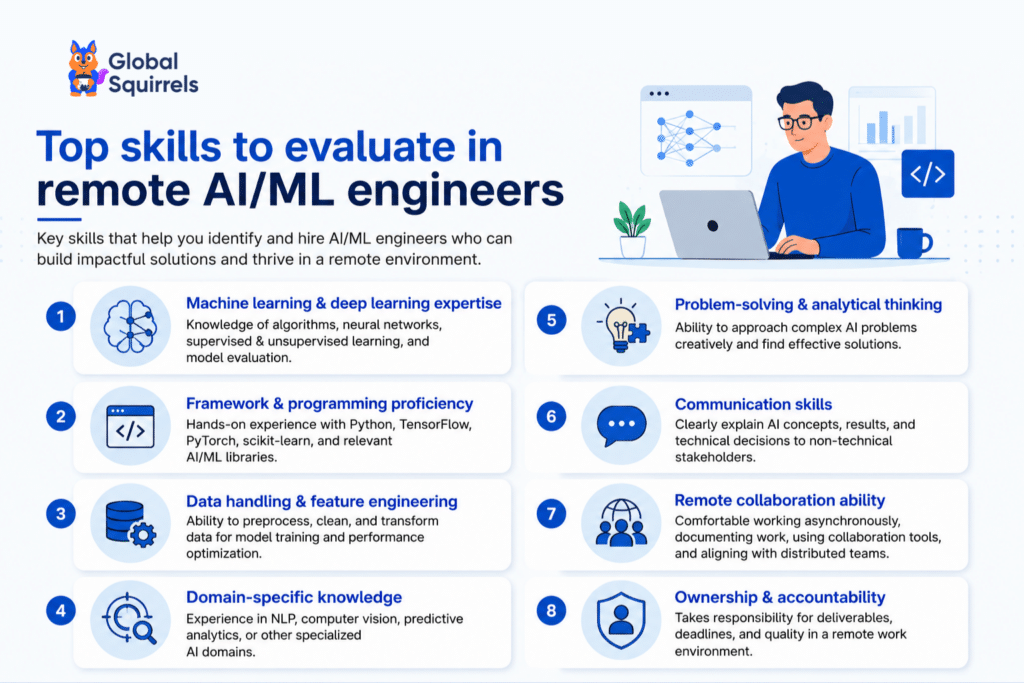
How companies can build a better process to hire an AI/ML engineer
Hiring an AI/ML engineer will require you to follow a structured approach that will go beyond traditional recruitment. By following a well-established process, you can easily attract the right talent, ensure skill alignment, and set up teams for remote functioning. A step-by-step guide is given below:
1. Define the objective of your business in detail
Prior to writing a job description, you should clearly define the goals of your business for the AI/ML project. Identify the problems that the teams should work on, which KPIs will have maximum impact, and how the success of the talent will be measured. Having clear objectives in place will ensure that you attract candidates who are aligned with your vision.
2. Identify the technical requirements
You can outline the primary technical skills required for the role. This should include frameworks, programming languages, and domain expertise. You should also specify the level of experience your business needs and clarify project-specific tasks. This can include NLP, computer vision, or model deployment.
3. Carry out screening to assess communication
Technical skills by themselves are not going to be enough for a remote AI/ML engineer. You should assess a candidate’s ability to communicate complicated ideas clearly. Try including scenario-based questions or mock discussions to evaluate their communication skills in detail. Most businesses partner with AI staffing solutions since it is more reliable and time-saving. If you are sourcing talent overseas, explore our dedicated guide on hiring AI and ML developers from India for deep insights into local tech ecosystems and candidate screening.
4. Conduct practical assessments
Evaluating portfolios and resumes is just a small part of the process. Use coding challenges, hands-on tests, or mini projects that will simulate a real-world task. Review previous projects that involve AI/ML frameworks like TensorFlow, PyTorch, and NLP to validate expertise.
5. Check for remote collaboration skills
You must hire someone who can perform from a remote location. You can evaluate your candidates on communication, documentation practices, tool familiarity, and their ability to work independently. This will ensure a smooth integration of everyone into distributed teams.
How to overcome these remote AI/ML hiring challenges with Global Squirrels
Global Squirrels is a staffing and EOR platform that will source, screen, hire, and onboard AI/ML engineers from top countries like India, Mexico, and the Philippines, giving tech leaders a scalable framework for managing global AI teams. Moreover, we provide all the necessary administrative support, which includes processing payroll and staying compliant with varying labor laws. Additionally, we have built-in remote talent management tools like multi-country timesheets, leave management, and SquirrelTracker to ensure your remote hires are aligned with the goals of your business. Below is how Global Squirrels will help overcome the challenges stated above:
1. Handle worker classification
Global Squirrels will classify your hires accurately. Additionally, we also handle benefits, payroll, and tax obligations. This tends to significantly reduce any risks associated with misclassification, thus ensuring regulatory compliance and allowing companies to focus on handling their teams effectively.
2. Payroll processing and compliance
Every country has a varying set of employment laws. These laws include contracts, termination policies, and working conditions. At Global Squirrels, we ensure that your business will comply with all the local labor laws. This significantly reduces any risk of legal disputes and penalties.
3. Performance monitoring ability
One of the most common issues with handling remote talent is the lack of visibility into their performance and tasks. You can easily assign a one-time or recurring task to your remote AI/ML engineer. As a manager or an employer, you can evaluate the status of the task. This will ensure accountability and transparency.
How does our platform work?
Depending on your business needs, you can pick from the multiple plans offered by Global Squirrels. Whether you want to hire talent from top countries like India, the Philippines, or Mexico, or you want to onboard a candidate you have already sourced, you can rely on Global Squirrels to handle the entire process seamlessly.
This includes sourcing, screening, onboarding, payrolling, and taking care of the benefits. You will also be able to track your remote talent using our built-in tools for performance tracking, timesheets, and task tracking.
Request a demo to understand how we can help your business hire an AI/ML engineer from across the border.
Conclusion
Hiring a remote AI/ML engineer comes with a unique set of challenges like compliance risks, unclear expectations, etc. By defining your requirements clearly, assessing the technical and soft skills of the candidates, using practical evaluations, and ensuring remote readiness, your company can build a high-performing team that will deliver results quickly. A structured approach will ensure better hires, quick onboarding, and long-term success.
FAQs
1. What are the most common mistakes companies make when hiring remote AI/ML engineers?
The top mistakes include unclear role definitions, focusing only on technical skills, weak screening processes, ignoring remote work readiness, and overlooking global compliance and payroll requirements.
2. How can I screen AI/ML candidates effectively?
Use a combination of resume reviews, portfolio evaluations, live coding or modeling exercises, and project discussions. Practical assessments that simulate real-world tasks are essential.
3. What challenges come with hiring AI/ML engineers remotely?
Common challenges include managing time-zone differences, ensuring smooth communication, verifying technical competence, and maintaining team alignment without in-person supervision.
4. How does Global Squirrels simplify remote team management?
The platform provides tools for timesheets, task tracking, performance monitoring, and reporting, helping managers stay on top of remote AI/ML engineers’ productivity.
5. How does Global Squirrels ensure candidates are technically qualified?
Global Squirrels screens candidates, analyzes portfolios, tests live problem-solving, conducts practical assessments, and reviews previous AI/ML projects to ensure skill alignment with your business needs.
