
Questions you should ask an EOR provider before signing a contract

Choosing an Employer of Record or EOR provider is a crucial decision for businesses that are planning to hire employees internationally. Although an EOR can simplify global hiring, payroll, benefits, and employment compliance, remember that not all providers offer the same level of service, pricing transparency, or local expertise.
Before signing a contract, businesses should look beyond monthly service fees and understand how the EOR provider will handle legal responsibilities, employee onboarding, payroll accuracy, data security, and contract termination. Asking the right questions early will help prevent unexpected costs, compliance risks, and operational challenges.
In this blog, we will explore the key questions to ask an EOR provider before signing a contract to help you make an informed decision and choose a partner that supports your international hiring goals.
Why is evaluating an EOR provider important before signing a contract?
The right Employer of Record provider will help with more than making administrative decisions. They directly affect how your business will handle international employees, payroll, compliance, and employment costs. While an EOR can help in simplifying a lot of processes, selecting the wrong provider can expose your business to various unexpected expenses, legal complications, and operational interruptions.
Analyzing an EOR provider before signing a contract will help businesses in the following:
- Reduce compliance risks: Verify that the provider will understand the local labor laws, employment regulations, statutory benefits, and tax obligations in the countries from which you wish to hire.
- Avoid any unexpected costs: Understand the complete pricing structure. This includes service fees, payroll charges, deposits, and potential termination costs.
- Ensure accurate payroll management: Assess how the provider will handle salary payments, tax deductions, statutory contributions, and payroll reporting.
- Protect employee experience: Review the onboarding processes, benefits administration, employee support, and issue resolution processes.
- Maintain contract-based flexibility: Understand the minimum commitments, notice periods, employee transfer options, and contract resolution conditions.
Questions to ask an EOR provider before signing a contract
Before partnering with an Employer of Record provider, businesses should carefully analyze the provider’s capabilities, pricing structure, compliance expertise, and contract-related obligations. Although EOR providers will simplify international employment, their services, country coverage, and employment management processes can change significantly.
The 15 questions given below will help in assessing if an EOR provider can meet your international hiring requirements while also reducing potential risks and unexpected costs.
1. In which countries can you legally employ workers?
Confirm whether the Employer of Record services can help with legally hiring and managing employees in your target countries through their own registered legal entities or trusted local partners. You should check the provider’s geographical coverage and experience in handling country-specific employment regulations. For example, businesses planning to hire in India should understand how an Employer of Record in India supports local hiring and compliance requirements. It is also quite important to understand if they have the required licenses and registrations to function in those countries.
2. How do you ensure compliance with the local labor laws?
Ask how the provider will ensure compliance with local employment laws. This includes employment contracts, minimum wage requirements, working hours, overtime regulations, and statutory employee benefits. A reliable Employer of Record should constantly monitor changes in labor laws and update employment policies accordingly. Understand whether they have dedicated local legal and HR experts who can address country-specific compliance requirements. You should also check how they can handle mandatory registrations, employee classifications, and government reporting obligations.
3. What is included in the EOR pricing?
Request a detailed breakdown of the Employer of Record pricing structure to clearly understand exactly what is covered within the service fees. This will include employee payroll processing, employer contributions, benefits administration, employment contract management, and ongoing HR support. Ask if the provider charges a fixed monthly fee per employee or uses a percentage-dependent pricing model. It is also important to clarify if statutory taxes, insurance contributions, and compliance-related expenses are included or billed separately.
4. Are there any fees or additional charges?
Before signing an agreement, ask the Employer of Record provider about any extra fees that might not be included in the standard pricing package. These can include employee onboarding charges, refundable security deposits, currency conversion fees, contract amendment costs, and employee offboarding expenses. Some providers might also charge extra for certain HR assistance, benefits customization, or urgent payroll processing.
5. Who is responsible for payroll processing and tax compliance?
Clarify whether the Employer of Record provider will take complete responsibility for processing employee salaries, calculating tax deductions, and handling statutory contributions in each country. You can also ask how they ensure on-time salary payments, accurate payslip generation, and compliance with local payroll reporting requirements. You can also understand how the provider will handle income tax withholding, social security payments, and other mandatory employer contributions. Check whether they use automated payroll systems and have processes to identify and correct payroll errors.
6. How are employee benefits and statutory entitlements handled?
Understand how the Employer of Record services handle mandatory employee benefits and statutory entitlements as per the labor laws of every country. These might also include paid annual leave, sick leave, maternity and paternity benefits, health insurance, retirement contributions, and other legally required benefits. Ask if the provider also offers optional benefits like supplementary health coverage, wellness programs, or additional retirement plans.
7. What does the employee onboarding process look like?
Review the Employer of Record provider’s employee onboarding process to understand how quickly new hires can start working in their countries. Ask if the timelines involved in preparing employment contracts, completing identity verification, collecting required documentation, and registering employees for payroll and statutory benefits. You can also find out if the provider offers a digital onboarding platform to simplify document submission and employee communication.
8. How do you protect employee data and confidential business-related data?
Evaluate the provider’s approach to safeguarding sensitive employee data and confidential business data via the employment relationship. Ask about the security measures they tend to use. This includes data encryption, secure storage systems, access controls, and confidentiality agreements. It is also important to understand if they comply with applicable data protection regulations like the GDPR and relevant local privacy laws. Check how employee records are collected, processed, stored, and shared with authorized third parties.
9. What level of HR support and employee assistance does the EOR provider offer?
Understand the level of ongoing HR support provided by the Employer of Record to make sure your international employees receive on-time assistance with their employment. Ask if the provider offers dedicated HR representatives who can address employee concerns, payroll inquiries, benefits-related questions, and workplace issues. It is also important to understand their communication channels, response times, and availability across multiple time zones. Check if they provide local-language support and guidance on country-specific employment practices.
10. What happens if the employee resigns or has to be terminated?
Ask the Employer of Record provider how they handle employee resignations, contract terminations, and other offboarding situations while complying with local labor laws. Understand the applicable notice periods, severance pay requirements, final salary settlements, and statutory obligations in every country. You should also clarify if the provider helps with preparing termination documentation, conducting exit formalities, and resolving potential employee disputes. Check if there are additional charges for employee offboarding, early contract termination, or legal assistance.
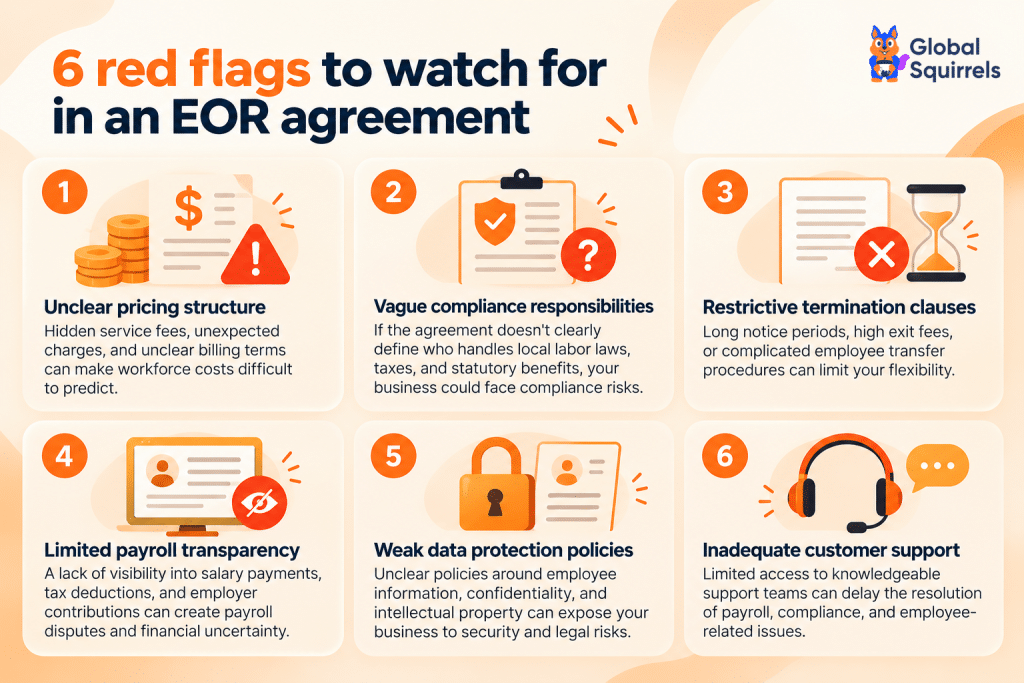
What should you review in an EOR contract before signing?
Before signing an EOR contract, businesses should carefully review the agreement to understand the financial commitments, legal responsibilities, and employment obligations. A well-defined contract will help prevent any unexpected expenses, compliance issues, and misunderstandings between the business and the EOR provider.
Some of the key elements to review in an EOR contract include:
| Contract element | What you should review |
| Pricing and payment terms | Verify service fees, billing cycles, currency conversion charges, deposits, and additional costs. |
| Employment responsibilities | Clarify the responsibilities of the EOR and your business regarding employee management and legal obligations. |
| Compliance and liability | Review how the provider handles local labor laws, statutory requirements, legal risks, and liability allocation. |
| Payroll and taxes | Confirm payroll schedules, tax withholding, statutory contributions, and reporting responsibilities. |
| Employee benefits | Check mandatory benefits, leave entitlements, insurance coverage, and associated costs. |
| Intellectual property rights | Ensure the agreement addresses IP ownership, confidentiality, and protection of business information. |
| Data protection | Review data security measures, privacy obligations, and employee information handling procedures. |
Pay special attention to clauses that cover liability, extra fees, and contract termination. These can massively affect the business if employment requirements tend to change.
How Global Squirrels helps businesses simplify international hiring
Hiring talent internationally does not mean dealing with a complicated payroll process, unexpected costs, and compliance-related challenges. Global Squirrels EOR services will simplify the process of international hiring by assisting businesses in handling their global workforce using one centralized platform.
1. Simplifies payroll management
Handle employee and contractor payments across multiple countries through a centralized platform. This reduces administrative work and payroll-related complications.
2. Local compliance support
Global Squirrels navigates country-specific labour laws, employment-related regulations, and payroll requirements with compliance support, which helps reduce hiring risks.
3. Transparent billing
Upon partnering with Global Squirrels, you can get clear visibility into payroll expenses, service fees, and workforce costs with transparent billing and no hidden charges.
How do we work
Global Squirrels has various plans that can match your business needs. If you want to find qualified remote talent or onboard someone who has already been selected from Mexico, India, or the Philippines, our platform will help support the complete process. We also help with sourcing, interviews, onboarding, payroll, and benefits. Moreover, you can manage your remote talent using built-in tools for timesheets, tracking tasks, and performance management.
Request a demo to understand how Global Squirrels will help in hiring remote talent.
Conclusion
Choosing the right Employer of Record provider is important for hiring internationally successfully. Before signing a contract, businesses should properly analyze the provider’s compliance expertise, payroll management, pricing transparency, employee benefits, and contract terms. Asking the correct questions will help reduce risks, avoid unexpected costs, and ensure a smooth workforce operation. Global Squirrels simplifies international hiring with streamlined payroll management, local compliance support, and transparent billing
Frequently asked questions
1. What should I ask an EOR provider before signing a contract?
Before signing an Employer of Record (EOR) contract, ask about the provider’s country coverage, compliance expertise, payroll processes, employee benefits, service fees, contract termination policies, and customer support. Understanding these details helps you choose a provider that meets your international hiring needs.
2. What are the most important terms to review in an EOR contract?
Review the service agreement, pricing structure, payment terms, employee termination procedures, liability clauses, intellectual property protection, data security policies, and responsibilities of both parties. Make sure the contract clearly outlines how employment-related obligations are handled.
3. Are there any hidden fees associated with EOR services?
EOR pricing structures vary by provider. Some may charge additional fees for onboarding, offboarding, benefits administration, currency conversion, or contract termination. Before signing, request a detailed breakdown of all service charges and potential additional costs.
4. How does Global Squirrels simplify international hiring?
Global Squirrels helps businesses hire and manage international employees through a centralized platform. It simplifies payroll administration, supports compliance with local employment requirements, and provides transparent billing, helping businesses reduce administrative complexity when expanding internationally.
5. What should businesses ask Global Squirrels before signing an EOR agreement?
Businesses should confirm the supported hiring countries, total employment costs, service fees, onboarding requirements, payroll schedules, compliance responsibilities, and termination conditions. They should also request a detailed explanation of the EOR service agreement to ensure it aligns with their hiring plans.