
Data protection & privacy in cross-border employment
Cross-border employment is lately becoming a new normal. Companies are hiring talent from multiple countries to access specialized skills, reduce costs, and expand their operations. With work extending beyond borders, the flow of employee data improves. This raises important challenges for data protection in cross-border employment.
Managing sensitive employee data across jurisdictions involves navigating a maze of global regulations. Every region enforces certain standards on how data should be collected, stored, transferred, and processed.
For businesses that operate internationally, understanding these frameworks is not just a legal necessity; it is a foundation to build trust, compliance, and transparency in global hiring. In this blog, we have explored the key principles of data protection that shape global hiring, the privacy risks companies should mitigate, and best practices to ensure compliant and secure global workforce management.
Understanding data protection in global hiring
Cross-border employment refers to the practice of hiring and managing employees who live and work in different countries from where the company is located. With the growth of remote work and digital collaboration tools, businesses can build globally distributed teams more easily than ever. This approach will allow organizations to access diverse talent pools, operate across time zones, and stay competitive in an increasingly interconnected economy.
At its core, cross-border employment blurs traditional workforce boundaries. A company based in the United States can consider employing developers in India, designers in the Philippines, and accountants in Mexico, all contributing seamlessly to the same business’s goals. However, this flexibility also introduces layers of complexity around tax obligations, labor laws, payroll management, and data privacy regulations, making global workforce management significantly more challenging.
Cross-border employment allows businesses to expand internationally; however, their success depends on how well they handle the technological, cultural, and regulatory challenges that come with managing a global workforce.
The risks to data security & privacy in cross-border employment
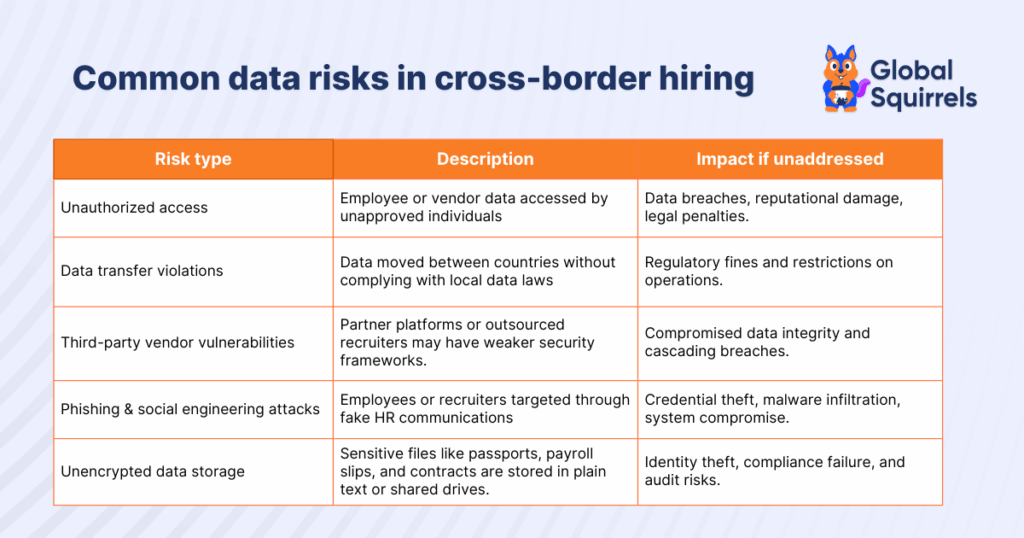
As companies expand their global workforces, managing employee data across borders introduces various privacy and security risks. Some of the key challenges organizations should be aware of include:
1. Inconsistent global data protection laws
- Every country tends to enforce certain data protection standards.
- These inconsistencies complicate data compliance. They require companies to adapt policies to every jurisdiction.
- Non-compliance results in hefty fines, reputational harm, and legal disputes.
2. Risks in data transfer and storage
- Employee data often travels across multiple servers in different regions.
- Some countries tend to lack strong data privacy frameworks. This increases exposure to misuse and unauthorized access.
- Lack of visibility into where and how data is stored can violate local data sovereignty rules.
3. Vulnerabilities in cybersecurity
- Remote teams rely massively on cloud platforms, online collaboration apps, and file-sharing tools.
- Every digital tool adds potential points of failure that hackers can exploit
- A single negative account can result in data breaches that would impact multiple countries.
4. Vendor risks
- Global employment requires third-party payroll, HR tech vendors, and background verification services.
- If these partners fail to meet strict security standards, sensitive employee data could be exposed.
- Companies remain legally responsible for data breaches that are caused by their vendors.
5. Insider threats and human error
- Employees accessing sensitive data from unsecured or personal devices can result in data leaks.
- Phishing scams, weak passwords, and improper file sharing are familiar sources of breaches.
- Insider misuse or negligence is often the leading cause of data security incidents worldwide.
Cross-border employee data privacy is a major concern due to the complexity of managing employee information across multiple legal and technological environments. Businesses must make significant investments worldwide in cybersecurity infrastructure, robust data governance, tech-enabled data compliance, and employee training to foster confidence and reduce regulatory risks.
With rising cross-border data risks, organizations increasingly hire cybersecurity professionals to secure global employee records. The right talent strengthens compliance, prevents breaches, and supports seamless global hiring.
Navigating the complex legal and regulatory landscape
As nations strengthen their data protection laws, the global legal landscape for data security in cross-border employment is becoming increasingly complex. Understanding these regulatory frameworks is essential for businesses engaging in cross-border employment to remain compliant and avoid costly infractions.
1. India – Digital Personal Data Protection Act, 2023
- India’s new DPDP Act governs the processing, collection, and storage of personal data, both domestically and internationally.
- It introduces principles like purpose limitation, data accuracy, and consent-based processing.
- Cross-border data transfers are subject to government-approved countries or entities, which makes compliance crucial for foreign employers hiring talent in India.
2. Latin America
- Nations like Mexico have developed privacy laws modeled on which reinforce employee rights and data transfer controls.
- In these regions, companies should appoint a local data representative or an EOR and establish clear mechanisms for international data transfers.
3. Philippines – Data Privacy Act of 2012
- Overseen by the National Privacy Commission (NPC), this law ensures that personal data is processed and collected fairly, securely, and lawfully.
- It mandates data subject rights, including access, correction, and the right to object to processing.
- Cross-border data transfers are allowed only if the receiving country provides adequate protection or if explicit consent is obtained.
- Companies should appoint a Data Protection Officer (DPO) and implement organizational, physical, and technical measures to safeguard employee data.
Best practices for cross-border employee data privacy
Safeguarding employee information in cross-border employment requires more than just compliance; it demands a proactive, standardized approach. Companies should establish secure systems, enforce consistent global policies, and thus ensure all stakeholders handle data responsibly.
Some of the key practices that protect data and maintain compliance across jurisdictions:
1. Implement strong data governance policies
- Develop a centralized data protection framework that applies to all countries of operation.
- Define clear policies on how employee data is collected, stored, processed, shared, and disposed of.
- Regularly review and update data management protocols to align with constantly evolving regulations such as CCPA and PDPA.
2. Adopt the principle of data minimalization
- Collect only the necessary information for employment-related purposes.
- Avoid storing redundant or outdated information to reduce exposure in case of a breach
- Establish automatic data retention and deletion policies for inactive records or ex-employees.
3. Use secure data transfer mechanisms
- When sharing or storing data across borders, use encrypted channels to protect data in transit.
- Implement data processing agreements with third-party vendors handling sensitive employee data.
- Verify that all data transfers comply with regional regulations.
4. Train stakeholders and employees
- Conduct regular data privacy and cybersecurity training for remote employees, HR teams, and third-party partners.
- Educate staff about recognizing phishing attempts, using strong passwords, and securing personal devices.
- Promote a “privacy-first” culture that makes data protection a shared responsibility across the organization.
Final words
The shift toward a borderless workforce offers unparalleled opportunities for innovation and growth, but it also places a significant responsibility on modern employers. As we’ve seen, managing cross-border data isn’t just a legal exercise; it is a critical component of operational resilience and brand reputation.
From the stringent requirements of India’s DPDP Act to the evolving frameworks in Latin America and the Philippines, the message for businesses is clear: Compliance must be proactive, not reactive. By adopting a privacy-by-design mindset, prioritizing data minimization, secure encryption, and continuous employee training, organizations can transform data protection from a hurdle into a competitive advantage.
Ultimately, the most successful global companies will be those that view data privacy as a bridge rather than a barrier. When employees trust that their personal information is secure, regardless of where they reside, businesses can focus on what truly matters: fostering a high-performing, unified global team.
