
How an Employer of Record simplifies hiring in Canada

Canada is a top choice for companies seeking to hire teams from other regions to improve operational efficiency. The time zone overlap with the US is one of the main causes of this. Although this alignment will undoubtedly facilitate communication, Canada is an excellent option for creating remote teams, given its highly educated workforce, labor laws, and stable economic climate.
An Employer of Record (EOR) will support hiring in Canada swiftly and legally, without establishing a local entity. It is a third-party organization that will legally employ workers on behalf of your company. The EOR will handle responsibilities like payroll, tax compliance, employee benefits, and employment contracts, while you can oversee the primary tasks.
In this blog, we will discuss employment contracts, benefits packages, payroll, employment insurance, severance compensation, and how EORs will operate in Canada. You can confidently expand your staff in this way.
Important things to consider before you hire talent in Canada
Often, companies get overwhelmed by areas like labor laws, taxes, and other regulations when hiring professionals in Canada. Many have faced consequences for non-compliance with the law, including penalties, lawsuits, reputational damage, and more. Here are the most important laws and regulations you should consider before hiring someone here.
1. Canadian labor laws
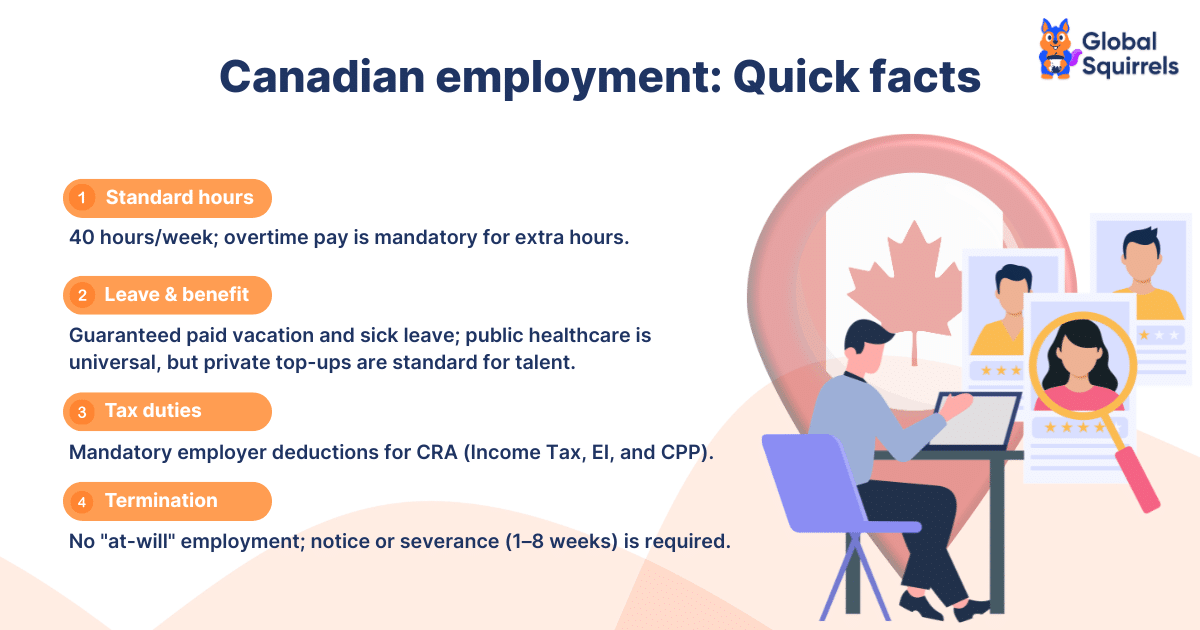
Canada has strict employment standards that your business is required to follow. This includes minimum wages, overtime pay, and working hours. If you fail to comply with these regulations, you may face penalties and damage your company’s reputation.
Some of the most crucial aspects of employment standards in Canada include the following:
- Minimum wage: This varies depending on the province, but usually ranges from USD 11.02/hour to USD 13.18/hour.
- Working hours: The standard number of working hours in Canada is 40 hours per week. In some provinces, it can go up to 48 hours.
- Overtime pay: Employees in Canada must receive overtime pay for work beyond the regular hours.
- Entitlement to paid leave: Employees are entitled to various types of paid leave, including sick leave, vacation leave, and paternity or maternity leave.
Need to know more about leave policies check our blog leave policies in canada.
2. Employment contracts
The terms and conditions of employment, including benefits, termination provisions, confidentiality agreements, probationary periods, remuneration, and more, are meant to be summarized in these contracts. When drafting these contracts, it is crucial to have a solid grasp of Canadian employment laws to ensure they comply with all applicable rules.
3. Tax compliance
Employers are bound by Canada’s complex tax structure when recruiting new workers, just as they are in most other nations. Thus, you must pay the Canada Revenue Agency (CRA) after deducting income taxes, employment insurance, and Canada Pension Plan payments from workers’ earnings.
4. Benefits and healthcare
Unlike the US, Canada has a funded healthcare system that covers all Canadian citizens. However, there are certain advantages that you should offer to your employees to attract top talent and improve employee satisfaction. These can also include private health insurance, life insurance, dental care, and more.
5. Termination laws
Canada does not have any at-will employment provisions. This implies that when terminating an employee’s contract, employers must provide a fair explanation or sufficient notice. The length of employment and the jurisdiction determine the necessary notice time. Typically, this lasts between one and eight weeks.
How does an EOR help in simplifying hiring in Canada?
Due to regional labor laws, payroll rules, and compliance requirements, hiring workers in Canada can be challenging. By serving as the legal employer and handling all payroll, compliance, and human resources functions, an Employer of Record will streamline this process. This will enable your companies to hire Canadian talent without creating a local organization.
1. Assures compliance with labor laws
As mentioned, Canadian employment and labor laws can be complicated. Using an EOR will help ensure your business stays compliant with all relevant laws and regulations. This will reduce the risk of legal issues and penalties. Compliance with tax requirements is another important aspect that an EOR can assist with, ensuring your business sends the correct amount to the CRA and avoids potential issues with the government.
2. Eliminates entity setup
Establishing an entity in Canada to hire someone is both expensive and time-consuming. There’s a high incorporation and legal expense involved, which can range from USD 11,000 to USD 22,000. Along with this, there are several administration-related costs involved for managing the complex payroll, benefits, and provincial-related labor laws and taxes. With an EOR, you can skip entity setup and the above expenses, as it assumes employer responsibilities for hiring, managing, and paying your talent in Canada. You will only have to pay the monthly costs of hiring an EOR.
3. Improves scalability and flexibility
Using an EOR will allow businesses to scale their operations in Canada without doing any extensive administrative tasks, such as payroll, onboarding, etc. This flexibility will be particularly important for short-term or project-based hires. This can be advantageous if you want to test the Canadian market before committing to anything permanent.
4. Streamlines onboarding and hiring
EORs in Canada can help in streamlining the hiring and onboarding process for your business. This also includes job postings, background checks, candidate screening, and more. Additionally, they will handle the administrative tasks that are associated with onboarding new employees. This includes setting up payroll, benefits, etc.
Learn more: Hire Employees in Canada
Global Squirrels: Your ideal EOR and staffing partner
Attracting remote talent and evaluating their profiles (sourcing) is often a significant challenge for businesses hiring in Canada. While EORs in Canada will usually handle the payroll and compliance, you will still be required to source and recruit candidates by yourself.
Global Squirrels will help in this regard by combining staffing and EOR/payrolling. Our SaaS platform will also help the business build teams in Canada by sourcing candidates that meet your business requirements. We share curated profiles of top talent with you within 2-5 business days for your review. Once you select the appropriate candidate for hire, our platform will handle their onboarding, payroll, HR, administration, and compliance. This will ensure your company builds remote teams efficiently without establishing a local entity in Canada.
Global Squirrels works on a flat fee and transparent pricing model. Unlike other EORs that charge high monthly fees ($599 and above), our platform charges only the payroll costs and a flat fee per hire. This makes us accessible to businesses of all sizes. Also, there are no hidden or additional fees to hire remote talent through our platform. You can view the complete breakdown of the hiring costs upfront on the platform.
Final words
In conclusion, if your company wishes to hire and manage workers in Canada, it can benefit greatly from utilizing an EOR solution. Partnering with an EOR can simplify entering the Canadian market and help your company achieve its remote staffing goals, from ensuring adherence to employment rules and regulations to delivering cost savings and access to top talent.
