
Onboard global teams seamlessly with an EOR partner

Onboarding talent globally can be challenging because each country has its own rules for contracts, payroll, taxation, benefits, and compliance. Managing these processes manually usually slows down hiring, increases risk, and creates inconsistent employee experiences. Partnering with an global employer of record services simplifies these complications by allowing companies to onboard international talent smoothly and legally, without setting up a local establishment.For companies exploring how to onboard international employees efficiently, managing compliance, payroll, and documentation across countries becomes one of the biggest challenges.
How EOR Simplifies Global Employee Onboarding
Global employee onboarding becomes complex when businesses hire across countries without a local legal entity. An Employer of Record (EOR) simplifies global employee onboarding by managing employment contracts, statutory compliance, payroll, and documentation, allowing companies to onboard international employees faster and with reduced risk.
In this blog, we have explored how an EOR streamlines global onboarding, ensures compliance, and helps businesses build unified, high-performing international teams.
The unique challenges of global onboarding
Onboarding a global workforce is significantly more complicated than onboarding local employees. Every country operates under multiple labor laws, compliance standards, tax structures, documentation requirements, and cultural expectations. Without proper systems in place, businesses risk delays, inconsistencies, and compliance errors that can affect operational efficiency and employee experience. Given below are the key challenges companies usually face when onboarding international talent:
1. Navigating multiple employment laws
- Global on boarding starts with understanding the legal requirements of every country. This is where most companies tend to struggle.
- Employment laws vary widely in terms of probation periods, contract formats, working hours, tax obligations, benefits, and protections for employees.
- A process that is legal in one country might be non-compliant in another, making it challenging for HR teams to standardize on-boarding.
- Without proper knowledge of local regulations, companies risk fines, disputes, and legal complications.
2. Country-specific benefits and payroll setup
Setting up payroll across multiple countries requires more than just paying salaries. Businesses should ensure compliance with local tax systems, social security contributions, mandatory insurance, paid leave policies, and statutory benefits. These vary significantly across countries and are updated regularly. Without local expertise, companies can struggle to stay compliant or deliver a smooth payroll experience. This can impact employee satisfaction from day one.
3. Complex documentation requirements
Each country has its own documentation standards and onboarding requirements. This can include local language employment contracts, ID verification, social security registration, tax forms, and country-specific declarations. Managing and verifying these documents across borders becomes complicated very quickly. Missing or incorrect documentation can result in delays, compliance issues, or future legal risks. This is especially true in countries with strict labor enforcement.
4. Differences in cultures
Cultural alignment is one of the most overlooked aspects of global onboarding. Communication styles, meeting etiquette, collaboration habits, and general workspace expectations differ widely across regions. Without a cultural context, new hires might feel disconnected, misaligned, or misunderstood with the company’s work style. This could lead to early frustration, reduced productivity, or poor integration into the team.
Onboarding offshore talent presents unique challenges, and avoiding common pitfalls is crucial for success. Here are some key mistakes to steer clear of:
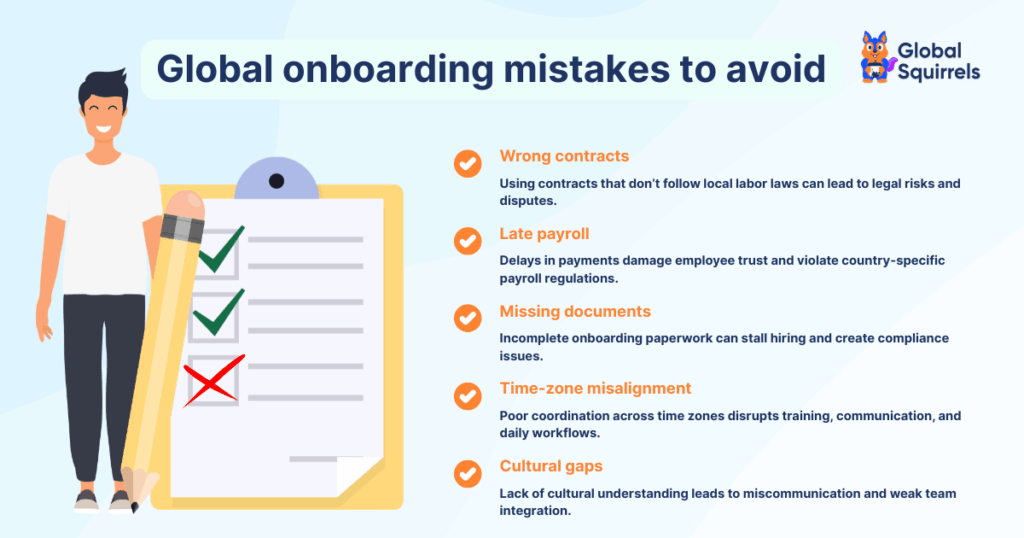
Strategic advantages of global team onboarding with EORs
An Employer of Record (EOR) is a third-party entity that legally hires and manages workers in a country where you do not have a physical presence. The way it works is by assuming the employer’s obligations and handling onboarding, legal compliance, payroll, benefits, and terminations.
EORs act as a powerful extension of your HR and global operations team. When onboarding or managing international employees, an EOR streamlines complex processes, minimizes legal risks, and ensures a smooth experience for both the company and the employee.
Global team onboarding with EORs brings a lot to the table:
1. Complete compliance management
EOR partner ensures that every hire complies with the country’s labor laws, payroll regulations, tax requirements, and statutory benefits. This will eliminate the risk of non-compliance, fines, or legal issues, thus giving companies peace of mind as they expand globally.
2. Employment contracts as per the country
Instead of drafting contracts from scratch, an EOR prepares legal and compliant agreements. These are also locally aligned with the employment rules. These contracts cover mandatory clauses, benefits, working hours, data protection, and intellectual property rights. This reduces your legal burden.
3. Seamless global payroll and benefits administration
The EOR will handle everything related to payroll, including salary disbursements, tax withholdings, social contributions, mandatory benefits, reimbursements, and leave management. This will ensure accurate, on-time payments and eliminate the need for companies to set up local payroll systems for global remote hiring.
4. Quick and efficient onboarding
With established processes and country expertise, EOR partners onboard employees way more quickly than the internal HR teams can. They manage documentation, conduct compliance checks, verify identities, and provide orientation support to help employees get started efficiently.
If you are exploring global growth, don’t miss our guide on why EORs are essential for global expansion.
Best practices for seamless EOR-based onboarding
Onboarding through an Employer of Record can significantly simplify global hiring, but the experience is most effective when companies follow certain best practices. Clear communication, structured processes, and strong coordination with the EOR partner help ensure that every international hire feels supported, informed, and integrated. Understanding how to onboard international employees successfully requires clear processes, strong coordination with an Employer of Record, and country-specific compliance planning.
1. Define the roles, expectations, and documentation clearly
Before the onboarding begins, companies should share the detailed role requirements, KPIs, responsibilities, working hours, and reporting structures with the EOR. Providing clear data helps them prepare compliant contracts, accurate documentation, and a smooth onboarding roadmap tailored to the employee’s location.
2. Align early with the EOR on compliance requirements
Every country has certain rules for contracts, taxes, payroll, and benefits. Establishing early alignment with your EOR partner ensures all legal requirements are being handled efficiently and reduces the risk of delays or missing documents. This also ensures the onboarding timelines are realistic and compliant.
3. Provide clear communication channels and tools
Remote onboarding requires intentional communication. Ensure the employee has access to tools like Slack, Teams, ClickUp, or Jira, or other project management platforms. Share communication expectations, meeting rhythms, and collaboration standards.
4. Maintain close collaboration with the EOR partner
Maintain regular contact with your EOR to monitor onboarding progress, confirm documents, and respond to any initial inquiries from the staff member. This proactive strategy prevents administrative delays and guarantees a seamless transfer.
Final thoughts
When you have an EOR partner handling compliance, payroll, contracts, and country-specific regulations, onboarding international teams doesn’t have to be difficult. The EOR guarantees a uniform, seamless, and legally compliant onboarding process across borders by optimizing each stage. The most effective and risk-free option for businesses to develop a strong global workforce is to collaborate with an EOR.