
How an EOR helps companies hire remote paralegals

Expanding your legal team no longer requires a larger office footprint or a local zip code. Hiring remote paralegals is a transformative move that allows law firms to scale their caseloads while maintaining lean operations. However, the logistics of remote staffing, navigating foreign labor laws, managing global payroll, and avoiding tax pitfalls can quickly become a management nightmare.
This is where an Employer of Record (EOR) becomes your firm’s most valuable partner. An EOR acts as the legal employer on your behalf, managing everything from locally compliant contracts to benefits administration. This allows you to hire a remote paralegal from anywhere in the world without the cost or headache of establishing a foreign legal entity.
In this blog, we’ll explore how an EOR streamlines law firm paralegal staffing and why it is the most efficient path to affordable paralegal hiring today.
What challenges do businesses face with hiring remote paralegals?
Hiring a remote paralegal can offer significant benefits; however, for most businesses, the process has been risky and complicated. Ranging from legal compliance issues to operational inefficiencies, businesses often face multiple challenges that can affect hiring speed and long-term stability.
1. Navigating the complicated labor laws
Every country tends to have its own employment regulations. This also includes rules around contracts, termination, employee rights, and working hours. Without local experience, it will be difficult to ensure your recruitment process aligns with these laws. This increases the risk of non-compliance.
2. Risk of worker misclassification
You can hire a remote paralegal as an independent contractor rather than an employee to ease your business operations; however, this can result in serious legal consequences if the role does not meet contractor criteria. Misclassification can result in back taxes, penalties, and legal disputes.
3. Tax complications and payroll
Handling payroll across multiple countries will involve handling the local currencies, statutory benefits, tax deductions, and reporting requirements. Without a structured system, payroll processing errors can lead to complex issues and employee dissatisfaction.
4. Documentation and contract challenges
Drafting legally compliant employment contracts will require knowledge of local laws and regulations. Missing or incorrect clauses can result in legal issues and complicate the dispute resolution process.
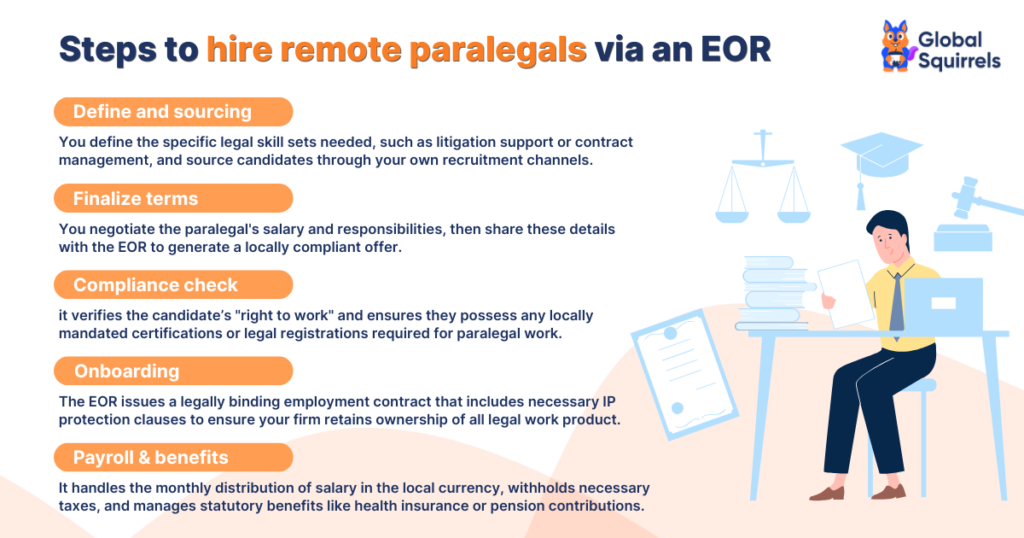
What is an Employer of Record (EOR) and how does it facilitate remote paralegal staffing?
An Employer of Record (EOR) is a third-party organization that assumes much of the responsibility for hiring paralegals remotely. It will provide the necessary support and ensure that the customer remains compliant throughout the process, in accordance with the country’s legal rules and regulations.
Let’s look at how an EOR assists US-based companies in securing remote paralegals from India, the Philippines, and Mexico.
1. Eliminates the need to have an entity
Setting up a legal entity in another country can be time-consuming and expensive, and is often unnecessary for hiring a few remote paralegals. An EOR will enable you to hire remote paralegals in multiple countries without establishing a local presence, allowing for quicker, more flexible expansion.
2. Ensures compliance with the local labor laws
Every country has a varied set of employment regulations, which includes working conditions, contracts, and termination policies. An EOR will ensure that all the employment practices comply with local labor laws, thus reducing the risk of legal disputes or penalties.
3. Handles payroll and tax obligations
Handling payroll across borders will involve currency management, tax deductions, statutory benefits, and reporting requirements. An EOR will handle payroll processing and ensure accurate, on-time payments for paralegals while staying compliant with local tax laws.
4. Reduce the administrative burden
HR tasks like employee management, compliance tracking, and benefits administration can get resources dependent. By handling these responsibilities, an EOR will reduce the workload on your internal teams, thus allowing them to focus on core legal operations.
5. Minimizes the legal and financial risks
Compliance errors in remote paralegal hiring can result in penalties, financial losses, and disputes. An EOR will mitigate these risks by ensuring that all employment contracts, practices, and payments are handled appropriately.
How much does it cost to hire a remote paralegal?
Regions such as India, the Philippines, and Mexico stand out for their strong legal talent pools, enabling affordable paralegal hiring and seamless collaboration.
1. India
Most law firms looking to staff remote paralegals often choose India, as the country has a huge pool of legally trained professionals with strong expertise in documentation, contract management, and legal research. Indian paralegals are a great fit for US-based firms because many of them are knowledgeable about common law systems. The average cost to hire a remote paralegal from India is $4,250-$6,376 per year.
2. Philippines
The Philippines is known for its highly skilled and English-speaking workforce and strong cultural alignment with Western countries. Paralegals in the Philippines are especially effective in documentation, client communication, and administrative support. They are familiar with US legal processes and can work across overlapping time zones, making them a reliable choice for law firms seeking consistent support. The average cost of hiring a remote paralegal from the Philippines is typically $5,760-$10,440 per year. But what factors actually influence this cost, and how much can you realistically save? Read the full cost and benefits breakdown here.
3. Mexico
Mexico is becoming increasingly popular for hiring remote paralegals, especially for US based firms. The biggest advantage is alignment with the time zone, which allows real-time collaboration with in-house teams. Multiple professionals in this region are bilingual, which is especially valuable for firms handling diverse client bases. The average cost to hire a remote paralegal from Mexico is typically between $12,096 and $19,488 per year.
Source: Glassdoor
Conclusion
There are many benefits to hiring remote paralegals worldwide, but it can easily get complicated and dangerous without the proper framework. By managing compliance, payroll, and legal obligations, an Employer of Record (EOR) streamlines this process and frees enterprises to focus on growth and productivity rather than administrative burdens.
An EOR makes remote hiring quicker, safer, and more scalable by eliminating the need to create a local business and guaranteeing that each hire complies with local laws. Using an EOR is more than a convenience for businesses seeking to build effective legal teams free from operational obstacles; it’s a tactical advantage.
