
5 mistakes companies make when hiring SDRs remotely (and how to avoid)

Remote hiring has made it easier than ever to build a global sales team, and Sales Development Representatives (SDRs) will play an important role in driving growth and revenue. However, hiring SDRs remotely is not always as simple and straightforward as it seems. Various companies will rush into this process or overlook key factors, thus leading to poor performance, missed opportunities, and wasted resources.
In this blog, we will break down the most common SDR hiring mistakes that your company can make and how you can avoid them to build a high-performing and results-driven sales team.
5 common mistakes companies make when hiring remote SDRs
Hiring a remote Sales Development Representative can massively boost your company’s sales pipeline; however, it should be done right. Various companies will assume that finding that a SDR remotely is just about sourcing candidates; however, the reality is far different. Without any clear strategy, businesses usually end up with poor performance, low conversion rates, and wasted resources.
Given below are the most common SDR hiring errors companies make when hiring a remote SDR:
Mistake 1: Writing vague job descriptions
One common SDR hiring mistake companies make when hiring remotely is failing to write clear job descriptions. In remote roles, everything must be explained at the outset, including required skills, responsibilities, and how performance will be measured. If the job description is vague, it will attract the wrong candidates and waste everyone’s time. A clear and detailed job description will help in attracting the right talent and set clear expectations from the start. It is also important to mention tools, working hours, and reporting structure to avoid confusion later.
Mistake 2: Misclassifying hired staff
To reduce final costs, some companies classify remote workers as independent contractors rather than employees; however, worker classification is governed by strict legal guidelines that vary by location. Misclassification occurs when someone is labeled as a contractor but works like an employee by following fixed hours, using company tools, and being fully integrated into the business. This can result in serious consequences, which include legal penalties, fines, back taxes, and claims for unpaid wages, benefits, or overtime. In many cases, workers can demand compensation for missed benefits such as paid leave or insurance, making it a costly mistake for businesses that fail to properly assess classification from the start.
Mistake 3: Hiring based on a resume and not real sales ability
Multiple companies will make the mistake of hiring an SDR based purely on resumes rather than on actual sales ability. A polished resume will not guarantee performance, yet an organization can often prioritize years of experience, well-known company names, or a general sales background. In reality, the success of SDR depends far more on practical skills such as strong communication, effective objection handling, consistent prospecting, and the ability to maintain outreach discipline over time. Many businesses do not see the need for an SDR to conduct practical sales assessments, and thus fail to evaluate candidates’ written communication skills during the hiring process.
Mistake 4: Weak onboarding and training
Weak onboarding and training are other major mistakes companies make when hiring a remote SDR. Hiring great talent is just one part of the job; however, without proper onboarding, even the best SDRs can struggle to perform. Various organizations fail to provide important support, such as product training, a clear messaging framework, or structured outreach playbooks. To avoid this, you should build a structured onboarding system that includes in-depth product knowledge, a clear understanding of the ICP, proven scripts, and training in objection handling to set SDRs up for success from day one.
Mistake 5: No Performance Tracking or KPIs
Lack of performance tracking and clear KPIs is a huge mistake when hiring a remote SDR. Without predefined metrics, it will be extremely difficult to understand what is working and where improvements are needed. Companies often rely on metrics like email and call volume without measuring actual outcomes such as meeting bookings or conversion rates. This further results in poor visibility, low accountability, and inconsistent pipeline growth. To avoid this, you should establish clear KPIs from the outset and use tools such as CRM systems and dashboards to track performance regularly. Monitoring the right metrics ensures better decision-making and helps build a results-driven SDR team. SDR recruitment mistakes often lead to poor performance and missed revenue opportunities.
Best practices for building your high-performing remote SDR team
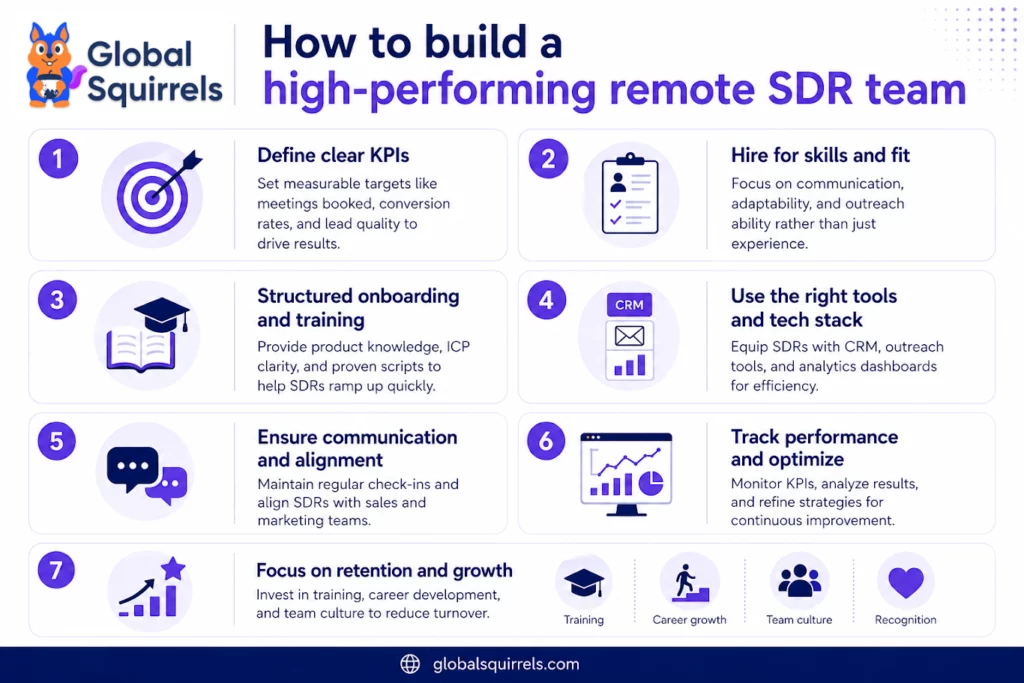
Building a high-performance remote SDR team requires much more than just hiring the right talent. It will involve establishing clear goals, using the right tools, and creating a structured system that will drive consistent results. With the right approach, businesses can build a scalable, results-driven, and efficient remote sales team. Following SDR hiring best practices helps companies build a high-performing and scalable sales team. You can build high-performance SDR teams by:
1.Establish clear KPIs for the SDR teams
Maintaining and building a successful SDR team begins with setting the right KPIs. To do this efficiently, you will need to consider which areas of the business will have the greatest impact. KPIs are important for helping management quantify and objectively evaluate each team member’s performance against benchmark targets.
2.Handling high staff turnover
It’s no secret that telemarketing and sales roles often experience higher staff turnover than other industries. This constant cycle of onboarding new hires can strain the rest of the team, who are left juggling their own targets while coaching new colleagues. To tackle this challenge, you have to make significant investments in recruitment, company culture, and staff retention. Quality training plays a huge part in attracting talent to specialist industries, creating a need for an ongoing learning and development program to ensure SDRs stay up to date with industry changes and insights.
3.Structured training and onboarding
Provide clear onboarding with product knowledge, a detailed understanding of the ICP, and messaging guidelines. Share proven scripts, call frameworks, and objection handling techniques so your SDRs know exactly how to approach prospects. A well-defined process will help them ramp up quickly and start generating results quickly.
4.Using the right tools and tech stack
Give your SDRs essential tools such as CRM systems, email outreach platforms, analytics dashboards, and call software. The right tech stack will streamline the workflows, improve productivity, and ensure all activities are tracked and optimized efficiently.
5.Ensure strong communication and alignment
Maintain regular check-ins, team syncs, and feedback sessions to keep SDRs aligned with the sales and marketing goals. Clear communication ensures consistent messaging, better collaboration, and quick issue resolution.
This financial services hiring success story demonstrates how hiring the right remote prospecting talent can improve business development efforts while reducing operational costs.
How does Global Squirrels help in hiring a remote SDR?
Hiring a high-performing remote SDR is more than just finding candidates. It involves sourcing the right talent, managing the entire hiring process, and ensuring compliance efficiently. Global Squirrels simplifies this by offering both staffing and Employer of Record (EOR) capabilities on a single platform, helping businesses find, hire, and manage remote SDRs without operational complications.
1.Access to pre-screened talent
Global Squirrels will provide access to a curated pool of skilled SDRs who are evaluated for communication, role fit, and outreach ability. This will reduce the time spent on screening and ensure higher-quality hires.
2.Issues with worker misclassification
As an Employer of Record, Global Squirrels will ensure correct worker classification in line with local laws, handle compliant contracts, manage payroll and statutory requirements, and reduce the risk of audits or legal issues. Instead of navigating complex regulations on their own, businesses can rely on Global Squirrels to hire and manage global talent without risk of misclassification.
3.Hiring talent from regions with overlapping time zones
Sourcing talent from regions with overlapping time zones is a primary driver of real-time collaboration and faster communication. Global Squirrels will help businesses hire from countries such as Mexico, the Philippines, and India, ensuring time zone alignment while efficiently managing sourcing, onboarding, payroll, and compliance. Learn how proper pre-screening led to higher meeting show rates in this consulting firm appointment setter case study.
Whether you’re hunting for top-tier SDRs or need to onboard someone you’ve already found, Global Squirrels offers a range of plans that will handle the heavy lifting. We manage the entire process from sourcing and interviewing management to onboarding, payroll, and benefits. Once they’re on board, our built-in suite of performance tools (task tracking, timesheets, and more) ensures your remote team stays productive and aligned. Book a demo to see how our platform works.
Conclusion
Your sales pipeline can be greatly enhanced by hiring remote SDRs, but only if you use the proper approach. Rather than the talent itself, many of the difficulties businesses encounter stem from unclear expectations, subpar procedures, and a lack of visibility into performance.
Businesses may create a high-performing remote SDR team that consistently delivers results by avoiding these common blunders and focusing on specific objectives, structured onboarding, appropriate tools, and measurable KPIs. A well-managed SDR function is more than just sales support in a cutthroat industry; it’s a major growth engine.
