
How to manage remote SDRs across time zones: A complete guide

Understanding the complexities of leading a global remote team can be quite overwhelming, especially when managing the challenges of different time zones. As businesses shift towards embracing distributed workforces, managers encounter obstacles such as misaligned communication, scheduling conflicts, and reduced team cohesion.
In this blog, we explain the complexities of time zone management, share practical insights, and provide proven techniques to improve productivity and collaboration across dispersed teams. By adopting best practices for managing remote SDR teams, you can foster collaboration, unlock the full potential of a global workforce, and support work-life balance for everyone.
Where do most companies find it challenging when handling offshore SDRs?
As a business owner, you may find the challenges of handling a remote SDR team overwhelming. You are not alone; managing an offshore SDR team is difficult when not approached properly from the very beginning.
Below are the challenges that are quite common among managers dealing with remote teams, who face the uncertainty of remote work.
- Time zone and language barriers lead to communication issues
- Lack of team collaboration
- Differences between members because of work cultures and practices
- Difficulty in coordinating and scheduling meetings
- Connectivity issues and failing technology
- Difficult to maintain accountability and trust
Common mistakes with remote SDR management (and how to address them)
To overcome the above challenges, various leaders will implement traditional management techniques, which can work well for in-office employees but do not always work for remote teams. Some of the common mistakes that you make for remote SDR management include:
1. Neglecting the difference in time zones
Ignoring time zone differences when scheduling meetings or assigning tasks can lead to inconvenience, burnout, and irritation.
2. Not communicating clearly
A lack of clear communication about working hours, availability, and expectations will lead to poor guidance.
3. Sidelining the cultural differences
Various cultural habits, like the length of lunch breaks and communication methods, can be very subtle. Consider these cultural differences to encourage understanding and productivity.
4. Distributing workload unequally
Because managers tend to collaborate directly with team members, this can add unnecessary pressure to individual team members’ workloads and lead to burnout.
5. Improper use of collaboration tools
With multiple HR and management tools available in the market, it is crucial to pick the best tools that fit your team’s needs and ensure they are used appropriately.
6. No initiation towards team building
Even if the entire team isn’t together, organizing a team-building activity will encourage trust among remote team members.
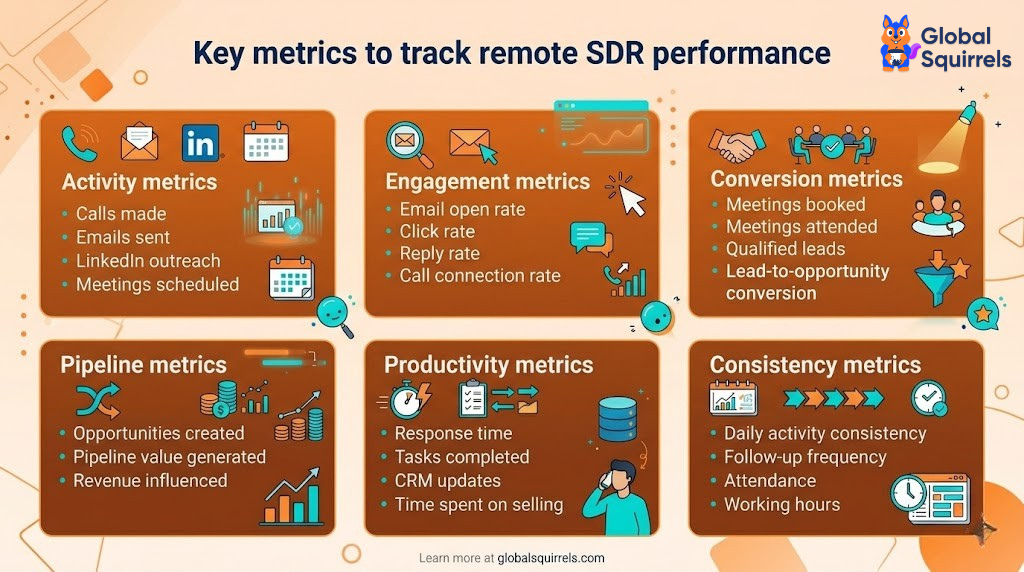
Best practices on how to manage remote SDRs
Navigating remote work across multiple time zones can get extremely challenging. However, it can be easily managed with the right strategies and practices. Below are some best practices you can adopt to streamline the workflow of your remote SDR team across multiple time zones.
1. Establish communication channels clearly
Effective communication is important for successful remote work, especially across various time zones. Using collaboration tools with real-time messaging, document sharing, and project management will help teams stay connected and work efficiently from anywhere in the world.
-
Define preferred methods of communication
Preferred communication methods are the channels your teams will use to communicate efficiently, depending on the situation. However, not every situation will require the same approach. For urgent tasks that need immediate attention, real-time communication, such as video calls or instant messaging, will help teams to respond quickly, even across multiple time zones. For non-urgent tasks, asynchronous communication, such as email, will enable team members to collaborate at their own pace without needing to be available simultaneously.
-
Set clear expectations for response times
Clear response-time expectations will help teams communicate more effectively and work more smoothly, especially across multiple time zones. You should agree on how quickly the team members should respond to different types of communication. This will help everyone to know what to expect and will thus reduce delays or missed deadlines.
2. Create a reference for the time zone
By establishing a shared time zone, teams can collaborate, communicate, and coordinate more efficiently. You should understand how to identify team members’ locations and time zones and establish a master time zone reference for your global SDR workforce.
-
Identify the time zones and locations of the team members
Begin by understanding where the team members are based and the time zones they work in. You can collect this data from every team member and also organize it in a central document or spreadsheet. This will make it easier to reference and help the team plan communication and work schedules more effectively.
-
Establish a master time zone reference
Create a central reference that shows every team member’s location and time zone. You can use a simple spreadsheet, document, or dashboard to keep the data in one place. This includes any daylight saving changes. To make it easier to understand, you can add simple visuals, such as flags or icons, to indicate their locations. This will help the team quickly identify the time zones and improve overall clarity.
3. Schedule meetings and collaborate efficiently
In remote teams, members usually work from different time zones, which can make scheduling meetings quite challenging. To handle this, you can plan meetings carefully, use the right tools, and communicate clearly. Choose time slots that work for most team members and be flexible when required. This approach will help in improving collaboration, keep everyone involved, and ensure meetings are inclusive and productive.
-
Consider the differences in time zones
Time zone differences can make scheduling meetings extremely difficult, especially for global teams. Keep in mind that time zone management for the sales team is very important. Be aware of the team members in different regions and pick meeting times that are reasonable for everyone. Tey to balance schedules so that nobody is consistently inconvenienced. This will help in creating a fair and collaborative work environment.
-
Utilize tools to schedule meetings
Meeting scheduling tools can make it easy to plan and organize meetings within teams. Popular options such as Doodle, Calendly, Google Calendar, and Microsoft Outlook will help in finding suitable time slots quickly. These tools will reduce the need for back-and-forth messages and make scheduling faster and more efficient.
4. Maintain documentation and data sharing
Keeping clear documentation and sharing data effectively are important for a smooth collaboration, especially in remote or hybrid teams.
-
Centralize resources and documents
In a remote work environment, keeping all documents and resources in one place is important for smooth collaboration. Create a central hub where files are organized and easily accessible. This will help team members find information quickly and encourage knowledge sharing. You can also use tools such as cloud storage, project management platforms, or an internal system to keep everything available in one place for the entire team.
-
Use collaboration tools for real-time updates
Collaboration tools can help the teams to stay updated and communicate in real time. Tools such as Slack, Trello, Asana, and Google Workspace make it easy to share updates, handle tasks, and track progress efficiently.
Related blog: Hire remote salesforce developers: key things to know
Conclusion
To overcome the challenges of remote SDR hiring, it is important to apply best practices and tactics and make good use of the necessary resources. We have covered all the strategies you need to efficiently handle remote SDRs across several time zones, as well as the communication platforms you can use. By accepting custom work schedules and demonstrating awareness of time zone differences, you can easily cultivate a culture of adaptability and empathy.
Ultimately, a well-managed global SDR team is more than just a logistical hurdle. This strategic advantage enables your business to maintain a “follow-the-sun” productivity model. As you implement these frameworks, remember that the goal is to create an environment where geographic distance does not dictate the quality of work or the strength of team bonds. By staying committed to clear documentation and inclusive scheduling, you ensure that every team member, wherever they are, feels empowered to drive revenue and grow with the company.
FAQs
1. How can you improve communication in remote SDR teams?
You can improve communication by establishing a clear channel, defining response times, and using collaboration tools for real-time and asynchronous communication, depending on the task’s urgency.
2. How can businesses efficiently build a global SDR team?
Businesses can hire SDRs across regions to ensure consistent coverage and broader market reach. Using staffing platforms, they can simplify the hiring process, compliance, and payroll across countries.
3. How can companies reduce burnout in remote SDR teams?
Avoid scheduling meetings outside reasonable hours, distribute workloads evenly, encourage breaks, and respect time zone differences to maintain work-life balance.
4. Can Global Squirrels help manage remote SDR performance?
Yes. Managing offshore SDRs is significantly easier with Global Squirrels, as the platform provides built-in tools for tracking timesheets, monitoring daily productivity, and managing attendance. There are no additional costs to use these tools.
5. How quickly can I hire remote SDRs using Global Squirrels?
Once you sign up and post a job, you will receive curated profiles of top talent within 2-5 business days. After interviewing them and confirming a hire, our platform will complete the onboarding process in 1-2 business days. This speed, combined with remote SDR best practices and effective time zone management for sales teams, ensures your outreach efforts can scale globally without typical administrative delays.
See this in action: an HVAC company hired a remote sales support specialist through Global Squirrels using this exact process.
