
Leave policy in India – A complete overview

Leave policies in India are primarily governed by the central labor laws. This includes state-specific regulations and company-level policies. Thus, this makes it complicated for both the employers and employees to navigate.
This blog provides a complete overview of leave policies in India. It will also cover statutory leave requirements, key considerations, and commonly followed employer practices. Whether you are managing a local team or hiring talent in India remotely, this blog will help you understand leave rules clearly and avoid compliance-related issues.
Leave policy in India: Quick overview
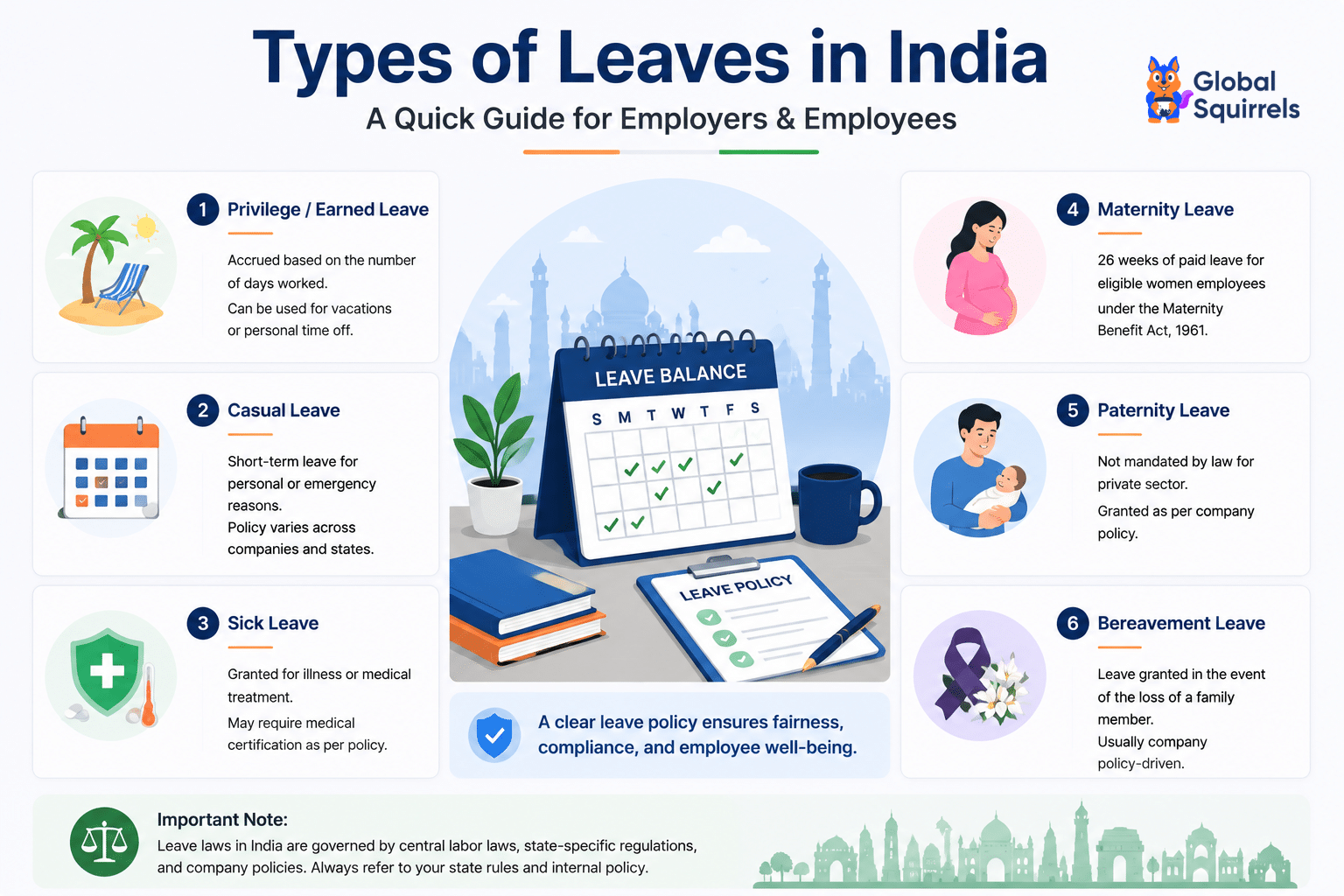
| Leave type | Common practice / statutory basis | Important note |
|---|---|---|
| Earned / Privilege leave | Governed mainly by applicable state laws and establishment rules | Accrual and carry-forward rules vary |
| Casual leave | Often company/state-policy driven | Not uniform across India |
| Sick leave | Depends on state law and company policy | Medical documentation may apply |
| Maternity leave | 26 weeks for eligible employees under Maternity Benefit Act | Applies nationally where the Act applies |
| Paternity leave | Not mandatory for private-sector employees | Depends on employer policy |
| Bereavement leave | Usually company policy-driven | No universal private-sector entitlement |
Why does it matter for your organization?
A leave policy is a formal document formulated by a company or business. It will clearly include the rules, procedures, and entitlements of all types of employee leave policies in India. It also briefly explains when and how workers can take time off for personal reasons, including illness, vacation, maternity or paternity leave, or bereavement. As per Indian labor laws, a clear leave policy should include eligibility conditions, leave encashment, compliance requirements, approval procedures, and carry-forward regulations. By creating a uniform, just, and open framework for handling time-off requests, the company will also demonstrate its culture and dedication to the workers’ well-being.
A well-established employee leave policy in India is essential to ensure fairness, employee well-being, and statutory compliance. This is why every organisation should lay out a structured and transparent leave policy:
1. Mandatory under Indian labour laws
Employees have a legal right to leave, and employers should abide by the rules outlined in the Factories Act and the relevant State Shops and Establishments Acts. A documented leave policy helps ensure full compliance with these legal obligations.
2. Supports employees during life events
Employees usually face personal situations, such as childbirth, illness, caregiving responsibilities, or bereavement, that will require time away from work. A clear leave policy ensures they can take this time without confusion or fear of repercussions.
3. Addresses day-to-day personal needs
Routine activities like family commitments, banking, or administrative tasks also require occasional time off. A structured leave system allows employees to handle these responsibilities without compromising business continuity.
4. Promotes rest and rejuvenation
Paid leave and vacation days encourage employees to disconnect, travel, or unwind. Research consistently shows that periodic breaks improve mental health, boost productivity, and reduce burnout.
5. Enhances trust and transparency
When leave-related rules are communicated and applied accurately, employees form a positive perception of the organisation as professional and fair. This usually builds trust, strengthens the employer brand, and improves workplace morale.
6. Elevates overall engagement and retention
Companies that are employee-friendly and have structured policies usually contribute to higher job satisfaction, long-term retention, and loyalty, thus making them an essential part of modern HR practices.
If you are planning to hire or onboard employees from India this guide will help you to hire employees from India.

What are the types of leaves in India?
Indian employers usually offer a wide range of leave options to support employee well-being and maintain compliance with labor laws. Below are the most common types of leaves in India for private companies, along with how they often work in modern workplaces.
1. Privilege or earned leave
Earned or privileged leaves are usually allotted to employees based on the number of days they have worked for your company. Multiple businesses use a structured system, like one day of leave for every twenty to twenty-three working days. These paid leaves are usually subject to prior approval. The exception is only during emergencies. Many companies also allow employees to carry over or cash out unused earned leave at the end of the financial year.
2. Casual leave
Casual leave is enabled for brief or unexpected personal reasons. This can include taking a quick break, attending an appointment, or caring for a family member. Many companies offer 3 to 7 days of casual leave and it is not uniformly prescribed under one nationwide rule for all private-sector employees. Entitlements vary depending on the applicable state Shops and Establishments Act, industry regulations, and employer policy. Many organizations provide casual leave as part of their internal leave structure.
3. Sick leave
Sick leave enables employees to recover from injury or illness. While state laws differ, most employers provide 5 to 12 sick days every year. These leaves are usually not transferable. Additionally, for prolonged leaves, a medical certificate must be submitted. Under the Employees’ State Insurance Act (ESI), workers making less than ₹21,000 a month are also eligible for sickness benefits.
4. Leave without pay or LWP
The company may offer Leave Without Pay to an employee who has exhausted all their paid leave options but still needs time off. Salary is withheld for the days of absence during LWP. Depending on policy, some employers let future accruals of earned leave offset LWP.
5. Compensatory off (Comp-off)
Employees who work on company-declared holidays or have a weekly day off are qualified for compensatory time off. In exchange, workers receive time off, often equal to or less than the additional hours worked, to preserve work-life balance. Companies have different approval policies and validity periods.
6. Maternity leave
Under the Maternity Benefit (Amendment) Act, 2017, the women employees who are eligible are entitled to:
- For the first two children, they can avail a 26-week period of paid maternity leave.
- From the third child onward, they can get a 12-week period of paid leave.
- Additionally, in the case of adoption or surrogacy, women can get 12 weeks of paid leave.
Apart from the above, women can also avail leave in case of miscarriage, medical termination of pregnancy, or complications such as premature birth. Under this law, a few companies also offer work-from-home flexibility and childcare support. It will entirely depend on the feasibility of the role.
7. Paternity leave
Paternity leave is not a mandatory requirement under the Indian labor law. However, multiple companies, especially those in the private sector, offer new fathers 5 to 15 days of paternity leave. Central government employees are awarded 15 days of paternity leave. Offering this type of leave is increasingly recognized as an inclusive and competitive corporate policy.
8. Marriage leave
Even though this leave is not compulsory as per the law, employers usually offer marriage leave. A vast number of businesses give around three days for marriage. However, depending on the policy, some can also give fifteen days. This leave is often available only to first-time married employees and can be used once during the employment period.
9. Compassionate or bereavement leave
Employees who lose a close family member are allowed to take compassionate leave. For close relatives like parents, siblings, spouses, children, or grandparents, the statutory expectation is typically at least 5 days every year.
10. Annual or privilege leave
Various state laws mandate a minimum of 18 days of annual or privilege leave each year. Organisations might:
- Credit 1.5 days per month, or
- Grant the full 18-day entitlement at the start of the year
This leave category is primarily paid, may be carried forward, and is often eligible for encashment under the company’s rules.
Also read: Different Types of Payroll Taxes in India
How leave policies vary across Indian states
Unlike countries with a single nationwide leave framework, private-sector leave policies in India can vary depending on the employee’s location, establishment type, industry, and applicable state employment regulations.
While certain benefits such as maternity leave are governed by central legislation, many routine leave entitlements, including earned leave, casual leave, and sick leave, are influenced by state-specific labour laws and establishment rules.
Employers hiring employees across multiple Indian states should review the applicable regulations for each location rather than applying one identical leave policy to all employees.
Central laws governing leave benefits in India
Some leave-related benefits are governed by central labour laws that apply across India, subject to eligibility requirements.
Examples include:
- Maternity Benefit Act, 1961: Provides maternity leave benefits to eligible women employees, including paid maternity leave provisions.
- Employees’ State Insurance Act, 1948: Provides sickness and other benefits to eligible insured employees covered under the ESI scheme.
- Factories Act, 1948 (where applicable): Establishes certain leave and working-condition requirements for employees working in covered factories.
These laws create the national framework for specific employee benefits, but employers must also consider additional state-level requirements.
State-specific leave regulations
For many private-sector employees, leave entitlements are also influenced by the applicable Shops and Establishments Acts of each state.
These state laws may define requirements related to:
- Earned or privilege leave
- Casual leave
- Sick leave
- Holidays
- Leave carry-forward limits
- Leave encashment rules
- Employee eligibility conditions
For example, an employee working in Maharashtra may have different leave requirements compared with an employee working in Karnataka, Tamil Nadu, Delhi, or Telangana because different state regulations may apply.
What employers should consider
Companies managing employees across multiple Indian locations should:
- Identify the applicable labour regulations based on employee work location.
- Maintain separate leave rules where state requirements differ.
- Clearly communicate eligibility, approval procedures, carry-forward rules, and encashment policies.
- Review leave policies periodically as labour regulations change.
A well-structured leave policy should balance statutory compliance with company-specific benefits while ensuring employees understand their available leave entitlements.
Essential components to include in your leave policy in India
Establishing precise, transparent leave policies for each category is the next step after determining the types of leave your company will provide. These regulations ensure uniformity, equity, and compliance while helping workers understand the specifics of their leave entitlements.
-
Grants or entitlement
Mention how many days an employee gets for each form of leave, how frequently these days are credited, that is, monthly, quarterly, or annually, and if entitlements vary according to employment type or tenure.
-
Availing rules
The document should clearly define the frequency of each type of leave employees can take, the notice periods required, any limitations on days, and any blackout dates that may occur during periods of high company activity.
-
Eligibility criteria
Clearly state who is entitled to each leave type. It could be full-time, part-time, contract workers, probationers, or employees who have completed a minimum service period.
-
Approval workflow
Provide the layout for approvals, any manager-specific limits, and the circumstances in which prior authorization is not required. This also includes medical emergencies.
-
Holiday coverage
Mention the possibility of employees combining different types of leave, such as casual and earned leave, and clarify the treatment of intermediate weekends, public holidays, and company closure days.
-
Leave encashment
Identify which leave types can be encashed, the maximum encashment limit, the payout calculation method (e.g., basic salary or gross salary), and whether encashment is allowed only at year-end or at exit.
-
Year-end processing
Define rules for carrying forward unused leaves, the maximum accumulation limit, lapsing conditions, and whether encashed or carried-forward leaves impact the following year’s entitlement.
-
Mandatory documentation
For leave types such as sick, maternity, or bereavement leave, specify any required documentation, including medical certificates, hospital discharge summaries, birth certificates, or death certificates. The HR team must ensure all records are maintained for legal and audit purposes.
These regulations should prioritize transparency and employee trust while reflecting the organization’s culture, operational needs, and legal duties.
Related read: Employee Background Checks in India
What we have observed while managing India-based teams
Managing leave policies across India requires more than simply creating a standard leave document. Companies working with India-based employees often need structured processes to account for different regulations, employee locations, and operational requirements.
1. State differences require structured tracking
Companies hiring employees across multiple Indian states often need to maintain location-specific leave records because applicable requirements can vary based on state regulations, establishment type, and employee location. A structured tracking process helps ensure accurate leave balances and compliance management.
2. Clear leave workflows reduce confusion
Well-defined leave workflows help employees and managers understand approval processes, documentation requirements, eligibility rules, and leave balances. Establishing these processes during onboarding creates transparency and reduces administrative challenges.
3. Centralized records improve compliance visibility
Maintaining organized leave records helps businesses manage payroll processing, employee requests, reporting, and compliance reviews more efficiently. A centralized approach also gives HR teams better visibility into leave usage across distributed teams.
Final words
Understanding leave policies in India is vital for staying compliant and building a fair and transparent workplace. With changing laws across states and evolving labor regulations, having the proper structure in place helps businesses avoid compliance risks while also supporting employee well-being. In addition to ensuring legal compliance, a well-defined and effectively administered leave policy promotes improved staff planning and trust.
FAQs for leave policy in India as per labor law
1. Is there a single leave policy applicable across India?
No. Private-sector leave requirements vary depending on state regulations, establishment type, and company policies.
2. How many paid leaves are employees entitled to in India?
There is no single nationwide number for all private-sector employees. Leave entitlement depends on applicable state laws and employer policies.
3. Is paternity leave mandatory in India?
Paternity leave is not generally mandatory for private-sector employees under central labour laws, but many organizations provide it as an employee benefit.
4. Do Indian employees get sick leave?
Sick leave availability depends on applicable state laws and company policies. Many employers provide sick leave as part of their benefits structure.
