
Minimum Wage in America: 2026 Federal and State Rates Guide

The federal minimum wage in the United States is $7.25 per hour in 2026. This rate has remained unchanged since July 24, 2009, making it the longest period without a federal minimum wage increase since the Fair Labor Standards Act was introduced in 1938.
However, the federal rate does not determine the minimum wage for every employee. Many states and Washington, D.C. have established higher minimum wage rates. When both federal and state minimum wage laws apply, employers must generally pay the higher applicable rate.
This guide explains the current federal minimum wage, compares minimum wage rates across the United States, and outlines the key compliance requirements employers should understand when hiring and paying employees in different states.
What is the federal minimum wage in 2026?
The federal minimum wage is the lowest hourly rate employers can legally pay covered, nonexempt employees under federal law. In 2026, the federal minimum wage remains $7.25 per hour.
This rate serves as a national baseline. However, many states and local governments set higher minimum wage rates. When federal, state, and local wage laws apply to the same employee, the employer must generally pay the highest applicable rate.
Some employees may be exempt or subject to different wage rules based on their job, industry, age, or employment classification.
Exemptions and special cases:
While most workers are entitled to the federal minimum wage, there are certain exceptions:
1. Tipped employees
Workers who earn tips, such as servers and bartenders, can be paid a lower direct wage as long as their total earnings meet or can sometimes also exceed the federal minimum wage.
2. Youth workers
Employees under 20 years old can be paid a training wage of $4.25 every hour during the first 90 days of employment.
3. Certain disabled workers
Employers can pay individuals with disabilities a wage below the set federal minimum if approved under a special certificate from the Department of Labor.
To understand how federal wage policies align with broader employment regulations, explore our detailed guide on employment laws in the USA.
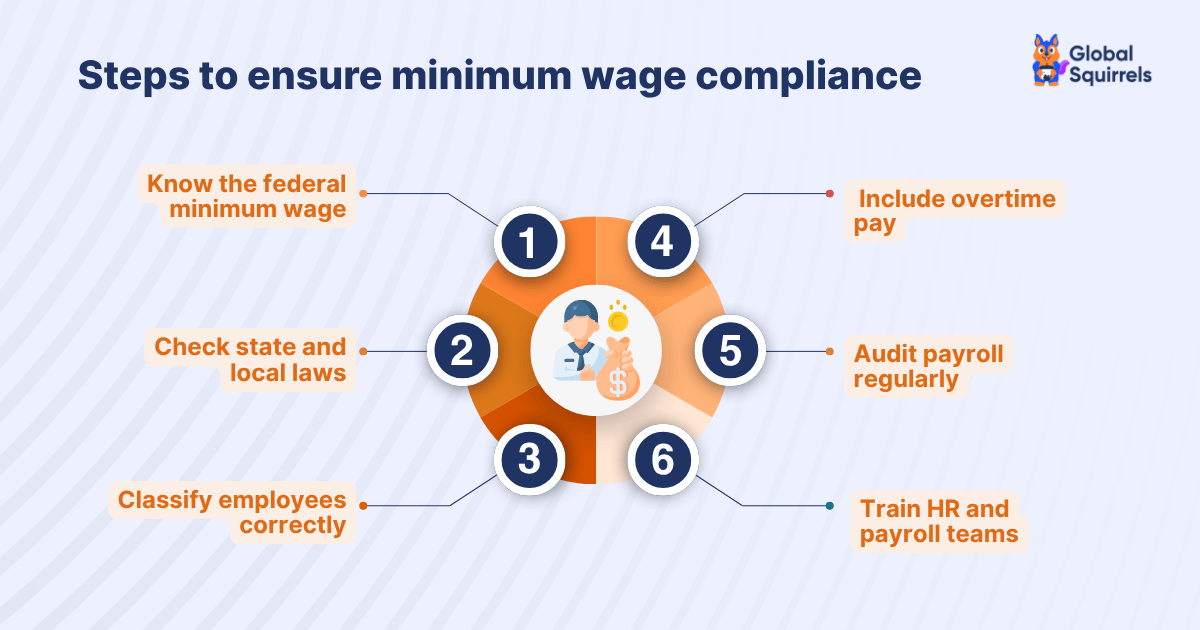
What is the minimum wage in America by state in 2026?
The US minimum wage per hour varies across the country. While the federal government will set a baseline rate, every state will have the power to establish its own minimum wage laws, usually setting higher rates to reflect local economic conditions and the cost of living. This would mean that workers of one state might earn significantly more or less than those in another state, even if it’s for the same job.
Given below is the table that lists all the minimum wages across the top states that job seekers prefer working in, thus examining how minimum wage in America varies by region.
| State | Minimum Hourly Wage |
|
Alabama |
$7.25 |
|
Alaska |
$13.00 |
| California |
$16.90 |
|
Colorado |
$15.16 |
| Connecticut |
$16.94 |
|
Florida |
$14.00 |
| Georgia |
$7.25 |
|
Illinois |
$15.00 |
| Indiana |
$7.25 |
|
Kentucky |
$7.25 |
| Kansas |
$7.25 |
|
Maryland |
$15.00 |
| Massachusetts |
$15.00 |
|
Michigan |
$12.48 |
| Mississippi |
$7.25 |
|
New Jersey |
$15.49 |
| New York |
$16.00 |
|
North Carolina |
$7.25 |
| Ohio |
$10.70 |
|
Tennessee |
$7.25 |
| Texas |
$7.25 |
|
Washington, D.C. |
$17.95 |
| Wisconsin |
$7.25 |
Federal contractors are subject to a separate minimum wage of $17.75 per hour under Executive Order 14026 — higher than the standard federal rate.
Source: US Department of Labor
How often does the federal minimum wage change?
The federal minimum wage in America is adjusted very rarely. However, the timing of this increase is driven by federal legislation rather than automatic adjustments based on cost-of-living or inflation. While the wage has been raised various times since its introduction in 1938, it has not been adjusted as frequently in the last few years. The federal minimum wage has remained at $7.25 per hour since July 24, 2009.
What would it take for Congress to raise the federal minimum wage?
A rise in the minimum salary in the US per month will require action by the ruling party. Lawmakers should pass new legislation to change the wage, which is then signed into law by the President. This process can take years and is influenced by various factors. This includes:
1. Political landscape
Federal minimum wage increases usually depend on the political climate. Democratic administrations and legislators tend to support wage increases while Republicans are more likely to oppose them, citing concerns over business costs and job losses.
2. Economic conditions
Economic factors like inflation and unemployment rates will usually play a role in estimating whether the party will approve a minimum wage hike. During periods of economic downturn, lawmakers will be less inclined to increase wages because of fears of harming businesses or causing unemployment.
3. Public pressure and advocacy
Protests by labor unions, public campaigns, and worker advocacy groups can put pressure on lawmakers to increase the federal minimum wage. Media coverage, nationwide protests, and petitions have significantly helped in bringing attention to wage stagnation and pushing for legislative action.
4. State and local precedents
Sometimes, wages will increase at the state or city level, which creates momentum for federal action. When states like New York, California, or Washington raise their minimum wages significantly, it could influence federal discussions by highlighting the regional disparities and the need for a consistent baseline.
How does the minimum wage affect employees and employers?
The lowest minimum wage in the US will serve as a baseline for compensation in the labor market; however, its effects will extend beyond the paycheck. Understanding the impact on both employees and employers is important to evaluate the broader side of wage policies:
Impact on employees
1. Higher income and better standard of living
A higher minimum wage will directly increase earnings for low-wage workers, which will help them in meeting basic living expenses, reduce reliance on government assistance, and improve overall quality of life.
2. Increased productivity and job satisfaction
Employees earning a fair wage will often experience high morale and engagement, which will translate into improved productivity and lower the absenteeism rate.
3. Career motivation and skill development
A higher wage can motivate employees to upgrade their skills or pursue further training, thus contributing to career growth and long-term earning potential.
4. Reduced income inequality
By raising the floor for earnings, minimum wage laws will help in narrowing the gap between the low and middle-income earners, thus promoting a more equitable distribution of wealth.
5. Potential employment trade-offs
Certain studies suggest that a sudden or very large increase in minimum wage might lead to reduced hours or fewer entry-level positions, especially in small businesses or industries with thin profit margins.
Impact on employers
1. Higher labor costs
Increasing the minimum wage will raise payroll expenses, which will especially affect small businesses and labor-intensive industries like hospitality, food services, and retail.
2. Profit margins and price adjustments
To avail higher wages, certain businesses might increase product or service prices, which can impact competitiveness. Others might absorb the cost, thus reducing profit margins.
3. Employee recruitment and retention
Higher wages can improve employee retention by reducing training costs and turnover. It will also help in attracting a higher motivated and skilled workforce.
4. Operational adjustments
Employers might respond to higher wages by automating certain tasks, which will reduce staff hours or restructure roles to maintain efficiency while controlling costs.
5. Enhances brand image
Companies that pay fair wages can strengthen their brand reputation, which is usually appealing to socially conscious consumers and improves public perception.
How will Global Squirrels help businesses navigate the US minimum wage laws?
Understanding and complying with US minimum wage laws will be challenging, especially for companies that are hiring across multiple states or managing remote teams. Global Squirrels is a staffing and payrolling platform that helps businesses hire, manage, and pay top local and remote talent. Regardless of the state from which you want to hire talent, our platform ensures 100% compliance with local laws, including the state’s minimum wage. Here’s how businesses in the USA leverage our staffing and EOR/payrolling platform:
1. Compliance with federal and state wage laws
Global Squirrels will ensure that your employees and contractors are being paid in accordance with federal, state, and local minimum wage regulations. Whether you are hiring in California or in Texas, where the federal rate applies, our platform will manage these differences automatically, thus reducing the risk of compliance violations and penalties.
2. Payroll management for employees
Managing payroll across multiple states with evolving minimum wages can get complicated and time-consuming. Global Squirrels will take care of accurate payroll processing, which includes deductions, taxes, and wage adjustments based on local laws, which will allow your HR and finance teams to focus on growth instead of administrative overhead.
3. Support for remote and contingent workers
For companies outsourcing contingent staff or remote teams, Global Squirrels will act as the Employer of Record (EOR). This means you can hire and manage workers without worrying about minimum wage compliance, benefits, or tax regulations in the US. This way, your global workforce will remain fully compliant and supported.
Check our Global Squirrels interactive demo to understand how our staffing and payrolling platform helps you manage US minimum wages across multiple states.
Frequently asked questions about the federal minimum wage
1. What is the current federal minimum wage in the United States?
The federal minimum wage is $7.25 per hour in 2026 for covered, nonexempt employees under the Fair Labor Standards Act. This rate has remained unchanged since July 24, 2009.
2. Is the federal minimum wage increasing in 2026?
No. The federal minimum wage remains $7.25 per hour in 2026. A federal increase would require a change in the law. However, many states and local governments have raised their own minimum wage rates above the federal level.
3. Which states use the federal minimum wage in 2026?
In 2026, approximately 20 states either have a minimum wage of $7.25, have no state minimum wage, or have a state rate below the federal level. These include Texas, Pennsylvania, Georgia, Iowa, and several other states.
Employers covered by the Fair Labor Standards Act must generally pay at least $7.25 per hour, even when a state’s minimum wage is lower or the state has no minimum wage law. Local minimum wage requirements may also apply.
4. What is the federal minimum wage for tipped employees?
Under federal law, an employer may pay a tipped employee as little as $2.13 per hour in direct wages if the employee’s wages and tips together equal at least the federal minimum wage of $7.25 per hour.
If the employee does not earn enough in tips to reach $7.25 per hour, the employer must pay the difference. Some states do not permit this federal tip credit and require employers to pay tipped workers the full state minimum wage before tips.
5. What is the minimum wage for workers under age 20?
Employers may pay eligible employees under age 20 a federal youth minimum wage of $4.25 per hour during their first 90 consecutive calendar days of employment.
The employee must be paid at least the regular applicable minimum wage after 90 calendar days or when they turn 20, whichever happens first. Employers cannot displace other workers to hire someone at the youth minimum wage.
6. Do employers follow the federal or state minimum wage?
Employers must follow all federal, state, and local wage laws that apply to the employee. When the rates are different, the employee is generally entitled to the highest applicable minimum wage.
For example, if the federal rate is $7.25 but the applicable state minimum wage is $15, the employer must generally pay at least $15 per hour.
7. Can a city have a higher minimum wage than its state?
Yes. Some cities and counties set minimum wage rates that are higher than both the state and federal rates. Employers should check federal, state, and local wage requirements based on the employee’s work location.
8. Who is covered by the federal minimum wage?
The federal minimum wage generally covers nonexempt employees who are protected by the Fair Labor Standards Act. Coverage may depend on the employer’s business activities, annual revenue, interstate commerce involvement, and the employee’s job duties.
Some employees may be exempt or subject to separate wage rules. Employers should not assume that an employee is exempt based only on their job title or salary.
9. Are salaried employees entitled to the minimum wage?
Being paid a salary does not automatically remove an employee’s minimum wage protections. A salaried employee who is nonexempt must still receive enough compensation to meet the applicable minimum wage for every hour worked.
Employees must satisfy specific legal requirements to qualify for an exemption under the Fair Labor Standards Act.
10. Does the federal minimum wage include overtime pay?
No. Minimum wage and overtime are separate requirements. Covered, nonexempt employees must generally receive overtime pay at one and one-half times their regular rate of pay for hours worked beyond 40 in a workweek.
11. Can an employer make deductions that reduce pay below minimum wage?
Employers generally cannot make deductions for employer-required items, such as uniforms or tools, when those deductions reduce a covered employee’s pay below the applicable minimum wage or cut into required overtime compensation.
12. Are employers required to display a federal minimum wage poster?
Yes. Employers with workers covered by the Fair Labor Standards Act must display the official federal minimum wage poster in a visible location where employees can easily read it.
13. What happens if an employer pays less than minimum wage?
An employer that violates minimum wage laws may be required to pay unpaid wages and additional damages. Depending on the circumstances, the employer may also face civil penalties, legal expenses, or other enforcement action.
