
7 mistakes companies make when hiring a remote Cybersecurity Engineer
Cyber-related threats are increasing by the day. Hence, finding the right cybersecurity remote talent has become one of the most important aspects. They help protect sensitive data, maintain customer trust, and safeguard your business’s continuity. However, multiple companies struggle when hiring a remote cybersecurity engineer. This results in consuming time, security, and money.
In this blog, we have explored the top seven common mistakes that your company can make when hiring a remote cybersecurity engineer and provided tips to avoid them. Understanding the cybersecurity hiring mistakes in detail will help in attracting the right talent. This is irrespective of whether you are building a remote security team for the first time or scaling your existing team. This also ensures compliance and strengthens your business’s overall security. Learn more about how to hire cybersecurity engineers remotely to build a reliable security workforce.
What mistakes do companies make when hiring remote cybersecurity engineers?
Threats related to cybersecurity are becoming increasingly relevant. Therefore, businesses cannot depend only on their in-house team to protect their data due to a lack of talent or skills. Hiring cybersecurity engineers remotely will give your business access to various features. This includes global talent, specialized skills, and quick security coverage across multiple time zones. However, not hiring a cybersecurity engineer by following a process can result in legal issues.
Usually, businesses only focus on certifications or salary when hiring remote cybersecurity engineers. This can cause weak security controls, delayed threat detection, high expenses, and compliance gaps. Given below are some of the most common cybersecurity staffing mistakes that companies can make and how you can avoid them.
1. Hiring depending on certifications
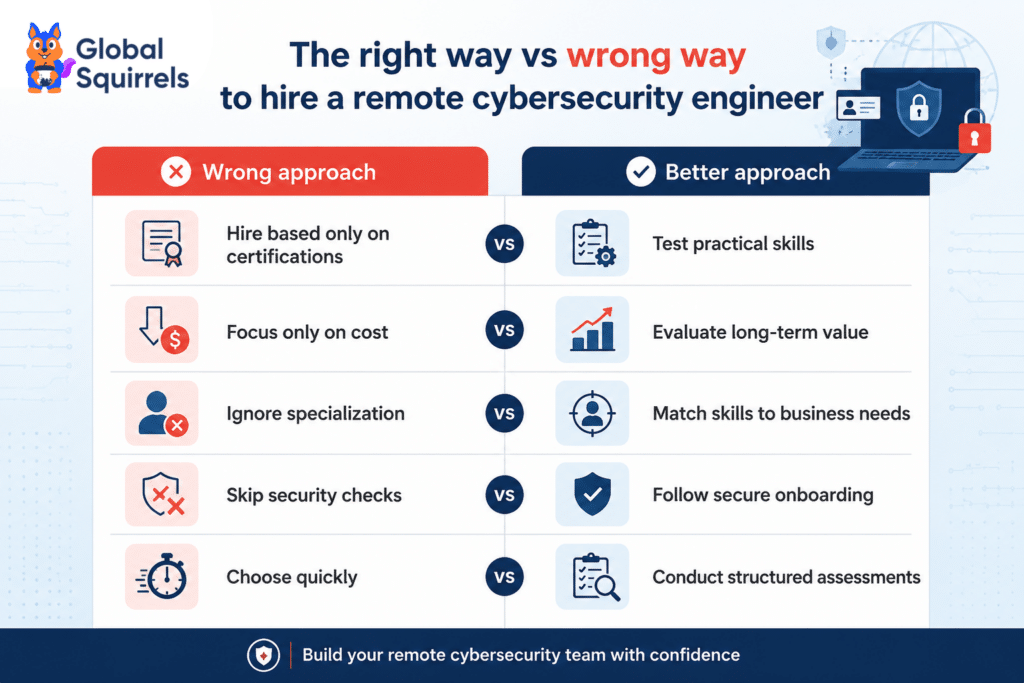
A lot of companies happen to give too much importance to certifications without actually testing them. These include CEH, CISSP, CompTIA Security+, or OSCP. Although certifications are useful, they might not always prove that the candidate can handle threats, secure complicated systems, or investigate incidents.
How to avoid:
You should conduct practical assessments, case-dependent interviews, and scenario-based tests. Ask candidates how they will respond to problems. This can include ransomware incidents, phishing attacks, or cloud misconfigurations. This can help you evaluate their problem-solving abilities.
When hiring cybersecurity professionals remotely, companies should prioritize background checks, identity verification, and technical assessments. Learn more about conducting effective employment background checks for remote employees.
2. Not analyzing hands-on incident response experience
Certain cybersecurity engineers can understand security concepts. However, they can lack experience in handling real incidents. This will become a huge problem when your company faces a breach, data leak, or malware attack and requires quick action.
How to avoid:
You should ask about past incidents that they have handled. Also, ask about the tools they required, the steps they followed, and how they communicated during the response. A remote cybersecurity engineer should know how to detect, investigate, and report security incidents.
3. Ignoring the skills of cloud security
Various companies use AWS, Google Cloud, Azure, or hybrid environments. However, they hire cybersecurity engineers without testing their cloud security knowledge. This can also leave cloud workloads exposed. This is because of weak access controls, unmonitored assets, and poor configurations.
How to avoid:
You should check if your candidate understands cloud logging, encryption, network security groups, IAM, container security, and cloud compliance. You can also ask them to identify common cloud risks. This can include public S3 buckets, excessive permissions, insecure CI/CD pipelines, and exposed APIs.
4. Ignoring secure remote work practices
Remote cybersecurity engineers usually access sensitive systems, logs, VPNs, internal documentation, and security dashboards. If your company does not define secure access rules, the hiring process can create a security risk.
How to avoid:
Establish clear remote access policies from the beginning. Use VPNs, multi-factor authentication, device compliance checks, password managers, endpoint protection, and least privilege access. Also, avoid giving complete access before trust and role requirements are properly verified.
5. Not verifying communication skills
As part of the job role, cybersecurity engineers will be required to explain complicated risks to non-technical team members, clients, and leaders. A skilled candidate with weak communication skills can end up causing confusion during incidents or audits.
How to avoid:
Understand how the candidate will explain security issues in simple language. Ask them to write a short incident summary or explain the issue to a non-technical manager. Strong communication is usually important in remote teams. This is where most updates happen via chat, emails, documentation, and calls.
6. Hiring without understanding the requirements of specialization
Cybersecurity is a very broad field. A penetration tester, cloud security engineer, SOC analyst, GRC specialist, and application security engineer all tend to have different skill sets. Various companies make the mistake of hiring a general cybersecurity profile for a specialized requirement. Depending on your security requirements, you may also need specialized roles such as information security analysts who can help monitor threats, review security events, and maintain security standards.
How to avoid:
Define the role clearly before hiring. Identify if you need threat monitoring, compliance support, vulnerability assessment, application security, cloud security, endpoint security, or incident response. This will help in hiring a candidate whose expertise will match your business requirements.
Remote cybersecurity teams often handle sensitive systems and data, making compliance critical. Businesses should understand cross-border data protection and privacy requirements before expanding globally.
7. Ignoring data privacy and compliance knowledge
Companies hiring cybersecurity engineers remotely across borders should consider compliance requirements. These can be GDPR, HIPAA, SOC 2, ISO 27001, PCI DSS, or industry-specific regulations. Ignoring this can expose the business to legal and financial risks.
How to avoid:
Ask candidates about their experience with compliance frameworks, audit preparation, access reviews, risk assessments, and security documentation. Even technical security engineers should understand how their work will support compliance and data protection.
Why cybersecurity hiring is different from traditional tech hiring
Cybersecurity hiring will need a different approach. This is because these professionals will protect critical systems, sensitive data, and business operations from evolving threats. A traditional tech role focuses on building solutions. While cybersecurity roles will need specialised skills in identifying risks, preventing attacks, and responding to incidents.
Companies should evaluate candidates beyond technical qualifications. You should consider security expertise, compliance knowledge, adaptability, and real-world experience.
1. Specialized experience
Cybersecurity is a broad field that includes areas like penetration testing, cloud security, incident response, application security, compliance, and threat intelligence. Unlike general IT or development roles, cybersecurity professionals require specific expertise depending on the company’s requirements. A strong candidate should not just understand the security concepts but also have experience with security tools and vulnerability management.
2. Constantly changing threats
Cyber threats are evolving with every passing day. There are new vulnerabilities, attack methods, and security challenges emerging on a regular basis. Cybersecurity professionals should constantly update their skills and stay informed about the latest defense strategies. Companies should also look for candidates who demonstrate adaptability, constant learning, and the ability to handle new security challenges efficiently.
3. Compliance and risk requirements
Cybersecurity roles require more than just technical protection. Security engineers usually support compliance requirements, audits, risk assessments, and data protection standards. This includes GDPR, HIPAA, SOC 2, and ISO 27001. Businesses should hire professionals who will understand how security practices will align with regulatory requirements.
4. Shortage of talent
The demand for a skilled cybersecurity professional continues to exceed the available pool of talent. Multiple companies struggle to find experts with specialised skills in areas such as cloud security, threat detection, and incident response. Remote hiring will help organizations access global cybersecurity talent and overcome local hiring limitations. However, companies should evaluate technical skills, communication abilities, and secure remote work practices before making a hire.
Step-by-step cybersecurity hiring process
Hiring the right cybersecurity engineer requires you to follow a structured approach since these professionals require specialised skills, practical experience, and the ability to handle evolving security threats. A clear hiring process will help your company to identify candidates who can help protect systems, manage the risks, and support the security goals of your business.
1. Define the requirements
Begin by identifying your security needs and the type of professionals you require. Determine if you require a cybersecurity engineer, cloud security specialist, SOC analyst, compliance expert, or penetration tester. Also, clearly define the required skills, level of experience, responsibilities, security tools, and compliance knowledge for the role.
2. Curate a detailed job description
A strong job description will help in attracting qualified candidates. Also include the technical requirements, preferred certifications, tools experience, security responsibilities, and remote work experience. Highlight important skills like incident response, network security, cloud security, vulnerability management, and threat monitoring.
3. Source skilled and qualified talent
Cybersecurity talent is highly competitive, so you should always use multiple sourcing channels. This should also include professional networks, referrals, cybersecurity communities, and remote hiring platforms. Expanding your hiring process globally can also help your business access specialized cybersecurity professionals way beyond local talent pools.
4. Evaluate technical skills and experience
Resume reviews are not sufficient when you are hiring a cybersecurity engineer. Evaluate candidates depending on their experience, previous security-related projects, tool knowledge, and ability to solve real security challenges. Also, look for experience with SIEM tools, cloud security platforms, vulnerability scanners, firewalls, and incident response processes.
5. Conduct practical tests
Technical assessments will help in verifying if candidates can apply their knowledge in real-world situations. Use security-related situations, analysis-related tasks, or incident response exercises to evaluate problem-solving skills.
6. Check for communication skills
Cybersecurity professionals should explain risks clearly to the technical teams, leadership, and other stakeholders. Assess how candidates communicate security issues, document findings, and collaborate during incidents.
Challenges of hiring a remote cybersecurity engineer
Hiring a virtual cybersecurity engineer can bring multiple benefits. However, for most businesses, this process can get quite complicated and risky. From security-related issues to operational challenges, businesses usually face multiple challenges that can massively impact hiring speed and long-term stability. Some of these challenges include:
1. Security-related issues
When you hire a cybersecurity engineer internationally, you might have to share sensitive client data for your hire to work efficiently. Maintaining security is quite important for your business. Virtual security is not always going to provide the security that is required to handle private discussions.
2. Compliance with labor laws
All countries have varying employment laws, which you should be aware of when hiring remotely. This will also include rules around contracts, employee rights, terminations, and working hours. Hiring a virtual cybersecurity engineer internationally without local experience can make it difficult to ensure that the recruitment process aligns with the laws. This also increases the risk of non-compliance.
3. High markup fees
Multiple businesses usually depend on staffing agencies to hire a cybersecurity engineer remotely. However, these agencies tend to charge high markup fees. It can be up to 60% of the talent’s pay sometimes. This can result in going overboard with costs and also limit transparency. In such situations, you might usually have to pay more than the employee actually receives in compensation.
How does Global Squirrels help in overcoming these challenges
Global Squirrels is a staffing and EOR platform that will source, hire, and onboard cybersecurity professionals for your business. Additionally, we have built-in remote talent management tools such as multi-country timesheets, leave management, one-time or recurring task assignment, and SquirrelTracker to ensure your remote hires are properly aligned with the goals of your business. Given below is how Global Squirrels can help in overcoming the challenges stated above:
1. Handle the security-related issues
We ensure your cybersecurity talent works actively on your project. Our platform will help your business mitigate risks of absconding via offer letters and agreements. By outlining the scope of work, exit processes, and other corporate policies in detail, these agreements will ensure that there is no risk to your business.
2. Comply with local labor laws
Global Squirrels will ensure that your business complies with the labor laws. This also includes curating contracts, handling benefits, taxation, and employee classification. Our local expertise will reduce the legal risks and protect your business from penalties. This will enable you to focus on your business and core operations.
3. Transparent pricing structure
Unlike a traditional staffing agency, Global Squirrels will follow a transparent pricing model. This means you will only be required to pay the actual payroll costs. This includes a flat platform fee. There would be no additional inflated salary or hidden markups. Additionally, you can also view the breakdown of hiring costs on our platform.
Conclusion
Hiring cybersecurity engineers remotely requires more than just analyzing certifications or technical knowledge. Companies should increasingly focus on practical experience, security expertise, communication skills, compliance awareness, and the ability to work efficiently in a remote environment.
By avoiding making common cybersecurity staffing mistakes and following a structured recruitment process, your business can build a reliable cybersecurity team that will protect your sensitive data, reduce security risks, and stay prepared for evolving cyber threats.
Frequently Asked Questions (FAQ’s)
1. How can companies evaluate the technical skills of remote cybersecurity engineers?
Companies can conduct technical assessments, scenario-based interviews, vulnerability analysis tests, and incident response simulations. These evaluations help determine whether candidates can handle real cybersecurity challenges.
2. What skills should companies look for when hiring remote cybersecurity engineers?
Companies should look for skills in areas such as threat detection, vulnerability management, cloud security, network security, incident response, security tools, compliance frameworks, and risk management.
3. How can companies ensure security when hiring remote cybersecurity engineers?
Businesses should implement secure access policies, multi-factor authentication, VPNs, endpoint protection, device compliance checks, and least-privilege access controls. Access should be provided based on role requirements and trust levels.
4. How does Global Squirrels ensure compliance when hiring remote cybersecurity engineers?
Global Squirrels helps manage employment contracts, employee classification, benefits, payroll requirements, and local labor regulations. This reduces compliance risks when hiring cybersecurity professionals across borders.
5. What types of cybersecurity professionals can Global Squirrels help companies hire?
Global Squirrels can help businesses hire cybersecurity professionals such as cybersecurity engineers, cloud security specialists, SOC analysts, penetration testers, security architects, and compliance experts based on their requirements.
