
How to onboard remote SDRs: A 30-60-90 day plan for fast ramp-up

Efficiently onboarding remote sales development representatives (SDRs) is important for driving sales performance and ensuring long-term success. Unlike traditional in-office onboarding, remote SDRs will need a structured approach to quickly understand your company’s products or services, sales processes, and outreach strategies while staying engaged with the team from the beginning. A well-designed 30-60-90-day plan will assist remote SDRs in producing effective results, establishing clear goals, providing consistent training, and establishing feedback loops that encourage productivity and confidence. In this blog, we shall break down a step-by-step 30-60-90-day onboarding plan designed to help remote SDRs hit the ground running and quickly contribute to your sales pipeline.
Why does a structured SDR onboarding process matter
Employee onboarding is more than just an employee’s first day; it is also about the overall process of bringing new employees on, from the moment an offer letter is signed until they are ready to take full responsibility for their role. Following SDR onboarding best practices will significantly affect your employee retention, engagement, productivity, and more.
According to a Fortune article, nearly one-third of employees find it confusing, and 80% of new hires say they did not receive proper training during onboarding and therefore planned to quit.
You can help reduce these statistics by implementing a structured onboarding program. The reason a structured SDR onboarding plan matters is that:
1. Increases employee engagement
Engaging your employees is crucial because it will have a major impact on your business at every level, from absenteeism and safety to overall profitability. Businesses with the highest level of engagement show better results than those with lower engagement. The first several weeks prior to hiring a new employee are an important time for employee engagement. Following a standard onboarding program is easily one of the most effective ways to encourage employees’ excitement and enthusiasm, thereby translating it into motivation and productivity.
2. Promotes employee retention rate
Hiring and onboarding a new employee is an expensive process. However, in the case of replacing them, it can easily cost up to 40% of an employee’s salary. This can get way more expensive when the new employees in your business spend just a few days or weeks on the job prior to quitting. Moreover, some might not show up on the initial days at all. This is easily one of the most common ways of ghosting by a candidate after they accept an offer.
A systematic approach to onboarding is a tried-and-tested strategy for retaining your staff members. Remembering that onboarding should begin before an employee’s first day is essential to doing it correctly. Following receipt of a signed offer letter, you should contact your new hires as part of SDR onboarding best practices and inform them what to expect, including who to contact, what to do before the first day, and what to expect on the first day. By introducing them to coworkers and familiarizing them with your company’s protocols, a planned onboarding process will help new hires settle into their positions more easily.
3. Increases productivity
The process for onboarding the remote sales team will include expectations to ensure the productivity of the new hires. This is helpful for various reasons, like:
- It ensures a standardized experience for every new employee, tailored to their roles.
- It will help new hires understand how to succeed and stay on track with onboarding goals.
- Hiring managers will be able to determine whether new hires are reaching, surpassing, or lagging behind their goals, enabling them to offer customized feedback and assistance.
Hiring managers, recruiters, HR, and prospective hires won’t have to worry about what to do next if a systematic onboarding procedure is followed. Key personnel can effectively and precisely manage the administrative aspect of onboarding, freeing up new hires to concentrate on learning the ropes.
4. Strong company culture
When a new SDR joins your company, they shouldn’t feel like they have entered an unfamiliar territory. This can leave them feeling disconnected and uncertain, making them feel they have not made the right decision in accepting the job offer. Also, keep in mind that just because the new hire will last beyond the initial 90 days does not mean they have been successfully placed in the company.
Using a standard procedure for onboarding sales development representatives ensures everyone has access to the same resources. Every new hire will feel appreciated and welcomed owing to an onboarding plan that explains how their work will support company objectives. These principles will be ingrained in the company’s culture if a shared sense of purpose, openness, and trust is established during the onboarding process.
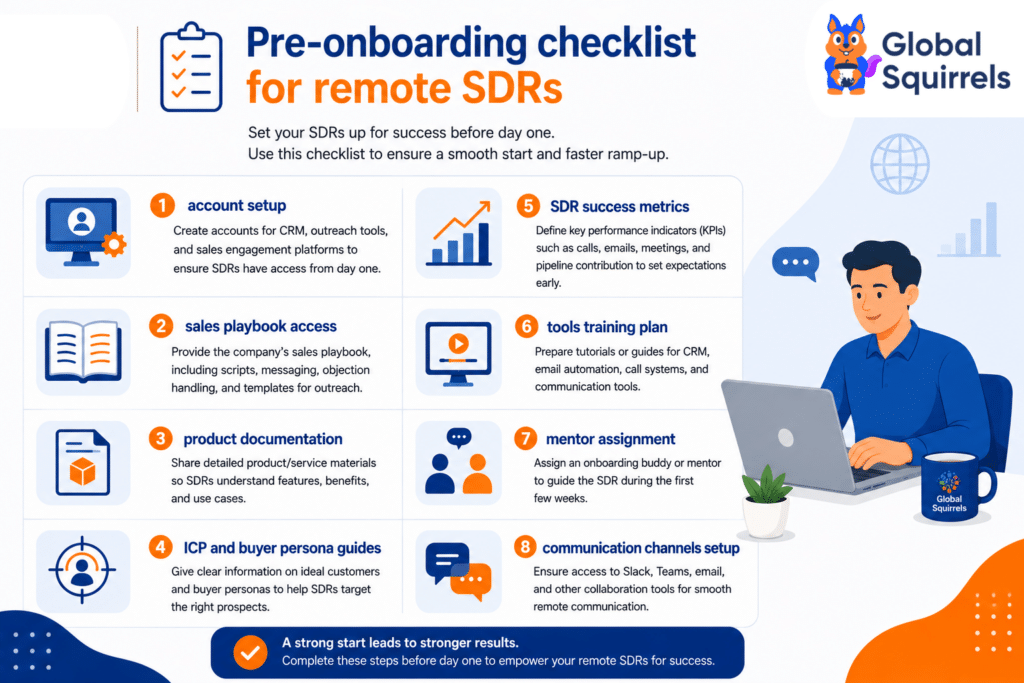
Prepping for SDR onboarding before day one
Proper preparation before a new Sales Development Representative (SDR) begins is important to ensure a smooth and productive onboarding experience. The key areas to focus on are given below:
1. Account setup
Before day one, ensure all accounts and tools are ready so the SDR can start working immediately. Some of the common tools include:
- CRM: Create new accounts, provide access to the sales database, and configure permissions.
- Outreach tools: Establish email sequences, templates, and contact lists.
- Sales engagement platform: Ensure there is access to call systems, chat tools, and workflow automation platforms.
2. Sales playbook access
You should provide the SDR with the company’s sales playbook in advance. This should include outreach strategies, scripts, objection handling techniques, and call or email templates to familiarize them with the sales process.
3. Product documentation
Share all product and service documentation so that SDRs can understand the company’s features, benefits, use cases, and common customer pain points in detail. This knowledge is important for effective conversations and lead qualification.
4. Buyer and ICP persona guides
Provide clear guidance on the Ideal Customer Profile (ICP) and detailed buyer personas. This will help the SDRs to identify the right prospects, custom messaging, and prioritize outreach efficiently.
5. SDR success metrics
Outline expectations and key performance indicators (KPIs) before your hire begins. Metrics can include meetings booked, pipeline contribution, lead quality, and number of emails or calls. Providing clarity on success metrics will ensure that SDRs understand goals and can self-track their progress from the beginning.
The 30-60-90-day remote SDR onboarding plan
A structured 30-60-90-day onboarding plan will help a remote SDR work efficiently, gain confidence, and become fully productive. This SDR ramp-up plan is as follows:
Day 1-30: Learn and build foundations
- Orientation: Introduce the SDR training plan to the team, your company, and remote work culture.
- Tools for training: Familiarize them with CRMs, outreach tools, sales engagement platforms, and communication channels.
- Product training: You should dive deeply into the benefits, product features, and use cases.
- Sales playbook and process: Review outreach strategies, messaging, scripts, and objection handling.
- Observation and shadowing: Listen to live calls, read emails, and observe experienced SDRs in action.
- Initial tasks: Start practicing with emails, mock calls, and internal exercises to build foundational skills.
Day 31-60: Execute and gain confidence
- Live outreach: Begin by making calls, sending emails, and engaging with potential prospects under supervision.
- Contributing to the pipeline: Begin by generating leads, booking meetings, and qualifying prospects.
- Feedback loops: Regular check-ins with managers for performance feedback, coaching, and skill improvement.
- Collaboration: Work closely with marketing and sales teams to understand campaigns and messaging alignment.
- Skill reinforcement: Continue training on products, tools, and the sales process to build confidence and consistency.
Day 61-90: Optimize and own performance
- Independent performance: SDRs take ownership of their outreach and lead generation activities.
- Process optimization: Identify opportunities to improve efficiency, messaging, and conversion rates.
- Advanced skills: Refine objection handling, negotiation, and multi-channel engagement strategies.
- Performance tracking: Independently monitor KPIs such as calls made, meetings booked, and pipeline contribution.
- Continuous improvement: Participate in coaching sessions, peer reviews, and knowledge sharing to sustain growth.
See how a US consulting firm built an active sales pipeline using remote SDRs in our remote appointment setter case study.
Recommended SDR KPIs for the First 90
Tracking the right KPIs will help managers guide remote SDRs during their initial 90 days, ensuring they focus on activities that support pipeline growth and achieve early wins. The 3 categories of SDR KPIs include:
| Category | What it measures | Example metrics |
| Activity | Effort | Dials, emails sent, sequences started |
| Efficiency | Quality of effort | Connect rate, conversion rate, reply rate |
| Outcomes | Business impact | Meetings booked, pipeline generated, opps created |
Some of the common SDR KPIs for the first 90 days include:
1. Dials per day
Set a daily dial goal, then optimize for conversion rate rather than dial count. The dial floor is just to check the inputs. Outbound SDRs usually make about 50-80 calls daily, while inbound-focused reps might make around 30-50. Your target will depend on your motion, tools, and whether calls serve as the primary channel.
2. Emails sent everyday
If you are establishing a KPI for daily email volume, keep in mind that volume will only matter when combined with late replies. If email volume is high but reply rate is flat, your company will have a personalization problem rather than a sequencing problem. Personalized emails will pull 3x higher reply rates than templated emails.
3. Touchpoints for every prospect
Multiple reps tend to give up too soon. A lot of SDRs give up after 1-2 touches, while most conversations usually happen after the fifth touch. This persistence ensures that opportunities are being met. Single outreach is not enough anymore. Stopping early is a common and low-cost mistake. One of the easiest ways to increase reach is to have SDRs complete the full sequence before retiring a lead.
This is also why companies should avoid common remote SDR hiring mistakes such as unclear expectations, weak onboarding, and poor performance tracking before building or scaling a remote sales team.
Common challenges when onboarding a remote SDR
Sales development representative onboarding will help your business improve sales and significantly reduce overall costs. However, this comes with a certain set of challenges that can be handled efficiently. Some of the primary challenges that your business can face when onboarding a remote SDR include the following:
1. Compliance-related issues
When onboarding a remote SDR, you should ensure compliance with industry standards and local laws, which can be difficult. There may be concerns about ensuring that the onboarding is conducted in compliance with regional laws.
2. Verifying experience and credentials
Since the hiring process takes place online, it can get extremely difficult to confirm a candidate’s experience, background, and certifications. You should be careful when conducting background checks and verifying backgrounds, and you should also request sample work to ensure you are hiring a qualified candidate. One tax relief firm addressed this by requiring voice recordings during screening, letting the hiring manager assess phone confidence and clarity before interviews even began.
3. Payroll and benefits
Payroll and benefits can be challenging when onboarding a remote SDR, since there are varying tax rules, payment schedules, currencies, and benefit expectations. Clear salary, commission, payroll support, and leave details will help avoid confusion and create a smooth onboarding experience.
How does Global Squirrels help in hiring and onboarding remote SDRs?
Global Squirrels is a staffing and EOR platform that helps with sourcing, hiring, and onboarding skilled remote talent tailored to your company’s job requirements. In addition, multi-country timesheet and leave management are among the integrated remote personnel management features of our platform. It will also handle one-time or recurring task assignments and provide a tracker to ensure resources are aligned with and productive for your business’s goals. This is how Global Squirrels will assist in overcoming the above challenges with hiring a remote SDR:
1. Compliance with rules and regulations
Global Squirrels will deal with foreign labor laws, tax requirements, and classification concerns on behalf of your company. Whether you want to hire talent from the Philippines, India, or Mexico, our platform will handle the legal agreements, compliance, international payroll, and benefits. This will also reduce risks and ensure your business complies with regional laws without requiring you to establish an office.
2. Access to pre-screened candidates
One of the biggest challenges of hiring a remote SDR is to verify the background, credentials, and experience. At Global Squirrels, we ensure that this is handled by conducting a thorough pre-screening and vetting process before sharing candidate profiles with you. Our team will carefully verify the qualifications, certifications, and professional history to ensure authenticity.
3. Help with an efficient payroll process
Global Squirrels will help your business overcome payroll and benefits challenges by managing remote SDR payroll, employment documentation, benefits, local compliance, payslips, and ongoing workforce support. This will help companies pay remote SDRs on time while also reducing confusion around taxes, leave, deductions, and local labor requirements.
About our plans
Global Squirrels offers suitable plans that will fit your business needs. Whether you need to source qualified talent or onboard a remote SDR you have already identified in India, Mexico, or the Philippines, our platform will support the entire hiring process. This will range from sourcing and managing interviews to onboarding, payroll, and benefits. You can efficiently manage your remote SDR talent with our built-in tools, including timesheets, task tracking, and performance management. Request a demo of our platform to see how it works.
Final thoughts
For remote SDRs to scale up swiftly and make a significant contribution to the sales pipeline, effective onboarding is essential. Organizations can help SDRs develop core skills, gain confidence in outreach, and ultimately take responsibility for their own performance by implementing a structured 30-60-90-day plan. In addition to increasing productivity, this strategy fosters engagement, upholds best practices, and establishes clear expectations, all of which support SDRs’ success and produce quantifiable outcomes for the company.
FAQs
1. What is the purpose of a 30-60-90 day onboarding plan for remote SDRs?
A 30-60-90 day plan provides a structured framework to guide new remote SDRs from learning foundational skills to gaining confidence in outreach and eventually owning their performance independently.
2. How long does it typically take for remote SDRs to become fully productive?
With a well-structured onboarding plan, most remote SDRs reach full productivity within the first 90 days, gradually ramping up their outreach, pipeline generation, and conversion skills.
3. What should be included in the first 30 days of onboarding?
Focus on orientation, tool training, product knowledge, understanding the sales process, shadowing experienced SDRs, and practicing outreach in a controlled environment.
4.Why is pre-onboarding preparation important?
Preparing accounts, tools, playbooks, and documentation before day one ensures SDRs can start smoothly and reduces the time required for the SDR ramp-up plan.
5. How does Global Squirrels help managers track SDR performance?
Global Squirrels’ platform has an in-built performance management tool. Here, you can assign one-time or recurring tasks to your remote SDRs, including timelines. And, you can track their performance based on the tasks assigned to them.
