
Understanding Colorado labor laws

Navigating the intricate landscape of Colorado labor laws can be challenging for businesses of all sizes. This blog offers a concise overview of essential topics under Colorado employment laws, including minimum wage, overtime, breaks, leaves, and benefits. It also examines recent legislative changes and key Colorado workplace laws related to privacy, anti-retaliation, and discrimination. Additionally, the post highlights the importance of understanding Colorado employee rights to ensure a fair and compliant workplace. We will then talk about the consequences of non-compliance and how Global Squirrels can help your business achieve full legal and ethical compliance.
What are some key Colorado labor laws?
Minimum wages in Colorado
Colorado’s minimum wage is $15.16 an hour as of 2026, and it is adjusted for inflation each year. Under Colorado labor laws, employers are required to pay employees at least this amount, regardless of whether they are compensated hourly, by salary, commission, or piecework. In 2027, the minimum wage will increase to $15.71 an hour. This mirrors trends seen across the country — see how minimum wages compare across US states.
Exceptions to the standard minimum wage
- Unemancipated minors: Can be paid 15% less than the minimum wage under Colorado employment laws.
- Local wages: A few local governments have increased minimum wages over what the state dictates. Employers must adhere to the highest applicable rate as outlined in Colorado workplace laws.
Colorado Minimum Wage Overview in 2026
| Region | Standard minimum wage in 2026 | Wage w/ Tip credit |
| Colorado (Statewide floor) | $15.16 | $12.14 |
| Denver City/County | $19.29 | $16.27 |
| City of Edgewater | $18.17 | $13.50 |
| Boulder County (Unincorporated) | $16.82 | $13.80 |
| City of Boulder | $16.82 | $13.80 |
Source link: Colorado Labor Law
Overtime pay in Colorado
Employees in Colorado are entitled to overtime pay, as stated in Colorado labor laws, at 1.5 times their regular hourly rate for:
- More than 40 hours per week worked.
- 12 or more hours worked in one day.
- When you work more than 12 consecutive hours.
For example: Employee works 45 hours in one week
Regular hourly rate: $15.16
Overtime rate:
$15.16 × 1.5 = $22.74/hour
For 45 hours:
-
First 40 hours: 40 × $15.16 = $606.40
-
Overtime hours: 5 × $22.74 = $113.70
Total weekly pay:
$606.40 + $113.70 = $720.10
So, an employee working 45 hours would earn $720.10 before taxes/deductions. Curious how this compares to salaried roles? Read salary vs. hourly pay: what’s the difference.
Work hours
Under Colorado labor laws, employees are entitled to specific breaks and rest periods based on their working hours, ensuring fair treatment and compliance with state regulations.
Break schedule
Work hours:
- 0–2 = No rest period
- Over 2 to 6 hours: 1 rest period
- Over 6 to 10 hours: 2 rest periods
- Over 10 to 14 hours: 3 rest periods
Standard work hours
- Standard workweek: 40 hours per week is typically considered full-time.
- Overtime pay: Non-exempt employees must receive overtime pay for hours worked over 40 hours per week at a rate of 1.5 times their regular pay.
Leaves
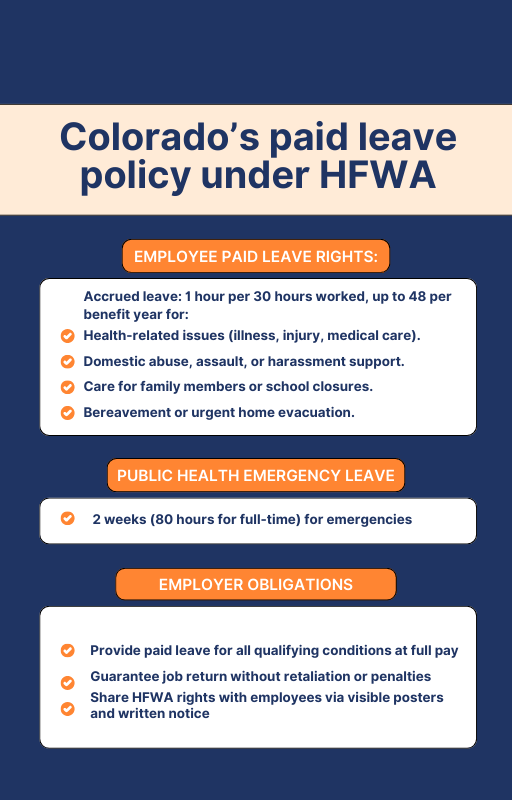
1. Healthy families and workplaces act (HFWA)
The Colorado Healthy Families and Workplaces Act (HFWA) requires paid leave for employees in certain situations, and it is an important part of the Colorado labor laws.
A. Accrued paid leave
Eligibility: All employees in Colorado.
Accrual: Employees get paid leave of 1 hour for every 30 hours they work, up to a maximum of 48 hours a year.
Leave can be taken for:
– The illness or injury (physical or mental) of the employee.
– Vaccinations are part of preventive medical care.
– Situations related to domestic violence, sexual assault, or stalking (medical attention, mental health care, legal services).
– Any family member who is caring for someone with any of the above conditions.
– Things like workplace closures or school closures for children.
– Bereavement or legal or financial arrangements following the death of a family member (from August 7, 2023).
– Inclement weather or other emergency that requires evacuation or someone to care for a family member.
B. Public health emergency (PHE) leave
Additional entitlement: Employees can be entitled to up to 80 hours of supplemental leave (pro-rated for part-time workers) during a PHE.
Covered situations:
– Related to the emergency, testing, or treatment.
– Caring for family members or children whose schools or childcare facilities are closed.
C. Employer obligations
Employers must:
– Posters and written communication must notify employees about their HFWA rights.
– Make sure employees will not be retaliated against for asking for leave.
2. Colorado Family Care Act
The Family Care Act provides additional family relationships while ensuring that workplace laws are equitable.
Eligible leave reasons: Employees may take unpaid leave to care for:
– A seriously ill domestic partner or civil union partner.
– A partner with a child or parent with a serious health condition.
Eligibility: The same requirements as FMLA.
– An employee must have worked at least 12 months and 1,250 hours in the past year for a covered employer.
3. Paid family and medical leave insurance program (FAMLI)
Colorado began a Paid Family and Medical Leave Insurance (FAMLI) program, which is part of the state’s evolving employment laws.
Coverage: Paid leave up to 12 weeks, plus 4 weeks if pregnancy or childbirth complications.
Eligibility: The leave can be used by employees for:
– Their own serious health condition.
– Bonding with a new child.
– Family member with a serious health condition.
– A need related to a family member’s military deployment.
Funding: Paid through payroll deductions split in half between employee and employer. Managing leave entitlements across a distributed team? See our guide to effective PTO policy management for global teams.
Benefits
1. Paid sick leave
Under the healthy families and workplaces act (HFWA):
- Paid sick time is provided at a rate of one hour for every 30 hours worked, not exceeding 48 hours in the calendar year.
- During a Public Health Emergency (PHE) employees can be eligible for up to 80 additional hours of paid time off.
Eligible uses include:
- Sickness of oneself or a close family member or a loved one.
- Health promotion or illness prevention or control or the occurrence of communicable diseases.
- Such issues as domestic violence.
2. Family and medical leave (FAMLI)
Colorado’s Paid Family and Medical Leave Insurance (FAMLI) program provides paid leave benefits to eligible workers.
Provides:
Up to 12 weeks with pay (up to 16 weeks total for pregnancy or childbirth complications).
Coverage for:
- Bonding with a new child.
- Critical illness within the self or family member.
- Military family leave.
3. Workers’ compensation
Workers injured on the job are entitled to:
- Medical benefits.
- Wage replacement.
- Disability benefits.
- Rehabilitation support.
4. Unemployment insurance
Unemployed workers who meet eligibility requirements can receive:
- Weekly benefit payments (determined by prior earnings).
- Job training and placement assistance.
- Applications are handled by the Colorado Department of Labor and Employment (CDLE). Learn more about how this is funded in our breakdown of the Federal Unemployment Tax Act.
5. Health insurance
Employers with 50 or more full-time employees must provide access to affordable health insurance as per the Affordable Care Act (ACA).
6. Retirement benefits
401(k) plans
A 401(k) plan offers Colorado employees a valuable retirement savings option while adhering to Colorado employment laws. Under Colorado workplace laws, employees can defer part of their salary into a 401(k), benefiting from tax-deferred growth and flexible contribution options. Employers sponsoring 401(k) plans must comply with Colorado employee rights, including fair treatment and non-discrimination in benefits. Participants may also take hardship withdrawals or loans, but early distributions may be subject to penalties under federal and state regulations. For a broader look at what’s typically offered, see the most common employee benefits.
Discrimination and harassment laws
The $50 per day penalty relates to wage payment violations, not general discrimination claims. In Colorado, the $50 per day penalty applies to certain failures related to wage payment orders issued by the Department of Labor. Workplace discrimination claims are handled under Colorado civil rights laws and may involve different remedies depending on the nature of the claim and applicable legal limits.
The “three times wages or $3,000” penalty applies to wage theft violations, not general discrimination retaliation claims. Under Colorado wage laws, employers who willfully fail to pay owed wages may face statutory penalties based on unpaid wage amounts. These wage-and-hour penalties should not be confused with remedies available for discrimination or retaliation cases.
Workplace discrimination complaints remain a significant compliance concern. Data from the Colorado Civil Rights Division shows that the agency receives a substantial number of workplace discrimination complaints each year, emphasizing the importance of understanding employment regulations and maintaining compliant workplace practices. Misclassifying workers can compound these risks — see our guide on the ABC test and employee misclassification in California and the core differences between independent contractors and employees.
What are the challenges of not complying with Colorado laws?
Non-compliance with Colorado employment laws and Colorado workplace laws can lead to severe financial and legal consequences. Unpaid wage penalties for employers may reach up to $50 per day, depending upon the willfulness of the offense, and penalties may exceed $3,000 for willful violations. If a wage payment order is not complied with within 60 days, there is a 50% increase in the penalties or an additional $3,000, whichever is greater. Beyond that, there are ongoing violations that can lead to fines of $1,000 for each violation, including not listing pay in job postings. Asset seizures may be allowed under court judgments, and costs grow ever higher. Ignoring Colorado employee rights not only damages reputations but also imposes crippling financial and operational burdens on businesses. Employers should also understand their broader tax and reporting duties — see W-2 employer responsibilities.
How does Global Squirrels help eliminate all the challenges?
Global Squirrels is a staffing and payrolling platform that helps you hire and manage your employees. Our platform offers HR functions such as payroll setup, benefits administration, task and timesheet management, compliance with local and international labor & tax laws, and performance management. While other staffing agencies charge you 50% more, our platform saves you 20% on hiring. New to this model? Start with what is a PEO and PEO vs. EOR: what’s the difference.
By partnering with Global Squirrels, you will face no legal risks. Global Squirrels is your trusted partner in navigating the complexities of Colorado labor laws and Colorado workplace laws, ensuring your business aligns seamlessly with regulatory requirements. Our team prioritizes Colorado employee rights by addressing every detail of local laws when hiring and managing your workforce.
Using advanced compliance analytics and assessments, our platform identifies areas of improvement and reduces the risk of non-compliance to ensure your business stays on the right side of ever-changing regulations. Our platform will help you avoid costly penalties while safeguarding your organization’s reputation by proactively addressing compliance challenges.
Global Squirrels also specializes in eliminating employee misclassification risks and compliance with classification rules to eliminate possible legal action. With Global Squirrels, you can rest assured that your business complies with all Colorado employment laws, supporting a fair, secure, and legally sound workplace.
So, how does our platform help you with your specific business needs? Global Squirrels offers you plans based on your requirements that ensure you face no issues in terms of compliance or hiring.
How does Global Squirrels work?
Navigating Colorado labor laws requires a clear understanding of state-specific regulations and an efficient hiring process. Global Squirrels will offer flexible plans that align with the business needs, whether you are looking to source qualified talent or onboard candidates you have already selected.
Our platform will manage the entire workflow, from sourcing and interview coordination to onboarding, payroll, and benefits administration, ensuring everything is handled seamlessly in a single platform. We also help ensure compliance with Colorado employment laws and local employment requirements, reducing risks and simplifying workforce management.
With the built-in tools for task tracking, performance monitoring, and timesheet management, you can efficiently oversee the team while maintaining complete visibility into everyday operations.
Are you ready to comply with Colorado labor laws? Get a demo today!
Related state labor law guides:
Texas | New York | Georgia | Washington State | Florida
