
Florida Employment Laws: A Complete Guide for Employers

Top 5 key takeaways of Florida labor laws
1. Florida’s minimum wage is $14 per hour in 2025 and will increase to $15 per hour on September 30, 2026. Employers must monitor wage changes and update payroll practices accordingly.
2. Eligible nonexempt employees must receive overtime pay at 1.5 times their regular rate for hours worked beyond 40 in a workweek.
3. Florida employers must comply with federal leave requirements. Eligible employees may receive up to 12 weeks of unpaid, job-protected leave under the Family and Medical Leave Act.
5. Workplace discrimination is prohibited. The Florida Civil Rights Act generally applies to businesses with 15 or more employees and protects workers from discrimination based on legally protected characteristics.
5. Accurate policies and recordkeeping are essential for compliance. Employers should regularly review payroll, employee classification, leave policies, workplace notices, and employment documentation to reduce legal and financial risks.
Florida employers must navigate a unique framework of regulations known as Florida employment laws that shape the employee-employer relationship. These include Florida workplace laws on minimum wage, overtime, discrimination, and leave policies, as well as specific provisions protecting Florida employee rights. Adhering to these Florida labor laws is essential for businesses to operate both legally and ethically while fostering a positive work environment.
In this blog, we will look at some of the most important regulations, describe the potential risks of failing to comply, and demonstrate how Global Squirrels can assist businesses in navigating the complexities of these challenges without any gaps with support and compliance solutions.
What are some key Florida employment laws?
Minimum wages & overtime pay
The minimum wage in Florida, governed by Florida employment laws, increased to $13.00 per hour on September 30, 2024. These adjustments are part of Florida labor laws under Amendment 2, which was approved by voters to gradually raise the state’s minimum wage to $15.00 per hour by 2026.
Employers are required by Florida workplace laws to display the current minimum wage in a visible location for employees. Adhering to these regulations is essential to protect employee rights in Florida and maintain compliance. For businesses, that means planning ahead to make sure their payment practices play along with these updates.
Overtime pay in Florida is governed by federal regulations under the Fair Labor Standards Act (FLSA), which apply alongside Florida employment laws. Under these provisions, nonexempt employees must be paid 1.5 times their regular hourly rate for hours worked in excess of 40 in a workweek.
While Florida workplace laws do not set separate state-specific overtime rules, employers in Florida must comply with federal standards to ensure they uphold Florida labor laws and protect employee rights in Florida. Under the FLSA, a workweek is a fixed and recurring period of 168 hours (seven 24-hour consecutive days), and overtime pay must be computed on a workweek basis. Employers must pay employees for overtime hours on the regular payday for the pay period in which such wages were earned.
Work hours
Work hours in Florida are primarily governed by federal regulations under the Fair Labor Standards Act (FLSA) and provisions of Florida employment laws. As per Florida workplace laws, employees are typically expected to work up to 40 hours per week under normal conditions, excluding overtime.
The weekly hours of any employee who is covered under an approved short-time compensation plan can be reduced by up to 40%, and the employee can share remaining work hours in proportion to the reduction in hours while proportionate compensation is paid. This arrangement protects Florida employee rights by helping businesses avoid layoffs while ensuring employees receive part of their wages and benefits during reduced work periods. Employers must ensure their work-hour policies comply with federal and Florida workplace laws to maintain legal and ethical operations.
Leaves
Florida’s leave laws are based on both federal requirements and Florida-specific provisions to protect an employee’s rights. Florida does not have its own comprehensive family and medical leave law, but employers in Florida do have to follow federal laws such as the Family Medical Leave Act (FMLA) that allows eligible employees to take up to 12 weeks of unpaid, job-protected leave during a 12 month period for qualifying reasons. Reasons for such leave are because you have had a child, adopted a child, or you have to care for a family member with a serious medical condition, or you have a personal medical issue so that you can not work. Employees also have grievances under the FMLA for health benefits throughout the leave and for reinstatement to pre- or equivalent jobs upon return.
Florida’s employment laws provide leave protections for specific situations, such as military family leaves for ‘qualifying exigencies’ or up to 26 weeks to care for a covered service member with a serious injury or illness. These provisions align with Florida labor laws to support employees facing personal or family health challenges.
In addition, Florida has other leave provisions, such as jury duty leave, domestic violence leave, and voting leave, which are designed to uphold employee rights in Florida and ensure fair treatment in the workplace. Employers in Florida must remain compliant with both federal and Florida workplace laws to foster a supportive work environment and avoid legal repercussions.
Benefits
Florida benefit laws guarantee employees get fair access to health care and other essential benefits provided as a result of state and federal regulations. The Florida Employee Health Care Access Act is a cornerstone of Florida employment laws, designed to promote the availability of health insurance coverage for small employers and their employees. This law guarantees that small businesses can sell guaranteed-issue health benefit plans, regardless of claims history or the health status of employees, and protects them with things like limits on preexisting condition exclusions.
Employers must also comply with Florida workplace laws governing eligibility for benefits like health insurance. For example, employees working at least 25 hours per week are generally considered eligible for health benefits under Florida labor laws, provided they meet the waiting period and other requirements. In addition, they were required to maintain uniform premium rate-setting practices and maintain fairness in the health benefit plan offerings.
Additionally, employee rights in Florida include protections for dependents, guaranteed renewability of health plans, and access to annual open enrollment periods. Specific coverage standards must be met by health plans, and employees or dependents may not be excluded from coverage because of health status or claims history. If you are a small business, the state will give you mechanisms to access affordable healthcare options, like the Florida Small Employer Health Reinsurance Program for small businesses.
Employers must remain compliant with Florida labor laws to uphold Florida employee rights and create equitable workplaces where all eligible employees can access the benefits they deserve. Failure to adhere to these benefit laws can lead to penalties for both employers and employees.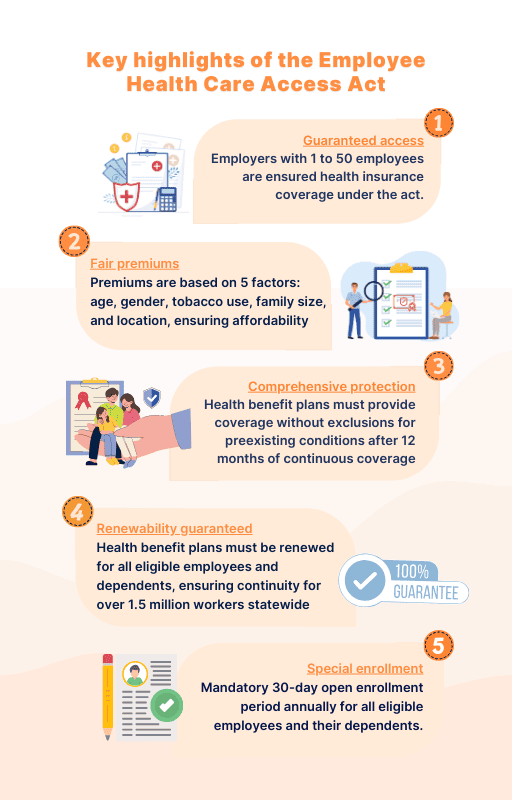
Source link: https://www.flsenate.gov/laws/statutes/2023/627.6699
Workplace Discrimination and harassment laws
Florida employment laws protect employees from workplace discrimination and harassment. Under the Florida Civil Rights Act of 1992 (FCRA), employers cannot discriminate based on race, color, religion, sex, pregnancy, national origin, age, disability, or marital status.
The FCRA generally applies to employers with 15 or more employees. These employers must follow fair employment practices when hiring, promoting, compensating, and managing workers.
Florida workplace laws also prohibit sexual harassment and conduct that creates a hostile work environment. Employers must take steps to prevent harassment and respond appropriately when complaints arise.
Employees can file a discrimination complaint with the Florida Commission on Human Relations (FCHR). The complaint must be filed within 365 days after the discriminatory treatment ends. Available remedies may include back pay, compensatory damages, and punitive damages of up to $100,000.
Florida labor laws also protect employees from retaliation. Employers cannot punish workers for whistleblowing or reporting workplace violations. Protections may also apply to employees who face discrimination based on genetic information or HIV/AIDS status.
These protections support employee rights in Florida and help create fair, respectful, and accountable workplaces. They also give employees legal options to report discrimination, resolve complaints, and seek appropriate remedies.
Related Read: Understanding Arkansas employment laws and Colorado labor laws
What are the challenges of not complying with Florida laws?
How does Global Squirrels help eliminate all the challenges?
Global Squirrels provides advanced staffing and payrolling solutions, allowing you to easily hire and manage your workforce. Our platform offers an online platform for key HR functions, including payroll processing, benefits management, task and timesheet tracking, compliance with Florida employment laws, and performance management. Unlike most staffing agencies, which inflate their costs by 50%, Global Squirrels saves you 20% on recruitment costs.
When you partner with Global Squirrels, you reduce the risk of non-compliance with Florida labor laws. This is because our platform ensures that you stay compliant with all of these regulations so you do not face any legal complications. Our platform also ensures that you access regulatory frameworks, helps with employee classification challenges, and keeps you up to date with changes in employment laws using compliance analytics and expert support.
How does Global Squirrels work
Global Squirrels provides an array of plans that will cater to your business’s needs. If you are looking to find qualified talent or onboard talent you have already selected, our platform will help you handle the entire process from start to finish.
This also includes sourcing talent, coordinating interviews, onboarding, managing benefits, and processing payroll, ensuring everything runs smoothly in one place. We also assist in navigating region-specific requirements, including understanding Florida employment laws, so you can stay compliant at every stage.
With built-in tools for tracking tasks, monitoring performance, and managing timesheets, you can easily manage your workforce and maintain complete visibility into everyday operations.
Optimize your HR and staffing needs by requesting a demo today!
Frequently Asked Questions
