
Remote SDR KPIs: What metrics to track (and what to ignore)

Is your business working with remote SDR teams to generate quality sales? If yes, you must be aware of the difficulties of ensuring the productivity and performance of the team. While building a high-performing SDR team, you should track the right metrics and not just the volume of activity taking place. You should cover the KPIs that separate top-performing teams from the rest. This ranges from email response metrics, call-to-connect rates, to lead quantification accuracy and pipeline generation. Your business should measure what will drive your revenue, set clear SDR performance goals, and constantly define your approach depending on data-backed insights.
In this blog, we have summarized the most important remote SDR KPIs to track, which metrics actually show performance, and which metrics your team should be avoiding. Irrespective of whether you are building a distributed sales team or improving your current SDR process, these metrics will help you in measuring what matters and will support faster and more predictable pipeline growth.
Why remote SDR KPIs matter for sales performance
Remote SDR KPIs will help sales leaders to understand if the daily outreach is helping in creating qualified conversations, real pipeline opportunities, and booked meetings. In a remote setup, the managers require clear performance data instead of depending on screen time, online status, or assumptions.
1. They create visibility without the need for micromanagement
Remote SDR teams require visibility, but the managers should not measure performance just by tracking the hours invested or screen activity. Better KPIs that actually show performance include calls completed, email reply rates, connect rates, meetings booked, and meetings completed without really micromanaging your hires.
Learn more in our guide on how to manage remote SDRs across time zones.
2. They assist managers in identifying coaching gaps
KPIs will help managers find where SDRs need support. Low reply rates might point to poor targeting or weak messaging. Low connect rates can show issues with lead quality or call timings. Low meeting rates usually suggest poor qualification or weak follow-up. These insights make coaching more useful and specific.
3. They improve pipeline predictability
SDR KPIs connect everyday activity to the sales pipeline. When managers are aware of how many calls, meetings, emails, and replies are required to create a qualified opportunity, they can easily forecast the pipeline accurately and also fix any performance gaps at an earlier stage.
4. They support a quick SDR ramp-up
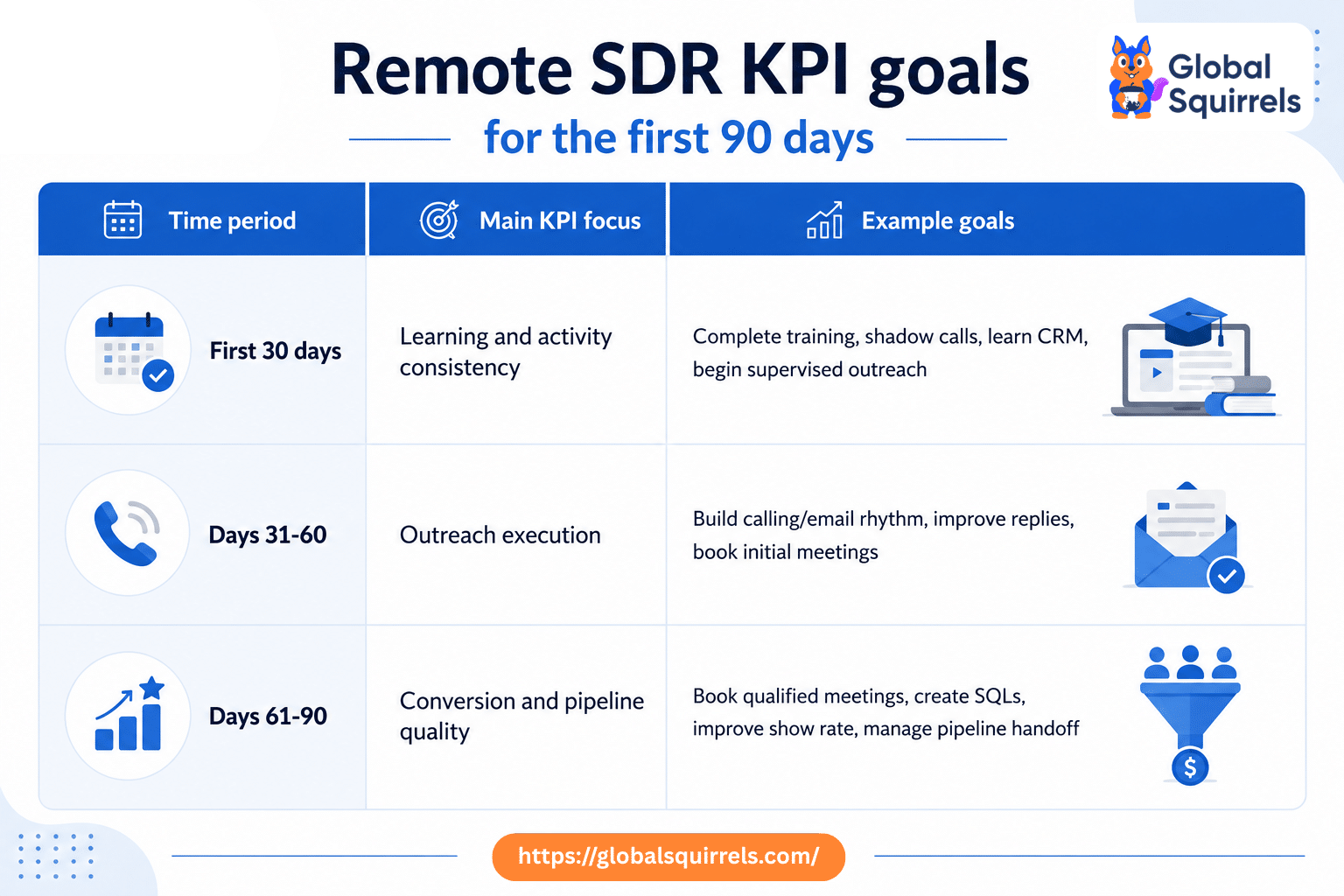
KPIs make the process of remote SDR onboarding more strategic and structured. During the initial 30, 60, and 90 days, managers will be able to track outreach quality, reply rates, meeting bookings, and qualification skills. This will help the new SDRs improve quickly and give managers a clear way to review performance.
What are the most important remote SDR KPIs to track?
The best remote SDR metrics tend to measure activity, conversion, meeting quality, CRM discipline, engagement, and pipeline impact. These metrics will help in analyzing if the remote SDRs are not just staying busy, but actually creating useful sales opportunities.
For remote teams, carrying out activities is not enough. For example, an SDR can make multiple calls or send many emails, but the main goal is to start conversations, book qualified meetings, and support pipeline growth. Tracking the right KPIs will help managers understand everyone’s performance, coach SDRs more effectively, and avoid micromanagement.
1. Calls made
Analyzing the calls made will help in measuring everyday prospecting activity and is especially useful for outbound SDR teams. However, call volume should not be taken as the only metric to judge, since a larger number of calls does not always mean better results. You can watch out for calls per day, connect rate, call-to-meeting conversion rate, and conversations created.
2. Emails sent
Tracking the number of emails sent by the SDR will help in measuring outbound email activity. However, this KPI is useful only when it is connected to replies and meetings. Managers should avoid judging an SDR just by the volume of emails sent. This is because high email activity without engagement will not create a pipeline. You can also check the open rate if available, reply rate, and email-to-meeting conversion.
3. Connect rate
Connect rate will show how many prospects have actually answered calls or engaged in conversations. A low connect rate might indicate poor targeting, bad timing, inaccurate phone data, or even ineffective calling windows.
4. Reply rate
Reply rate will show if SDR messaging is relevant enough to get a response from the target audience. For remote SDRs, this is one of the most prominent indicators of personalization, messaging quality, and audience fit being targeted by the audience.
5. Positive reply rate
Positive reply rate is a better measurable metric than the total reply rate since it will show how many prospects are actually interested. This will help the manager separate meaningful engagement from unsubscribes, negative responses, and objectives.
6. Number of meetings booked
The total number of meetings booked is easily one of the most common SDR performance metrics. It will show if the outreach is converting into sales-related conversations. However, the managers should also check if the meetings are attended and qualified.
7. Meeting show rate
The meeting show rate will measure how many booked meetings are actually taking place. A lower show rate can mean that the SDR is booking a weak-fit prospect, not confirming interest properly, or failing to establish clear expectations prior to any calls.
8. Qualified meetings
Qualified meetings are way more important than the total number of meetings booked. This KPI will help managers understand if the SDRs are targeting the correct audience, speaking to the right personas, and booking meetings that sales teams can actually use.
Remote SDR metrics you should ignore
Remote SDR managers should be careful around metrics that look productive but do not provide a measurable sales impact. Sales development metrics such as online status, LinkedIn connection counts, raw email volume, and total number of dials can be extremely misleading when they are not connected to meetings, replies, qualified opportunities, or pipeline.
1. Raw email volume
High email volume is not always valuable if the emails sent are ignored, generic, or not converting. Instead of just tracking how many emails are being sent, managers should also measure reply rate, email-to-meeting conversion, and positive reply rate.
2. Total dials without the connect rate
Calls are extremely important for an outbound SDR team. However, the total dials alone will not show if your SDRs are reaching the right people. A high number of calls with a low connect rate can point to poor data, weak targeting, or wrong timing.
3. LinkedIn connections without meaningful conversations
LinkedIn connection count can look great; however, they do not always show real progress in terms of sales. This metric is just useful when connections result in replies, conversations, booked meetings, or qualified opportunities.
4. Booked meetings without a qualification
A high meeting count can look quite strong; however, it might not help sales if the prospects are not a vital fit. Managers should check if meetings match the ideal customer profile, are attended, and move forward in the sales process.
5. CRM activity without accuracy
CRM activity will matter just when the data is accurate, timely, and useful. Logging tasks or updating records just for the sake of activity will not help the team. Remote SDRs should keep the CRM notes, lead status, follow-ups, and meeting details clear and updated.
Recommended KPIs for experienced remote SDRs
An experienced remote SDR should be measured beyond just basic activity numbers. At this stage, managers should increasingly focus on conversion quality, qualified meetings, pipeline contribution, and consistency. Since experienced SDRs already understand outreach tools, CRM processes, and sales messaging, their KPIs should show how efficiently they will turn prospecting activity into real sales opportunities.
1. Consistency of high-level activities
Experienced SDRs should maintain a constant outreach across emails, calls, LinkedIn touches, and follow-ups. The goal is not always to complete a high activity on one or two days, but to keep a consistent prospecting rhythm that will support predictable pipeline creation.
2. Stronger conversion rates
For an experienced SDR, sales development metrics tend to become way more important when compared to the usual activity. Managers should constantly track call-to-meeting conversion, email-to-meeting conversion, positive reply rate, and meeting-to-opportunity conversion to understand how well outreach is actually performing.
3. Qualified meetings
Experienced SDRs should not be measured just by the total number of meetings they have booked. The meetings should match the ideal customer profile of the company, involve the right decision-makers, and have a clear idea of the business needs.
4. SQL creation
SQLs will show how many SDR-sourced meetings are accepted by the sales team as real sales opportunities. This KPI will help the managers measure if the SDR is booking meetings that are valuable and important for account executives.
5. Pipeline generated
Pipeline generated is one of the strongest KPIs for experienced SDRs since it will connect their work directly to revenue potential. It will show if their outreach is contributing to business growth and not just activity completion.
How to establish a realistic remote SDR KPI target
Remote SDR KPI targets should depend on your business model, target audience, and sales process. The right targets can vary depending on deal size, industry, sales cycle, ICP, data quality, channel mix, and whether the SDR handles inbound, outbound, or both.
Managers should avoid copying any generic SDR benchmarks blindly. A target that will work for a high-volume team might not work for an enterprise SDR team that is selling to senior decision makers. Instead, start with the current baseline data, review what is realistic for your team, and improve targets gradually over time.
Setting realistic KPIs begins with hiring the right SDRs. If your team struggles with inconsistent performance, the root cause may be hiring rather than measurement. Before defining benchmarks, review the most common remote SDR hiring mistakes and learn how to avoid them during recruitment.
1. Consider the length of the sales cycle
Sales cycle length has a huge impact on SDR metrics. If the sales cycle is short and the product is simple, SDRs will be able to achieve higher outreach volume and book meetings quickly. For a longer or more complicated sales cycle, SDRs might require more time for researching the account, multi-touch follow-ups, mapping stakeholders, and personalization. In this case, fewer daily activities can still result in better quality conversations and a stronger pipeline.
2. Consider inbound vs outbound SDR roles
Inbound and outbound SDRs should not always be measured by the same KPIs. Inbound SDRs usually focus increasingly on speed to lead, lead qualification, response time, and meeting conversion since prospects have already shown some interest.
Outbound SDRs usually need to be measured on connect rate, reply rate, positive reply rate, prospecting activity, conversations created, and meetings booked. Their success depends increasingly on how well they reach and engage cold prospects.
3. Consider ICP and market complications
Your KPI targets should be more thoughtful depending on how complex your market or ICP is. Compared to SDRs aimed at small firms, enterprise SDRs frequently require more thorough research, stronger customisation, and more strategic account-based prospecting.
Reaching a large company’s CFO, VP of Sales, or Head of HR, for instance, might take fewer but more individualized interactions. SDRs could be able to employ a higher-volume strategy with a more straightforward message for SMB prospects. Rather than treating all SDR roles equally, KPI targets should take these variances into account.
How can managers improve remote SDR KPI performance
Improving remote SDR KPI performance is not just about asking them to carry out more activities. Managers have to review the right data, identify where the performance is dropping, and also coach SDRs depending on specific gaps. A clear KPI review process will help a remote team improve outreach quality, meeting outcomes, and pipeline contribution.
1. Review KPIs weekly
Weekly KPI reviews will help managers identify issues early before they can start affecting the monthly pipeline. Instead of waiting till end of the month, managers should check the activity levels, reply rates, connect rates, meeting bookings, show rates, and SQL creation every week. This can make it easy to spot performance-related trends, support struggling SDRs, and also adjust outreach strategies before a small issue becomes a bigger pipeline gap.
Along with reviewing KPIs, following proven best practices for managing remote employees can improve accountability, engagement, and long-term team performance.
2. Coach depending on conversion gaps
KPI data should be used by managers to determine which SDRs require coaching. For instance, poor phone data, poor targeting, or poor calling times may be indicated by high call volume but low connect rates.
High response rates but few meetings could indicate that the SDR needs assistance scheduling the next step or resolving objections. Low attendance rates despite a high number of scheduled meetings could indicate poor qualifications or ambiguous expectations. When coaching is focused on particular conversion gaps rather than generic criticism, it becomes more beneficial.
3. Record and review calls
Managers may better understand how SDRs interact with prospects by using call reviews. Managers may enhance their pitch quality, tone, discovery questions, handling of objections, and meeting-setting abilities by reviewing calls.
Call reviews are particularly useful for remote SDRs because managers are unable to watch calls in person. The manager and SDR can analyze recorded calls to see what went well, what needs to be improved, and how future calls can be more effective.
Common mistakes managers make when tracking remote SDR KPIs
Tracking remote SDR KPIs can significantly improve performance. However, this is true only when the metrics are used correctly. Managers should avoid using KPIs just to pressure SDRs or measure activity without understanding the quality behind the numbers.
1. Tracking multiple metrics
Tracking too many KPIs can severely confuse an SDR and make performance goals harder to understand. Instead of tracking each and every possible activity, managers should concentrate on a small set of meaningful metrics like connect rate, qualified meetings, SQLs, reply rate, pipeline generated, and CRM accuracy.
2. Rewarding activity without analyzing the quality
High activity does not necessarily mean strong performance. An SDR might send multiple emails or make many calls. If those efforts do not create replies, meetings, conversations, or qualified opportunities, the activity has limited value. Managers should measure both outcomes and volume.
3. Comparing an SDR without context
Managers should avoid comparing SDRs without considering lead quality, territory, ICP, market maturity, and sales cycle length. One SDR can work with warm inbound leads, while the other can prospect into a colder or more complicated market. KPI reviews should account for these differences.
The challenge of managing a remote SDR: Lack of exclusivity
One important but overlooked factor of working with an agency-hired remote SDR is the lack of exclusivity in assignments. In multiple remote setups, SDRs are not always dedicated to a single client or campaign, and can work across multiple projects at the same time. This shared workload can significantly have a direct impact on how performance metrics are interpreted, since outreach volume, response rates, and meetings booked can vary depending on how an SDR’s time is split. Additionally, this can also have an impact on your business output.
You pay the hire for the number of hours invested to produce quality results for your business. Therefore, it is important to be able to ensure that the hire is working exclusively on your project. A dip in performance might not always reflect poor execution but rather divided attention across multiple industries and the pipeline. To ensure fair and accurate measurement, companies have to clearly define whether SDRs are dedicated or shared across projects.
How Global Squirrels solves the remote SDR exclusivity and KPI tracking challenge
Global Squirrels is a staffing and EOR platform that will source, hire, and onboard skilled remote SDRs from top destinations like India, Mexico, and the Philippines. We solve the challenge of a lack of exclusivity in remote SDR roles by ensuring strong workforce control and accountability. We have strict contract agreements in place, which will ensure that the candidate is working exclusively for your business. This helps in preventing divided attention across multiple clients. Moreover, our built-in time management and tracking tool will provide visibility into everyday activity and productivity. This will help you measure the talent’s performance accurately. For example, a Canadian company hired a full-time trilingual appointment setter from India, securing 160 dedicated monthly hours at a fraction of the local payroll cost while retaining full control over training and performance.
Conclusion
Managers can better comprehend what is actually influencing sales performance by monitoring the appropriate remote SDR KPIs. Teams should track how calls, emails, answers, meetings, and follow-ups become qualifying opportunities and pipeline rather than just activity statistics.
The finest KPI system provides remote SDRs with specific objectives without putting undue pressure or micromanagement on them. Sales leaders can create a remote SDR workforce that is more productive, accountable, and predictable by examining important data, spotting coaching gaps, and linking SDR performance to revenue results.
FAQs
1. What are the most important KPIs for remote SDRs?
The most important remote SDR KPIs include calls made, emails sent, connect rate, reply rate, positive reply rate, meetings booked, meeting show rate, qualified meetings, SQLs created, pipeline generated, CRM compliance, and speed to lead.
2. Should remote SDRs be measured by activity or results?
Remote SDRs should be measured by both activity and results. Activity metrics show effort and consistency, while outcome metrics show whether that activity is creating qualified meetings, opportunities, and pipeline.
3. Why is meeting quality more important than meetings booked?
Meeting quality is more important because a high number of booked meetings does not always create sales value. A strong SDR KPI system should measure whether meetings are qualified, attended, and accepted by the sales team.
4. Can Global Squirrels help manage payroll for remote SDRs?
Yes. Global Squirrels supports payroll management for remote SDRs hired across different countries. This helps businesses pay remote sales employees compliantly while reducing administrative workload.
5. Does Global Squirrels help with remote SDR compliance?
Yes. Global Squirrels will manage local employment compliance, contracts, payroll, and country-specific requirements of your business when hiring remote SDRs internationally.
